
New Archaeological Discoveries Reveal How San Antonio’s Earliest Settlers Irrigated Crops and Accessed Drinking Water
While preparing for school renovations, researchers in Texas found remnants of the historic San Pedro acequia, a centuries-old technology that provided water to the burgeoning village
/https://tf-cmsv2-smithsonianmag-media.s3.amazonaws.com/accounts/headshot/SarahKuta.png)
/https://tf-cmsv2-smithsonianmag-media.s3.amazonaws.com/filer_public/7a/29/7a29855e-24a9-4a9c-aae9-7efbf6302f17/large_acafe56c-aa33-4a9b-a27f-0ffe403d73a8.png)
Recent archaeological discoveries at a San Antonio high school offer an “amazing glimpse” into the city’s past, officials announced this month.
While preparing for renovations at the Fox Tech High School campus, located in downtown San Antonio, archaeologists unearthed numerous historic structures. The most significant discovery, according to officials, was a portion of the San Pedro acequia, a system of canals, dams and gates dating back to the 1700s that transported water to the city’s farms, homes and mills. Archaeologists found a limestone-lined channel, a groove that likely once contained a sluice gate to control the flow of water and what might be a footbridge. They also discovered the remains of the Newton House, which belonged to Samuel Galitzin Newton, a lawyer and Civil War officer who briefly served as the city’s mayor in 1872.

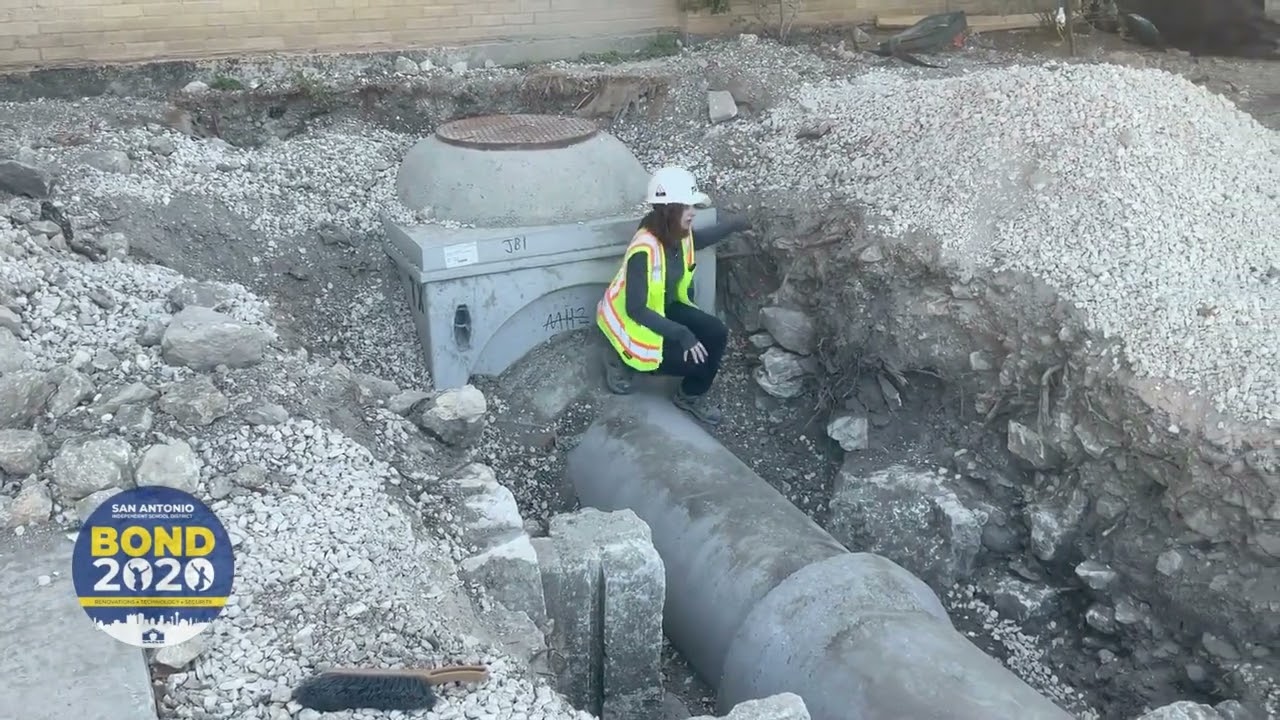
Measuring two feet deep by more than three feet wide, the San Pedro acequia was the largest of the canals that provided water to the city’s earliest Spanish settlers. It spanned more than three miles, and because the acequia was located on a ridge, settlers could easily divert water down either side to irrigate their crops.
Acequias had been widely used in Spain for centuries for large-scale irrigation. When Spanish colonists arrived in the region in 1718, they soon installed an acequia of their own. Dug by Native Americans, it was an open, dirt ditch for decades, until the city lined it with limestone in 1852, according to local historians. Around that same time, it became the city’s main source of drinking water.
“For the better part of two centuries, until modern methods replaced it, the acequia system was a sophisticated method of water distribution,” according to the county's reference page.

At least one is still in use: the San Juan acequia provides water for the crops grown on a five-acre Spanish colonial demonstration farm at Mission San Juan Capistrano, as Vincent T. Davis reported for the San Antonio Express-News in 2023. “The colonists knew what they were doing to leverage natural resources,” Mitch Hagney, the director of food sustainability at the San Antonio Food Bank, which manages the farm, told the publication.
Near the unearthed acequia, archaeologists also found the foundational remnants of a home built from limestone. It appears on maps as far back as 1896 but was demolished in the 1930s to make room for the campus to expand. The sluice gate and bridge were part of the home’s lot. Its owners likely maintained the acequia, says Tyler Bassett, an archaeologist with Pape-Dawson, the company leading the excavations on behalf of the school district, in a video shared by the district.
According to the school district, the Fox Tech High School campus dates back to 1883, when a three-story stone building opened on what was then Acequia Street, now Main Avenue. The building became the permanent home of San Antonio’s first public high school. Today, the historic site is home to three schools.
Did you know? Water engineers
Mayans built and used reservoirs for centuries that provided water to cities during the annual dry season. They also transported water through canals and used quartz sand and aquatic plants for water filtration.
In 2020, voters approved a $1.3 billion bond to update infrastructure and technology at schools across the district. Officials budgeted nearly $79 million to renovate gyms and construct a new performing arts building and a new black box theater at the campus. But before construction started, the school district commissioned an archeological study of the site that unveiled “culturally sensitive areas” within the project’s boundaries. Subsequent excavations revealed the historic structures.
Once construction is complete, officials plan to install a plaque on the campus in honor of the discoveries. They also plan to register two new historic sites with the Texas Historic Commission, reports the San Antonio Express-News’ Rhyma Castillo.
The historic structures are just the latest headline-making discoveries in San Antonio. Last month, archaeologists uncovered a fully intact, four-pound bronze cannonball that the Mexican army likely fired during the siege leading up to the Battle of the Alamo. Researchers also recently discovered four exploding shot fragments that were probably fired from an eight-inch howitzer that belonged to the Mexican army./https://tf-cmsv2-smithsonianmag-media.s3.amazonaws.com/accounts/headshot/SarahKuta.png)