
More Than a Billion Years’ Worth of Rock Layers Are Missing From Earth’s Geologic Record. Scientists Say They May Finally Know Why
Computer simulations suggest that movements in Earth’s viscous mantle layer lifted certain chunks of the planet’s surface, allowing ice sheets to scrape away the rock

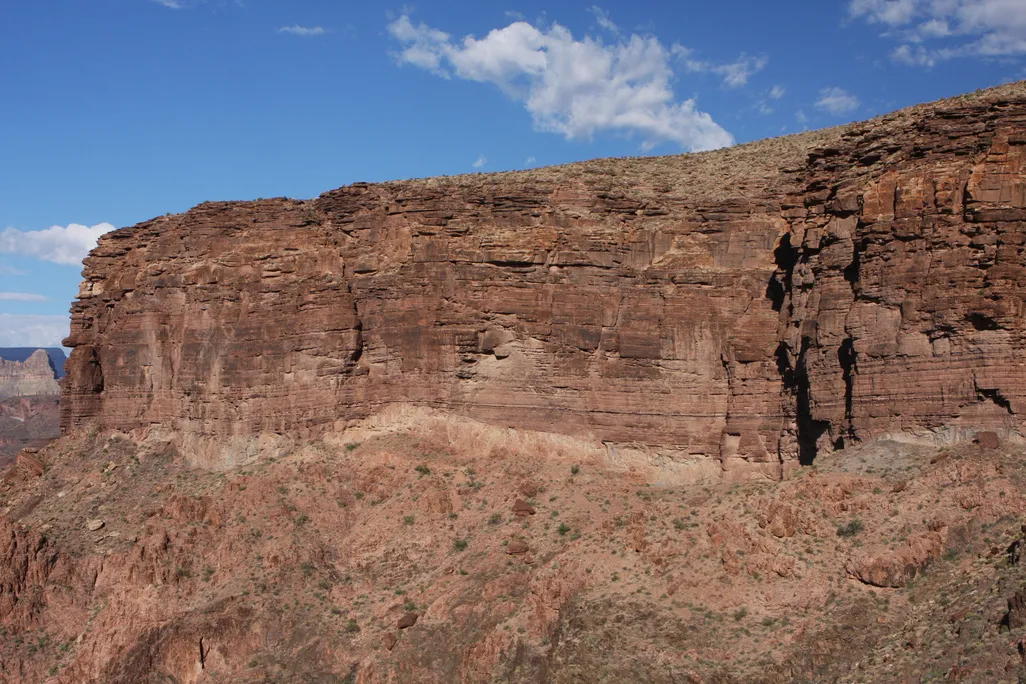
Rock layers record the Earth’s history, typically piling up from oldest at the bottom to youngest at the top. But a giant, mysterious gap exists in many of the globe’s landmasses. It’s well-documented in North America, northern Europe and northern China, where in some places more than one billion years of our planet’s geologic record is nowhere to be found.
Now, scientists say they may have figured out what caused the so-called Great Unconformity.
Computer simulations hint the missing rock layers, which should be older than roughly 540 million years old, were uplifted by movements of Earth’s viscous mantle layer and eroded away by giant ice sheets before the continents sank back down again. The findings, published November 4 in the journal Nature, help validate some of the possible explanations about the Great Unconformity, possibly solving the 150-year-old mystery.
“Imagine a book where a huge section in the middle has been ripped out. The Great Unconformity is that gap in Earth’s story, with the narrative jumping from the early chapters straight to a much later part of the story,” says study co-author Santosh Dhungana, an Earth scientist at the University of Wollongong in Australia, in a statement. “Our research suggests these pages weren’t lost by chance.”
Did you know? The Grand Canyon’s role
Researchers first described the Great Unconformity in the late 1800s in the layers of the Grand Canyon.
Many scientists suspect that during the planet’s theorized Snowball Earth period, when the entire planet may have been frozen some 635 million to 720 million years ago, moving ice scraped away the missing rock layers. But if ice sheets covered the globe, they should have eroded the Great Unconformity everywhere, which isn’t the case, reports Ars Technica’s Jacek Krywko.
Some researchers have also hypothesized that mantle movements, which alter the planet’s surface, could be to blame. In the viscous mantle, hotter material rises and cooler material falls, pushing and pulling Earth’s outer layer, called the crust. However, this concept of mantle-driven dynamic topography “hadn’t been quantitatively tested,” study co-author Nicolas Flament, a geoscientist at the University of Wollongong, tells Ars Technica.



So, he and Dhungana used computer models to simulate these mantle movements, called convection, over the past billion years. Their six models “consistently showed that mantle convection caused ancient continental blocks Laurentia (which now makes up much of North America), Baltica (parts of northern Europe) and North China to be lifted up from around a billion years ago to 540 million years ago,” the authors write for the Conversation. Over the past 540 million years, however, these continental chunks have sunk.
The era of continental uplift overlaps with the Snowball Earth period, and giant moving ice sheets erode landscapes more efficiently than rivers. The scientists speculate that the frozen masses would have ground their way down the slopes of raised landscapes, wiping away millions of years’ worth of rock accumulation.
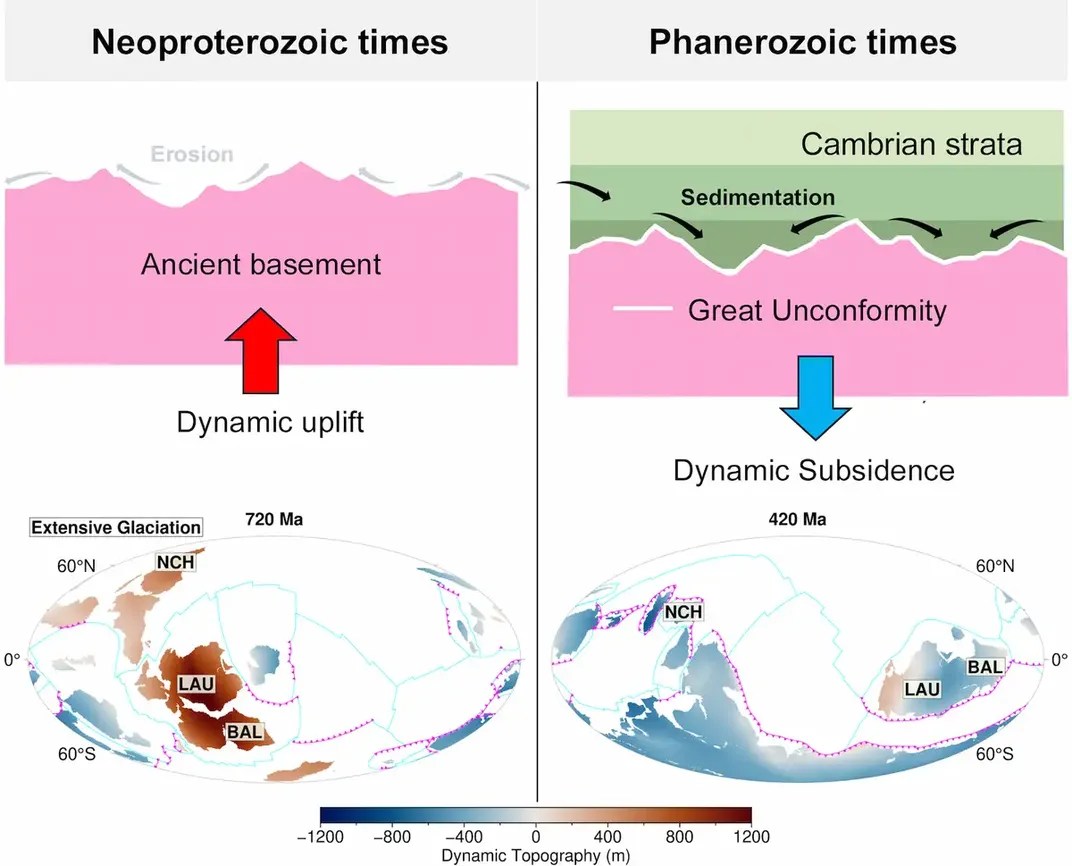
What’s more, the Great Unconformity intrigues scientists interested in life’s history because it wiped the rock record just before the Cambrian explosion around 530 million years ago, when all sorts of animals suddenly evolved.
The geologic processes that took place during the Great Unconformity may have created the foundation for this famous evolutionary event, Shanan Peters, a geoscientist at the University of Wisconsin-Madison who did not participate in the study, tells Live Science’s Stephanie Pappas. By exposing older crystalline rocks, for example, the erosion may have triggered a greater release of certain elements, such as potassium, iron, manganese and carbon, into the oceans, allowing marine life to invent shells. That, in turn, may have put more oxygen into Earth’s atmosphere, Peters adds.
“Sometimes what is missing can tell us more about the story of Earth than what we can see,” Flament says in the statement.
