
More Than 3,000 Tarantulas Were Found Hidden in Socks During a Major Wildlife Trafficking Bust at an Airport in Lima, Peru
According to Peruvian officials, the three European travelers—including one who’s been identified as a “renowned tarantula researcher”—could have made around $1.68 million from the creepy-crawly loot

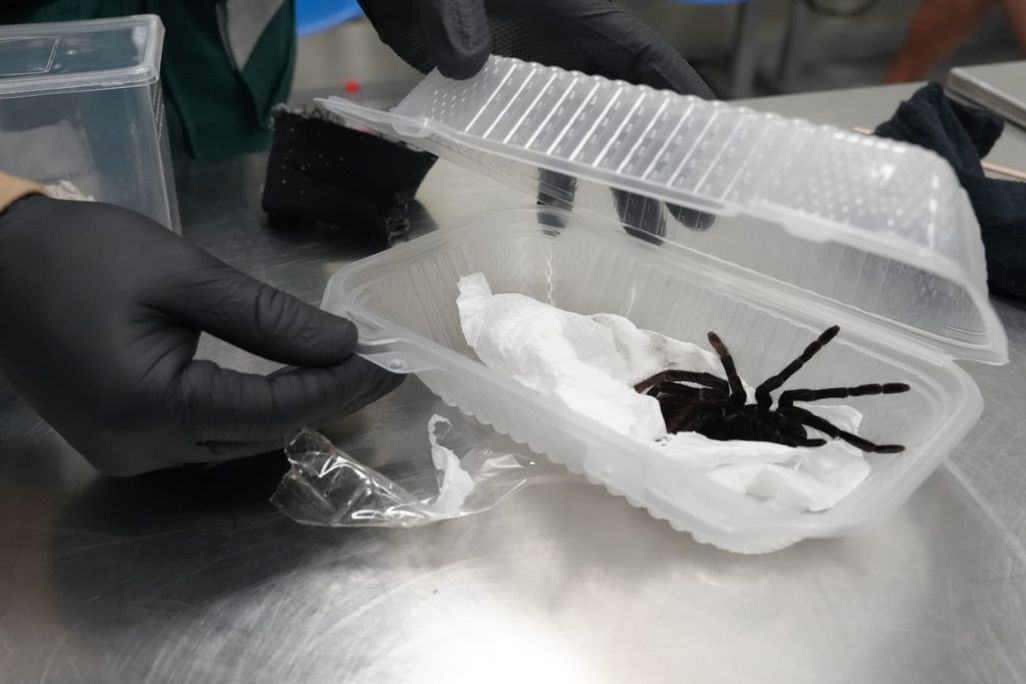
Authorities in Peru say they have foiled a plot to smuggle more than 3,000 tarantulas—including species not yet described in scientific publications—out of the country.
After receiving an anonymous tip, officials intercepted three travelers—two German citizens and one Polish citizen—at Jorge Chávez International Airport in Lima as they were checking in at the boarding area. When they searched the travelers’ luggage, they found thousands of eggs, hatchlings and adult spiders hidden in socks, according to a November 4 statement from the National Forest and Wildlife Service of Peru (SERFOR).
“We noticed that some of them were moving,” Cora Suárez, a SERFOR forest and wildlife control technician who works at the airport, tells the Agence France-Presse. “There were small ones and large ones.”
Workers used slender wooden sticks to gently brush the spiders into clear plastic containers. Once officials are done investigating them, the tarantulas will be taken to an authorized breeding center.
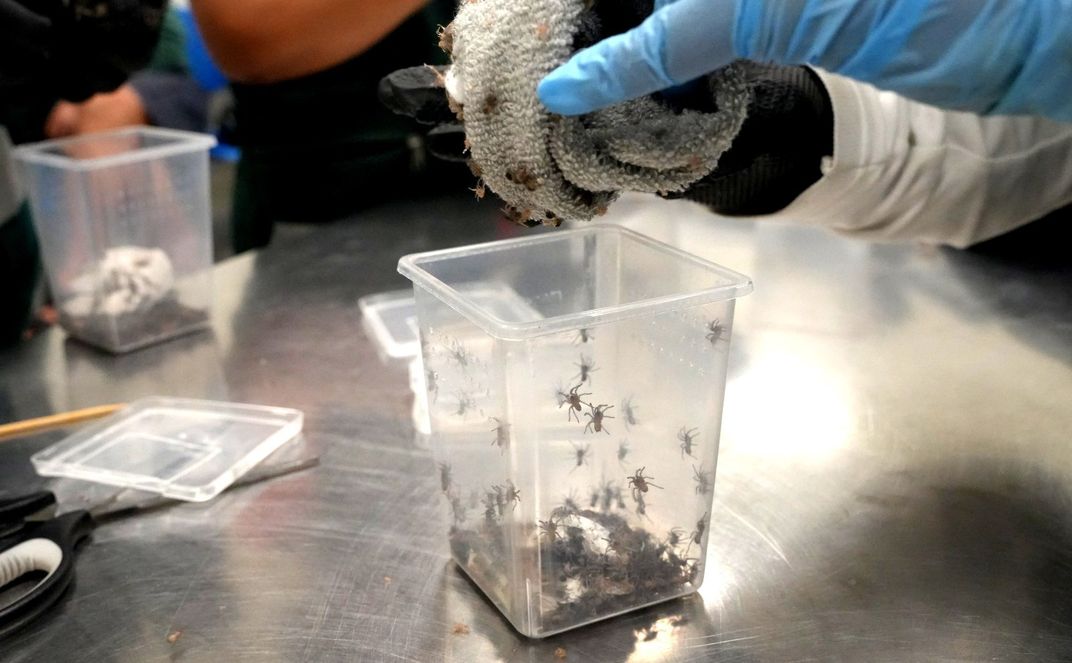
The travelers were trying to fly to Germany. Instead, they were detained by the Peruvian National Police’s environmental crimes unit and now face criminal charges.
Officials have not released the names of the individuals. However, one of the travelers was a “renowned tarantula researcher,” according to the statement, per a translation by the New York Times’ Amanda Holpuch.
Authorities suspect the individuals were smuggling the spiders for private collections, research and the exotic pet trade. Suárez tells the AFP that one tarantula can sell for roughly $560 in Europe, meaning the smugglers could have made around $1.68 million from the more than 3,000 tarantulas they had hidden in their suitcases.
The spiders originated from several different parts of Peru, including the cities of Cajamarca, Cusco and Junín, and the regions of La Libertad and Loreto. Officials are still trying to pinpoint all the species in the loot but said it included several brightly colored creatures.
Did you know? Wildlife trafficking
Wildlife trafficking is the world’s fourth-largest form of organized crime, with an estimated annual value of up to $20 billion.
So far, officials have identified Thrixopelma lagunas, also known as the Peruvian blue zebra or the blue birdeater. Authorities also found members of the Pamphobeteus genus, which are among the largest tarantulas in the world.
One species was P. antinous, which is considered a vulnerable, legally protected threatened wildlife species in Peru. These arachnids are commonly known as Bolivian blue-leg birdeaters or steely blue legs.
Some of the spiders are species that scientists haven’t formally described, including members of the Antikuna and Avicularia genera.
“The traffickers made a meticulous selection to include different species,” Suárez says in the statement, per a translation by the Times.
#LoÚltimo. El Serfor y Aduanas incautaron en el Aeropuerto Internacional Jorge Chávez más de 3000 tarántulas que eran transportadas de manera oculta dentro de equipajes de ciudadanos extranjeros, quienes tenían previsto viajar a Alemania. Los infractores fueron detenidos por la Policía Nacional del Perú (PNP) y se les abrirá un proceso administrativo sancionador. #NoTeCompresUnDelito 🔗 Más información en: https://t.co/XhEKaixkZ1
— Serfor Perú (@SerforPeru) November 5, 2026
According to Mongabay’s Spoorthy Raman, trafficking these spiders to the European Union is a relatively low-risk, high-reward pursuit. That’s because none of the species identified so far is protected under the Convention on International Trade in Endangered Species of Wild Fauna and Flora (CITES), a global treaty intended to ensure the trade of wild plants and animals is “legal, traceable and biologically sustainable,” according to the U.S. Fish and Wildlife Service.
If a wild animal is legally protected by its home country but lacks an international listing like CITES or specific protection in the E.U., the E.U. does not automatically ban its import, possession or sale. Advocates are calling on the E.U. to enact legislation that closes this legal loophole.
“This is a pattern that we have observed again and again: If [the tarantulas] were not seized [in Peru], they could have been legally imported to the E.U., due to a legal gap,” Sandra Altherr, the co-founder of Pro Wildlife, a wildlife conservation nonprofit based in Germany, tells Mongabay.
