
Michelangelo Used These Custom, Multi-Headed Brushes While Painting ‘The Last Judgment’ to Replicate His Intricate Sculpting Techniques
While restoring the Sistine Chapel, researchers discovered wavy groupings of brushstrokes which indicated that the artist used the special brushes to create a distinct crosshatching pattern

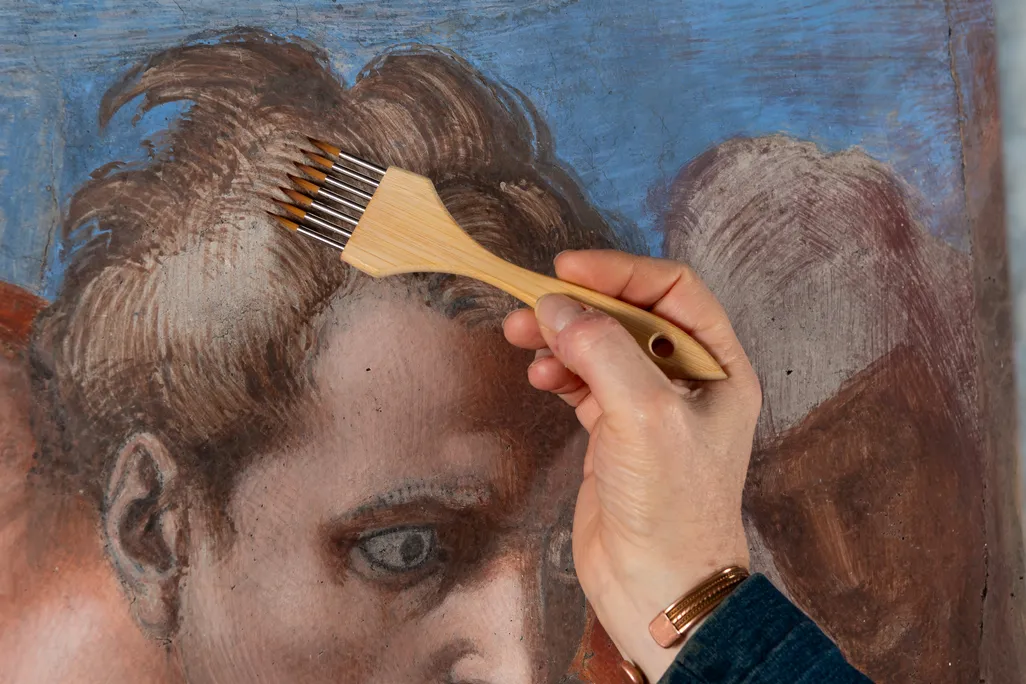
This spring, the Vatican restored the Sistine Chapel for the first time in 30 years. Restorers worked for three months to remove layers of calcium lactate—a whitish salt from the dried sweat from millions of visitors and the plaster in the walls—that had settled onto Michelangelo’s immaculate 16th-century murals.
As experts climbed temporary scaffolding and applied distilled water and absorbent Japanese paper to clean away the grime, they got a rare, close-up view of Michelangelo’s vivid masterpieces. They noticed something unique about The Last Judgment, the massive mural located behind the chapel’s altar, as its original colors emerged. Michelangelo had painted with wavy brushstrokes that appeared to have moved in synchronization.
“I initially saw that Michelangelo painted with parallel strokes, often perpendicular to each to give a cross-hatching effect,” Paolo Violini, the Vatican’s chief restorer, tells the London Times’ Tom Kington. “Then I saw that when a stroke wobbled slightly, other strokes parallel to it had an identical wobble. That meant one thing: Michelangelo was using special brushes with multiple heads, each with a small brush on the end of it, allowing him to produce parallel strokes with one large brush.”
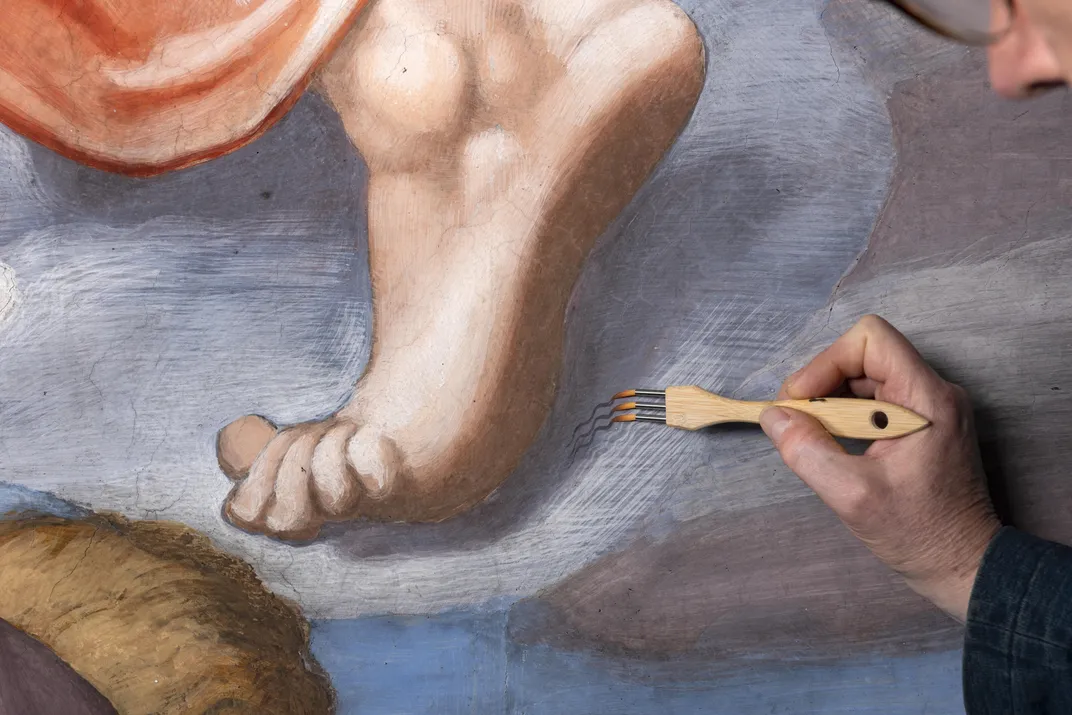
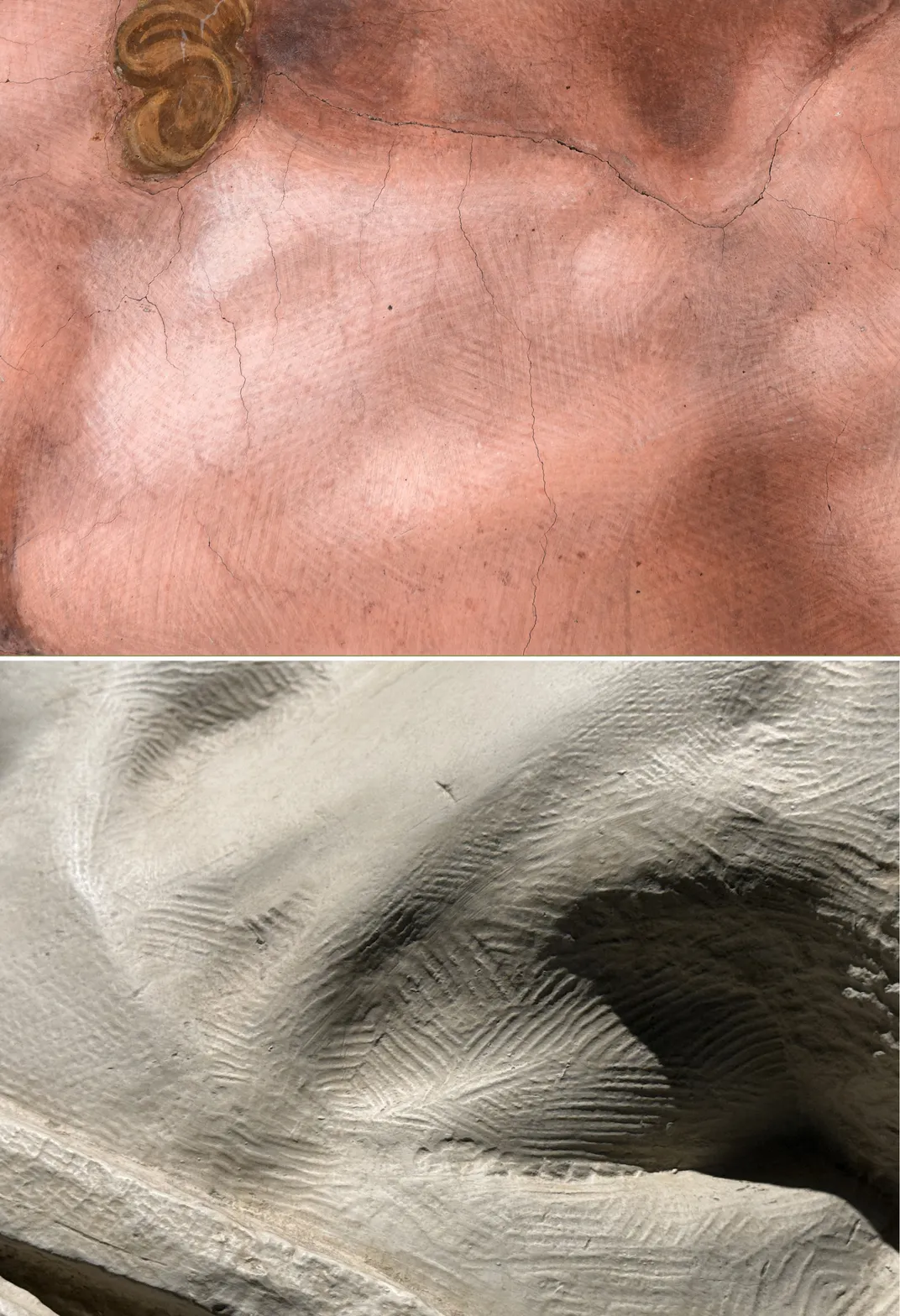
A close analysis of the mural indicated that Michelangelo used at least two specific brushes, including one with three brush-tips and others that reached nearly six-inches wide with 10 brush tips. Not only did these tools help Michelangelo work faster, but they allowed him to replicate one of his sculpting techniques—creating a cross-hatching pattern with a multi-pointed chisel known as a gradina—on a two-dimensional surface. The effect, in both cases, is to create a richer interaction between medium and light.
“Michelangelo painted magnificently—as a sculptor,” Barbara Jatta, director of the Vatican Museums, writes in the organization’s new book, Michelangelo 2026: The Extraordinary Conservation of the Last Judgment, which chronicles the restoration and these new observations.
In addition to the remarkable brush discovery, researchers also had a chance to more clearly view Michelangelo’s hidden self-portraits among the more than 300 figures painted in The Last Judgement’s depiction of Jesus Christ’s Resurrection.
His most visible self-portrait is in the flayed skin held out by St. Bartholomew. “It is a tragic face, with fearful eyes and deep lines of bitterness. This is more than a self-portrait; it is a symbol and a revelation,” an unnamed Italian art critic told the New York Times’ Fitzhugh Lee Minnigerode in 1925. “Michelangelo depicts himself as a second St. Bartholomew, a martyr, oppressed and overwhelmed by the calamities of the world.”

Did you know? Beard toward Heaven
- Contrary to popular belief, Michelangelo didn’t paint the ceiling of the Sistine Chapel on his back. Instead, he stood on scaffolding with his neck craned back at a painful angle.
- “My beard toward Heaven, I feel the back of my brain upon my neck,” he wrote to a friend in comical poem.
The second is more subtle, appearing in the bottom left-hand corner of the 45-foot-tall mural in the cloak-folds of a figure meant to represent Death.

“It is the last section of The Last Judgment to be completed by Michelangelo in 1541 after he had started it in 1536, and while painting it he fell off the scaffolding,” Fabrizio Biferali, curator of the Vatican Museums’ Renaissance department, explains to the Times. “Luckily, he was only a few meters off the ground, but still broke his leg and had to down tools for a few months.
Biferali added: “I believe he then painted his own face among the dead being reborn because he felt reborn after his injury, as well as feeling reborn because he was coming to the end of five years of work.”
