
Meet the Orange-Lipped ‘Likweli’ Monkey, a New Species That Was Discovered in the Congo Rainforest
The creatures, which weigh about the same as a small dog, have spiky black hair, orange-cream skin around their mouths and a white patch on their rear ends. Scientists say that they’re probably endangered
/https://tf-cmsv2-smithsonianmag-media.s3.amazonaws.com/accounts/headshot/SarahKuta.png)
/https://tf-cmsv2-smithsonianmag-media.s3.amazonaws.com/filer_public/28/36/2836c35b-9e1f-4646-b86b-8544a0060ac5/ccongoensis.jpg)
Scientists have found a previously undescribed species of monkey in the rainforest of the Democratic Republic of the Congo (DRC). The enigmatic creatures, called “Likweli” monkeys by locals, are just the fifth new African monkey species discovered in the last 75 years, researchers report in a new paper published July 15 in the journal PLOS One.
The animals have a distinct appearance, with spiky black coats, orange-cream skin around their mouths and white patches on their rumps. Weighing about 15 pounds—roughly the size of a small dog—they stretch about four feet from nose to tail. Their low roars sound “a bit like a frog or pig snorting,” writes Jackie Flynn Mogensen for Scientific American.
Researchers were first clued in to the existence of a potential new species in 2008, when conservation field scientists snapped a photo of an unusual monkey during an expedition on the Lomami River, which flows north through the middle of the DRC and empties into the Congo River. That first image was not great—it showed only part of the animal. Even so, the scientists could tell that the creature was special.
After that, the Likweli monkey trail went cold until November 2018, when another field researcher, Jean Pierre Kapale of the Lukuru Wildlife Research Foundation, who co-authored the study, photographed one. Over the next 10 months, Kapale and his team conducted dedicated surveillance patrols in search of the monkey, which resulted in seven more sightings.

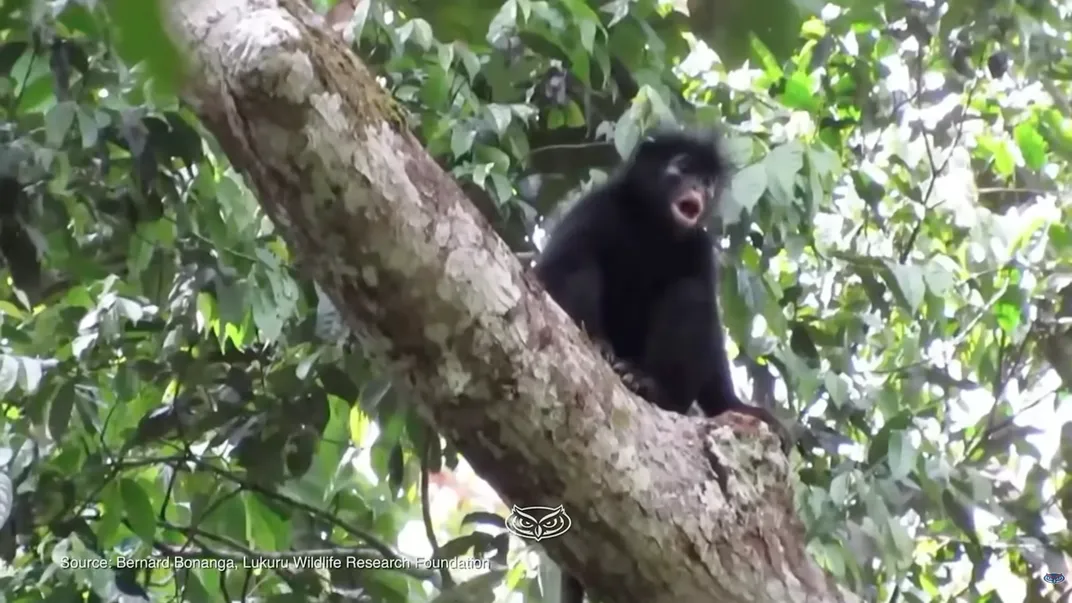
The creatures seem to hang out in small groups of about six individuals, living high in the dense forest canopy. The monkeys have a “quiet and watchful nature,” study co-authors Kate Detwiler and Junior Amboko, both biologists at Florida Atlantic University, tell BBC Wildlife Magazine’s Helen Pilcher. “When we encounter a group, the monkeys don’t usually flee as many other primates do. Instead, they climb higher into the canopy and simply watch us. It often feels as though we’re studying each other.”
In addition to observing the creatures in the wild, scientists analyzed skin, skeleton and tissue samples from three dead monkeys—two adult females and one adult male—that had been confiscated from hunters. They compared the Likweli monkey’s physical characteristics, including their skulls and pelts, to those of other African monkey species housed in museum collections. The anatomical comparisons “underscored how unique this new species is,” study co-author Julia Arenson, an anthropologist at Yale University, says in a statement.
DNA testing revealed that Likweli monkeys are genetically distinct from other primates. They’re most closely related to the black colobus, a species that lives more than 700 miles away in west-central Africa, but the two species appear to have diverged from a common ancestor that lived around five million years ago.
“We were shocked with the genetic data because it gave us such a signal of deep divergence,” Detwiler tells Scientific American.
Likweli monkeys are members of the Colobus genus, a group of monkeys living in West and Central Africa that have just four fingers on each hand—no thumbs. Their species name, congoensis, is a nod to the Congo Basin, which the researchers wanted to recognize for its biodiversity, reports Science’s Yejin Lhee.
Quick fact: Another local name
The Mituku communities that inhabit the newfound species’ eastern range call the monkeys kasaba nkoni, which means “branch shaker,” the researchers write in the paper.
Additionally, the researchers spoke with residents of 52 villages bordering the species’ range. Individuals from just eight of those villages were familiar with the Likweli monkeys. Because these community members have “extensive knowledge” of other local primates, the researchers write in the paper, the finding underscores just how elusive the species is. What’s more, the animals appear to inhabit a tiny range—an area spanning only about 650 square miles in the middle of the country.
For those reasons, the researchers propose that the newly identified monkeys be listed as endangered by the International Union for Conservation of Nature, which develops a global guide of at-risk species. “Just being endemic creates opportunities for extinction,” Thomas Gillespie, an ecologist at Emory University who was not involved with the research, tells Science.
The monkeys seem to live primarily within the bounds of Lomami National Park, a 3,400-square-mile protected area created after scientists reported that they discovered the Lesula monkey there in 2012. Hunting is prohibited in the park, but conservationists still worry about the surrounding area, where habitat loss from hunting or land cultivation might threaten the species’ survival.
The study is “very exciting, but [it’s] also very sobering to be finding a new species of primate when tropical forests are under so much stress right now,” Gillespie tells Science.
Though researchers recorded 114 field observations of Likweli monkeys between 2018 and 2022, they still know very little about the animals’ behavior, diet and lifestyle. They hope to learn even more about the cryptic creatures in the future, including how they fit into the broader primate family tree.
“I think it’s going to be a very important species for the ecology,” study co-author John Hart, a conservation biologist with the Lukuru Wildlife Research Foundation and the Yale Peabody Museum, tells the Washington Post’s Miriam Waldvogel. “I also think that once its genomics are fully explored, people are going to know a lot more about the evolution of African primate fauna. ... It looks to be an ancient lineage.”
/https://tf-cmsv2-smithsonianmag-media.s3.amazonaws.com/accounts/headshot/SarahKuta.png)