
Meet ‘Gabi,’ the Robot That Just Became a Monk at a Buddhist Temple in South Korea. It’s the Latest Robot to Take Up Religious Practice
The humanoid promised to obey humans, save energy and treat other robots peacefully. South Korean Buddhist leaders have recently started to embrace artificial intelligence
/https://tf-cmsv2-smithsonianmag-media.s3.amazonaws.com/accounts/headshot/ChristianThorsberg_Headshot.png)
/https://tf-cmsv2-smithsonianmag-media.s3.amazonaws.com/filer_public/fb/ac/fbac2f50-d0d9-4fff-a844-d7e98c6cf9fd/ap_robot_monk.jpg)
At first glance, the ceremony held Wednesday morning at a Buddhist temple in downtown Seoul unfolded like any other, with monks processing among rows of colorful hanging lanterns.
But one figure stood out from the rest, despite wearing the same robes as the other monks. The four-foot-tall humanoid robot, named Gabi, was unmistakable.
“Robots are destined to collaborate with humans in every field in the future,” Hong Min-suk, a manager at the Jogye Order, the largest sect of Buddhism in South Korea, tells the New York Times’ John Yoon. “It will only be natural for them to be part of our festival.”
For the temple, this marks the first time a robot has participated in the sugye initiation ceremony, when followers pledge their devotion to the Buddha and his teachings. Gabi—a Buddhist name that refers to mercy, Yonhap News Agency reports—was made by Unitree Robotics, a Chinese civilian robotics company. The model, G1, retails starting at $13,500.

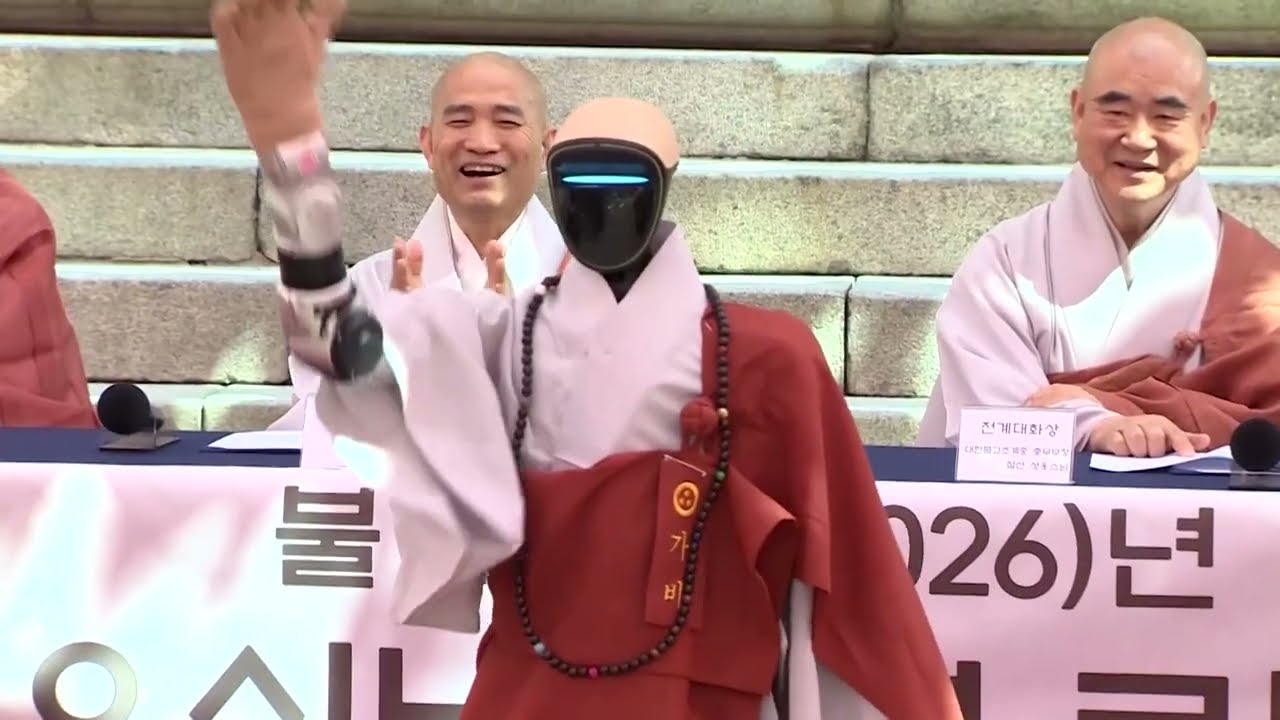
During the ceremony, Gabi agreed to five vows usually recited by human monks and slightly altered for the humanoid. The robot pledged to respect life, act with peace toward other robots and objects, listen to humans, refrain from acting or speaking in a deceptive manner and save energy.
Gabi participated in a modified yeonbi purification ritual. While a human monk normally receives a small incense burn on the arm, instead Gabi received a lotus lantern festival sticker and a prayer bead necklace.
The landmark event aligns with the promise made during a New Year’s address by the Venerable Jinwoo, president of the Jogye Order of Korean Buddhism, to incorporate artificial intelligence into the Buddhist tradition.
“We aim to fearlessly lead the A.I. era and redirect its achievements toward the path of attaining peace of mind and enlightenment,” he said, per a statement.
The idea that Buddhism—which is losing followers—should reckon with technology was echoed last month by the Venerable Jungnyum, another leader in the order.
“At this civilizational turning point where artificial intelligence is coming like a tsunami, there is widespread concern and hope that Buddhism should also move toward a new direction of hope,” he said in a news conference, Seoul Economic Daily’s Lee Jae-yong reports.
The inclusion of robots in religious practice is not unprecedented, but not yet common. In a 2024 literature review, published in the journal Theology and Science, researchers at the University of Vienna and the University of Erlangen-Nuremberg found nearly a dozen robots actively participating in liturgical and ritual practices, fewer teaching religious education or performing spiritual care, and even fewer actively preaching.
“Although empirical evidence suggests that robots are met with an overall neutral to positive reaction by believers, they are sometimes met with dogmatic rejection, for example, because they seemingly cannot weep, worship or ‘talk to God,’” the researchers wrote.
Did you know? Light the way
South Koreans celebrate Yeondeunghoe, a lantern-lighting festival, in honor of the birth of Buddha and the coming of spring. The lotus flower symbol is widely used. The festival is on UNESCO’s list of the Intangible Cultural Heritage of Humanity.
A humanoid nicknamed Pepper made headlines in 2017 when it performed Buddhist funeral rites, the Japan Times reported. That same year, an Indian tech firm introduced a robotic arm to perform aarti, a ceremony in which flames are ritually waved to deities, anthropologist Holly Walters wrote in the Conversation in 2023.
“In some ways, robots are sitting squarely in the middle of an argument that we have had about religion for thousands of years,” Martien Halvorson-Taylor, a religious studies scholar at the University of Virginia, said on the podcast “Sacred & Profane” in 2021. “Is what matters what we believe about the divine, or is it our actions and practices that matter? Sometimes in religion, action is more important than belief. How you do it takes precedence over why you do it.”
Later this month, Gabi is set to participate in the lantern festival celebration of Buddha’s birth.
/https://tf-cmsv2-smithsonianmag-media.s3.amazonaws.com/accounts/headshot/ChristianThorsberg_Headshot.png)