
Killer Whales Hunt Fish in Highly Coordinated Pairs and Perfect Their Movements With Practice, Drone Videos Reveal
Footage taken off the coast of Norway reveals that orcas team up to maximize their prey, according to a new study
/https://tf-cmsv2-smithsonianmag-media.s3.amazonaws.com/accounts/headshot/Sara_-_Headshot_thumbnail.png)
/https://tf-cmsv2-smithsonianmag-media.s3.amazonaws.com/filer_public/08/4a/084ac3f0-03f9-41cc-aa04-15fcafa77e4b/gr2_lrg.jpg)
For killer whales on the hunt for herring, two is better than one. A study published last week in the journal Current Biology found that the animals hunt in pairs and divide tasks with precision, leading to more fruitful catches.
The team used camera-equipped drones to observe a pod of 26 orcas in Norway that were hunting schools of migrating herring in the winter of 2016 to 2017. They found that the predators engage in coordinated attacks: A pair of whales—one larger and one smaller—will swim together toward their prey at specific angles before they strike. “They have to be very well synchronized and very well positioned to score,” lead author Paolo Domenici, a researcher at the Institute of Biophysics in Italy, says to Kristel Tjandra at Science News.
In these hunts, the larger whale in a pair takes the lead and slaps its tail at the herring. That blow knocks the school out of sync, stunning some of the fish. Then, the smaller orca blocks the herring from swimming away—and both orca hunters share their bounty.
Lone orcas are formidable predators, but these cooperative hunts are more successful than those conducted individually. “When they hunt in pairs, they stay in the feeding spot twice as long. So clearly, there is a lot more food,” Domenici tells Science News. Once they’ve trapped their prey, the orcas give up their formation.

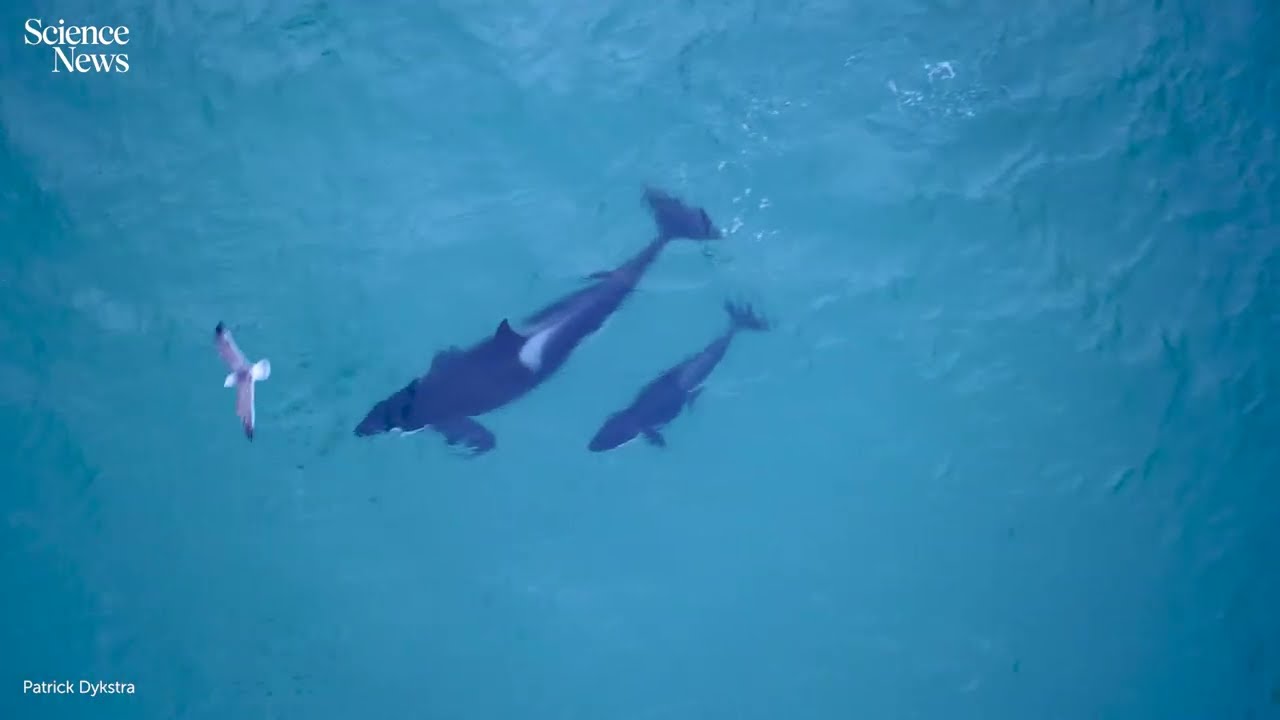
Male orcas tend to hunt in pairs more often than female orcas do, although more observations are needed to confirm this, Domenici says to Constanza Cabrera at El País. Further research could also help understand why such a difference might exist.
The killer whales also appear to have favorites when it comes to hunting buddies. In the study, the authors note that the orcas pair up with “preferred partners” with whom they can share social bonds for decades—some of them are likely close kin. This preference probably allows the animals to practice and perfect their positioning over the years, increasing their chance at success. Long-term hunting pairs have been observed in humpback whales as well, suggesting “social relationships have a more important role in foraging behavior than previously thought,” the authors write.
Quick fact: Orcas prey on great white sharks
Killer whales are known for a variety of surprising behaviors, including taking down great white sharks. In 2023, scientists spotted a single orca attacking and killing a great white shark for the first time.
While previous research has suggested that orcas hunt cooperatively, taking on specialized roles, this new study offers more evidence of this behavior, Jared Towers, a cetacean ecologist at Bay Cetology who was not involved in the research, tells Science News. “This study really confirms that,” he adds.
“Orcas live in groups for various reasons, and among these is cooperation when it comes to capturing food, which results in success for the group members,” says Bruno Díaz, chief biologist at the Bottlenose Dolphin Research Institute who was not involved in the study, to El País.
The team proposes that this joint hunting strategy stems from the pressure of hunting in shallow waters. In this coastal area, boats and other human activity can also impact the animals’ feeding behavior. Understanding how orcas hunt under natural conditions, the team writes in the study, could help inform management strategies to protect them from human interference that might force changes in their behavior.
/https://tf-cmsv2-smithsonianmag-media.s3.amazonaws.com/accounts/headshot/Sara_-_Headshot_thumbnail.png)