
In a First, NASA’s Experimental X-59 Plane Flew Faster Than the Speed of Sound, Setting the Stage for ‘Quiet’ Supersonic Aircraft
The United States banned supersonic flights over its land in 1973 due to their ear-splitting sonic booms. Experts are building a plane that should travel at those speeds but create only gentle thumps
/https://tf-cmsv2-smithsonianmag-media.s3.amazonaws.com/accounts/headshot/Sara_-_Headshot_thumbnail.png)
/https://tf-cmsv2-smithsonianmag-media.s3.amazonaws.com/filer_public/e6/9d/e69d51de-9425-4a3f-9022-36b0fe8074ed/x59-first-supersonic-ata-01.webp)
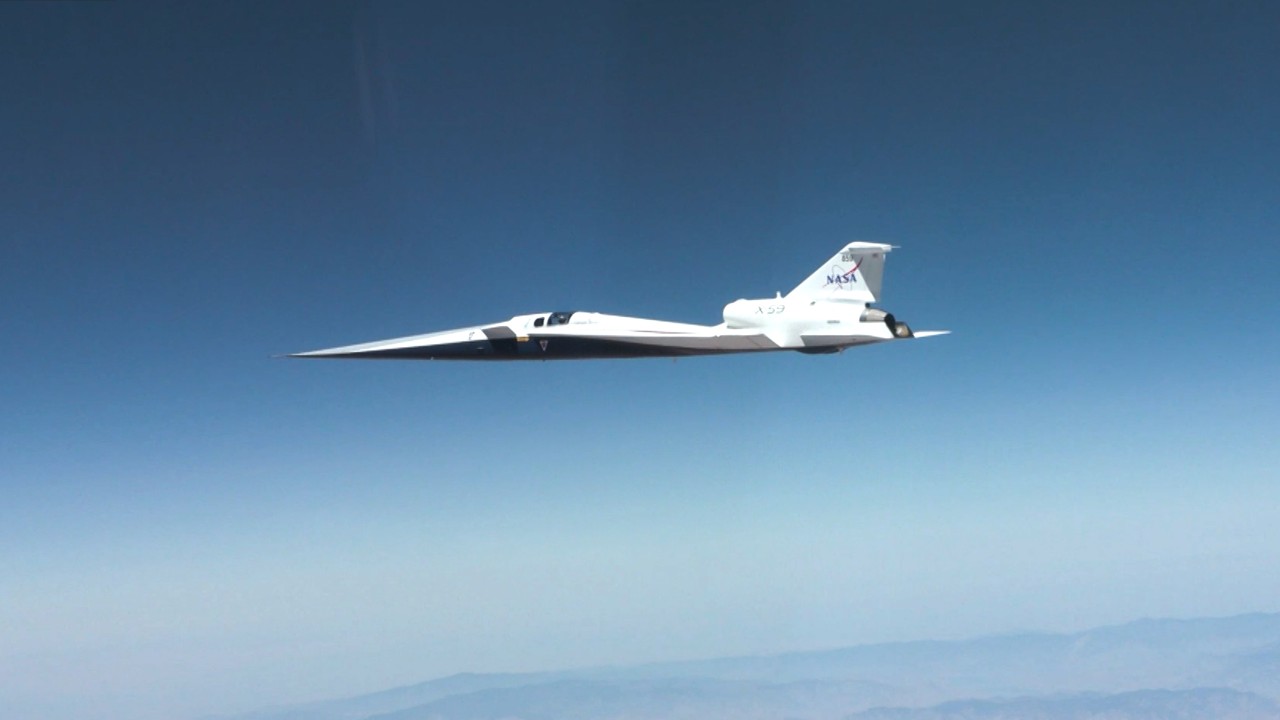
On June 5, NASA’s experimental X-59 plane went supersonic for the first time. The aircraft zoomed through the sky at a top speed of about 713 miles per hour, or Mach 1.1, and an altitude of 43,400 feet, traveling faster than the speed of sound.
The record-breaking flight lasted 81 minutes and took place at Edwards Air Force Base in Southern California. Reaching this milestone brings NASA one step closer to achieving “quiet” supersonic flight.
“The X-59’s first supersonic flight is a testament to America’s enduring leadership in science, engineering and aerospace innovation,” says Michael Kratsios, assistant to the president for science and technology and director of the Office of Science and Technology Policy, in a statement.

As an aircraft travels, it shoves air molecules aside and causes acoustic waves to spread in all directions from the plane. The waves move at the speed of sound, which can vary depending on altitude, temperature and other factors. For instance, sound travels faster in warmer air than in colder air.
Breaking Mach 1 means an object is zooming faster than the speed of sound while accounting for all those factors. When a plane exceeds the sound barrier, the acoustic waves spreading in front of it can no longer get out of the craft’s way, so they build up and form shock waves. This compresses the air, creating a traveling pressure difference that makes a thunderous “sonic boom” when it reaches people’s ears.
The first plane to break the sound barrier was called the Bell X-1, which used a rocket engine. The historic flight was piloted by U.S. Air Force Captain Charles E. “Chuck” Yeager in 1947. Military aircraft created afterward incorporated lessons learned from tests with the experimental plane.
/https://tf-cmsv2-smithsonianmag-media.s3.amazonaws.com/filer_public/e3/8f/e38fe855-a610-4353-b80e-fc509b4152e6/bell_x-1_in_flight.jpg)
However, the ear-splitting booms created by Bell X-1 and other supersonic craft can be disruptive and startling to people in the vicinity of their flights, which is why the Federal Aviation Administration prohibited them over land in the United States in 1973.
But for the past decade, NASA has been working to design an aircraft that can break the sound barrier with a gentle thump rather than a boisterous boom.
“We always kind of joke that the X-1 broke the sound barrier and now we’re trying to fix it,” said Catherine Bahm, the project manager of NASA’s Low Boom Flight Demonstrator overseeing X-59’s development, to the BBC’s Mark Piesing in 2023. “Its sonic boom won’t be loud enough for people to notice. It will be like distant thunder, or your neighbor’s car door closing, that merges into everyday life.”
In 2018, NASA awarded the aerospace and defense company Lockheed Martin a $247.5 million contract to build the X-59. The result is an ultrasharp, needle-nosed, 100-foot-long plane designed to break up shock waves. The plane first flew last fall.
“Since the aircraft’s first flight on Oct. 28, 2025, the team has made tremendous progress, flying 16 times in the last 90 days and getting into a steady test rhythm,” says NASA Administrator Jared Isaacman in the statement.
When the aircraft broke the sound barrier on Friday, NASA couldn’t measure its noise because of a chase plane that monitored the flight and drowned out any sounds made by X-59.
Did you know? Fastest-ever flight
The fastest speed ever reached by an aircraft is 4,520 miles per hour, or Mach 6.7, at an altitude of 102,100 feet, achieved during a flight in October 1967. However, it’s not recognized by the World Air Sports Federation because the craft was launched and did not take off from a runway under its own power.
An even more critical event is set to happen in a few days, according to NASA. The aircraft is expected to make its first “mission conditions” flight, where it will reach a cruising speed of 925 miles per hour, or Mach 1.4, and an altitude of roughly 55,000 feet. It will also be accompanied by a chase plane, per the statement.
Later test phases will involve isolating the sound of X-59 at supersonic speeds, a NASA spokesperson tells Paul Brinkmann at Aerospace America. Future flights will also take place over U.S. communities, so that the agency can gather feedback on how residents perceive the thump. That data will then be shared with U.S. and international regulators to help establish new noise standards, reports the outlet.
“I think the X-59 could be significant,” Christopher Combs, a mechanical engineer at the University of Texas at San Antonio, told the BBC. “You are demonstrating for the first time with a real-world vehicle that you can make quiet sonic booms and that can open the door for commercial industry to come in and start building aircraft like this.”
/https://tf-cmsv2-smithsonianmag-media.s3.amazonaws.com/accounts/headshot/Sara_-_Headshot_thumbnail.png)