
In a First, Astronomers May Have Spotted a Supermassive Black Hole That Wandered to the Edge of Its Galaxy
These giant celestial objects have mostly been identified at the centers of galaxies, where they’re known to reside. But a recently discovered one—found because of the light emitted while it snacked on a star—appears to be more than 30,000 light-years from its host galaxy’s heart
/https://tf-cmsv2-smithsonianmag-media.s3.amazonaws.com/accounts/headshot/Margherita_Bassi.png)
/https://tf-cmsv2-smithsonianmag-media.s3.amazonaws.com/filer_public/c1/61/c1611da3-9181-4540-b061-b52833e09e8c/pia22355.jpg)
For the first time, astronomers may have spotted a supermassive black hole that roamed to the edge of its home. Rather than sitting at the center of a galaxy, where these giant objects typically reside, the newfound one seems to be more than 30,000 light-years from its host galaxy’s core.
The findings, published on July 27 in the Astrophysical Journal Letters, offer long-awaited evidence of the existence of “wandering” black holes.
“We have not seen anything resembling this in literally 10,000 other objects that we’ve observed,” study co-author Robert Stein, an astronomer at the University of Maryland, tells Science’s Daniel Clery.
Most large galaxies are thought to have a supermassive black hole at their hearts. Our own Milky Way contains one called Sagittarius A*. But when galaxies collide with one another, theoretical research suggests that their black holes can sometimes be flung out into the cosmos.
However, these objects are hard to spot. They don’t produce light, so scientists search for them through indirect means. If a star gets too close to one of these hard-to-see celestial bodies, for instance, the black hole will rip it apart and devour it in what’s called a tidal disruption event (TDE). The dramatic scene causes a telltale light signature: a sudden brightening, then a gradual fade.
Did you know? Sagittarius A*
Astronomers estimate that the black hole at the center of our Milky Way galaxy is about 4.3 million times as massive as our sun and about 14.6 million miles wide.
Around 30 TDEs usually pop up each year in astronomical surveys. Before 2024, researchers had only spotted them in galactic cores, largely because that was where they were most searched for. But last year, researchers reported evidence of a TDE around 2,600 light-years from its host galaxy’s heart—merely one-tenth the distance between the Milky Way’s black hole and the sun—igniting a search for wandering black holes.
In the new study, Stein and his colleagues developed an artificial intelligence-based algorithm to automatically search for the TDE light pattern in data collected at the Palomar Observatory in California. The survey flagged a strange brightening event in a galaxy around 750 million light-years away in November 2025. Follow-up observations with space and ground-based telescopes found evidence of a probable TDE, dubbed TDE 2025abcr, on the outskirts of its host galaxy.
“The combination of all this data helped us rule out other explanations and confidently say it’s a tidal disruption event, despite its strange location,” says study co-author Jonathan Carney, an astrophysicist at the University of North Carolina at Chapel Hill, in a statement.
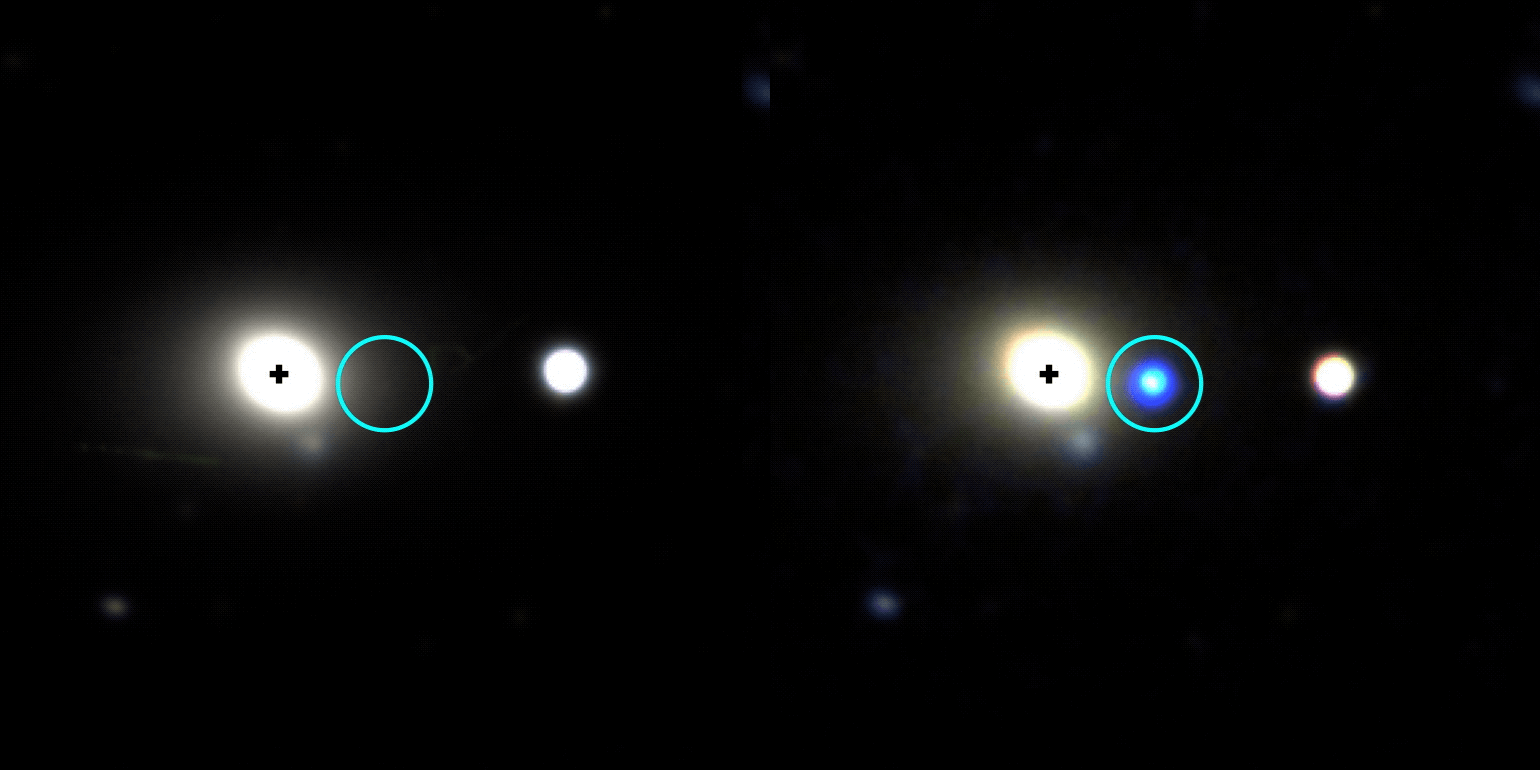
Other researchers are already racing to study the wandering black hole. Astrophysicist Kishore Patra, of the University of California, Santa Cruz, used the W. M. Keck telescopes in Hawaii and the James Webb Space Telescope to observe TDE 2025abcr in visible and infrared light. These wavelengths are typically obscured by the glow of starlight in a galaxy’s center, which is dense with stars.
“For the first time now, we can cleanly observe the intrinsic infrared emission from TDEs,” Patra, who was not involved in the new research, tells Science. He and his colleagues found more infrared emissions than expected. That suggests that some stars—a “stripped remnant of a satellite galaxy,” perhaps one that crashed into the larger galaxy—might be hanging around the wandering black hole, the researchers report in a study posted on the preprint server arXiv in April. The work has not been peer-reviewed.
More broadly, identifying TDEs, and therefore black holes, on the margins of galaxies can shed light on the histories of their homes.
“What’s exciting about this result is that we think it’s the tip of the iceberg,” Stein tells New Scientist’s Leah Crane. “If we can understand how many wandering supermassive black holes there are, then it can tell us about how many mergers the galaxy has been through and how it’s evolved over time.”
/https://tf-cmsv2-smithsonianmag-media.s3.amazonaws.com/accounts/headshot/Margherita_Bassi.png)