
In a First, Astronomers Identify a Star That Might Glow Green. New Research Highlights the Strange Hues White Dwarfs Can Take on
White dwarf stars are too far from Earth to be observed directly. So, scientists reconstructed how they’d look to human eyes based on the wavelengths of light they emit and found a colorful array of objects that might appear yellow, purple or pink


The color of most stars indicates their temperature: Cool ones glow orange, warmer ones look white and the hottest appear blue. It turns out, however, that white dwarf stars—technically dense remnants of dead stars—don’t always follow that rule. For the first time, astronomers say they’ve spotted one that would look green to our eyes.
White dwarf (WD) J1330+6435, located some 280 light-years from Earth, seems to have accumulated rocky material from its surrounding planetary system. The acquisition has enriched its atmosphere with calcium, lithium and sodium, giving the stellar object a chartreuse hue. The findings, published in the journal RAS Techniques and Instruments on October 15, show that changes in chemistry can make some white dwarfs emit rare colors.
“The colors that normal stars can have are pretty much only orange, white or blue,” says study co-author Mark Hollands, an astrophysicist at the University of Warwick in England, to Jack Guy and Lauren J. Young at CNN. “What we found is, for most white dwarfs, that’s the same as well. But there are some special cases where the physics in the outer layers of these stars are sufficiently strange that it causes actually quite big deviations in terms of their spectrum.”
Did you know? Incredibly dense
White dwarfs often contain roughly half the sun’s mass but are just a little bigger than Earth. That means the stellar remnants are around 200,000 times denser than Earth.
In the study, Hollands and colleagues looked at previously collected data on more than 150 white dwarfs. Because these stars are too far from us for their colors to be observed directly, the researchers calculated their hues by using their spectra, the different wavelengths within their light. It’s like the rainbow produced when white light passes through a prism. A star’s spectrum is influenced by its temperature, chemical composition and other factors.
The team ran the white dwarfs’ spectra through a model of human vision to find out how the objects might look to the human eye. A handful of them had unusual coloring, including yellow, purple and pink, thanks to the interactions between the gases in their atmospheres and other trace elements.
White dwarfs have incredibly dense atmospheres, up to about a gram per cubic centimeter, comparable to the density of liquid water. That means even a tiny amount of an element, like calcium or sodium, in a white dwarf’s atmosphere interacts more with the surrounding helium plasma and absorbs more wavelengths of light than it would at lower densities, according to a statement. The property allows colors to shift in unusual ways.
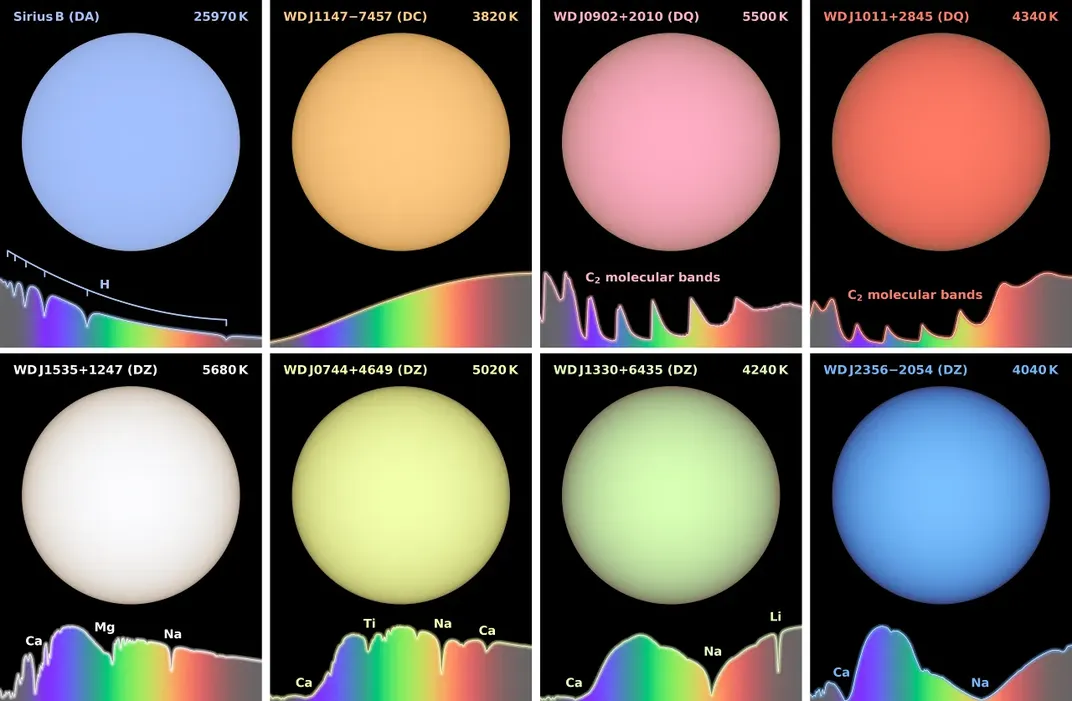
In the case of WD J1330+6435, “the end result is that the sodium atoms no longer absorb one very narrow wavelength of orange—they absorb the yellows, oranges and some of the red wavelengths,” Hollands tells Will Dunham at Reuters. “And what you’re left with is a star that has a beautiful chartreuse-green glow, something that wouldn’t be possible for sun-like stars.”
The team found that another star, WD J1011+2845 located merely 48 light-years from Earth, emits a salmon pink because of carbon. It could even be the reddest star ever recorded. Still, the researchers maintain that most white dwarfs are indeed white. By analyzing a representative sample of these stars within about 65 light-years of Earth, they estimate that roughly one in 30 white dwarfs have odd hues.
While the work doesn’t necessarily provide a new scientific understanding of white dwarfs, it does offer an intriguing approach and new view of them, says Agnès Kim, an astrophysicist at Penn State Scranton who wasn’t involved in the work, to CNN.
“Doing a study that goes from spectrum to what the human eye would see is a cool intersection of physics and biology to me,” she adds. “I love that some would look green to us if they were close enough for us to see them, and even more fun that some would look pink.”
The study also provides further evidence of how strange our cosmos is. “It does show that the universe is sometimes just as weird as anything science fiction can conjure up,” Hollands tells Reuters.
