
Here’s Why These Male Spiders Sacrifice Themselves by Somersaulting Into Females’ Fangs While Mating
A new study suggest that even strange, complex animal behaviors can have a relatively simple genetic basis
/https://tf-cmsv2-smithsonianmag-media.s3.amazonaws.com/accounts/headshot/SarahKuta.png)
/https://tf-cmsv2-smithsonianmag-media.s3.amazonaws.com/filer_public/cb/3a/cb3a3cf6-d5d9-491b-a0a5-b0ef9d2db312/3565053908_6da33fde6b_b.jpg)
While mating, a male redback spider somersaults so that his abdomen lands in his partner’s awaiting fangs, seemingly encouraging the female to eat him. But before she has a chance to chomp down, he constricts his abdomen, which helps him escape the fangs—and cheat death—long enough to finish copulating.
Now, a new study published August 12 in the journal Biology Letters sheds light on the underpinnings of the species’ unusual mating behavior. The findings suggest that even complex behaviors can have a relatively simple genetic basis.
Redbacks are a type of small venomous spider native to Australia. With bodies about the size of a large pea, females are usually black or brown, with an orange-red line running down their backs; they also have an hourglass-shaped orange-red spot on their bellies. Males are much smaller, with light brown bodies, white markings on their backs and pale spots on their bellies.

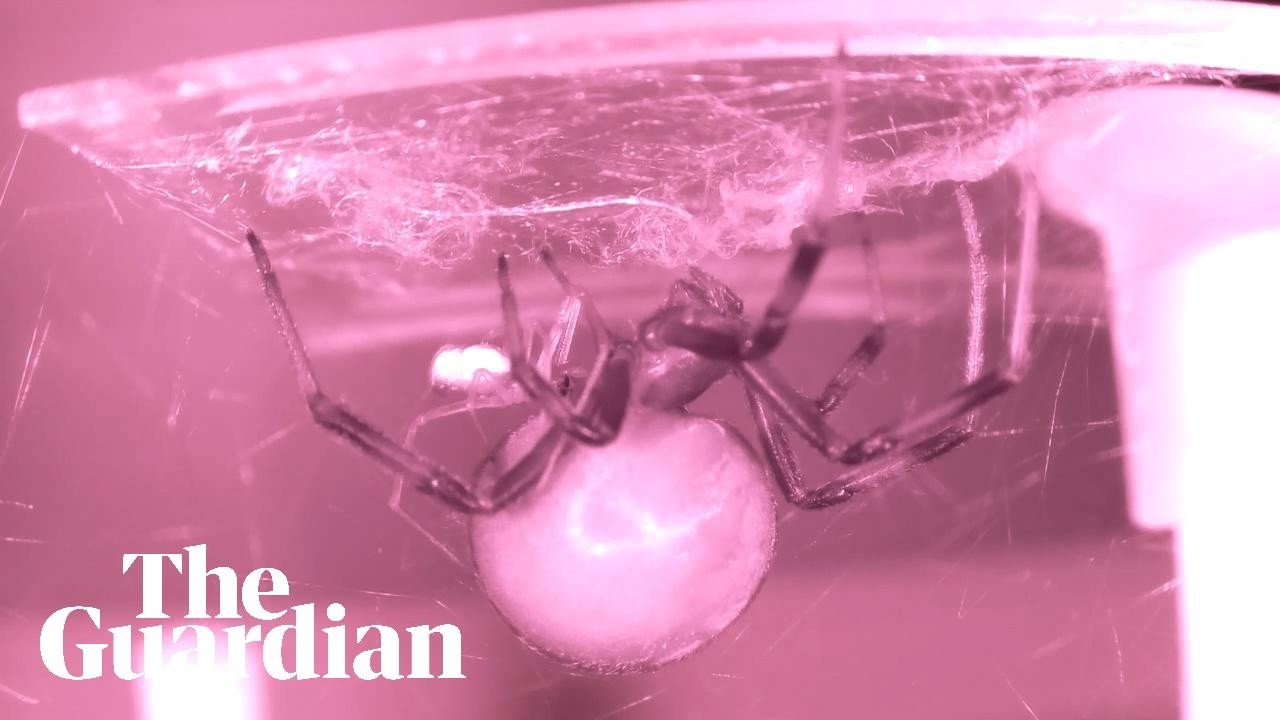
Male redback spiders actively trigger their own consumption. However, their close relatives, the venomous katipō spiders native to New Zealand, do not. In fact, male redbacks are the oddballs of the broader widow spider family: Of the 31 known widow spider species, males from just two—redbacks and brown widows—are known to engage in this self-sacrificial mating behavior.
“In the katipō, the male inseminates the female and runs off the web—that’s the same for most widow spiders,” Cor Vink, an ecologist at Lincoln University in New Zealand who helped collect spiders for the study but otherwise was not involved, tells the Guardian’s Donna Lu. “The term ‘widow’ is actually a misnomer.”
Researchers think katipō and redbacks diverged from each other around 100,000 years ago—relatively recently in evolutionary terms. So, they wondered why the two species exhibit such different mating behaviors.
“What makes this system so intriguing is the fact that we are dealing with two species here, which are very closely related,” lead author Kardelen Özgün Uludağ, a behavioral biologist at the University of Hamburg in Germany, tells Live Science’s Stephanie Pappas. “This is very uncommon in animals.”
They hypothesized that genetics might provide an explanation for the distinct mating rituals. One way to test this idea, the scientists reasoned, would be to crossbreed the two species and see which behaviors got passed along to the resulting hybrid offspring.
So the team collected eggs of both species, brought them back to a lab, reared the spiderlings and started playing matchmaker. First, they mated katipō females with redback males, which produced crossbred hybrid offspring. Then, they mated the resulting hybrid females with either male redbacks or male katipōs to produce hybrid males with a mix of genes from both species.
Finally, they mated the resulting males with katipō females. During this phase of the experiment, they filmed the copulation with infrared cameras so they could track how many of the hybrid males performed the self-sacrificial somersaulting and abdominal constriction behaviors. They observed 104 instances of successful mating.
Did you know? One-way interbreeding
Katipō males cannot reproduce successfully with redback females because the females tend to eat the males rather than mate with them.
Since somersaulting and abdominal constriction occur in quick succession during the mating process, the researchers thought the behaviors probably shared the same genetic basis. Perhaps they are encoded on a “supergene”—multiple contributing linked genes—located close together on the same chromosome, the team posited.
However, the evidence suggested otherwise.
Only about half of the male hybrids performed both behaviors while mating, while the rest did just one or the other. This suggests the behaviors are not genetically linked. Instead, the genes driving these behaviors are either located “very far apart on the same chromosome or even located on different chromosomes,” the researchers write in the paper.
“Given how important both traits are to survival, we would guess that they should be strongly linked together,” Michael Kasumovic, an evolutionary biologist at the University of New South Wales in Australia who was not involved with the research, tells the Australian Broadcasting Corporation’s Ellen Phiddian. “But they aren’t, and that suggests they evolved independently. And that's really cool.”
The experiments hint that the redbacks’ somersaulting behavior stems from a gene or supergene located at a single location on the spider’s X chromosome. Both males and females have two of these sex chromosomes, unlike humans. But male spiders have just one complete set of DNA in each X chromosome, while females have two sets.
The genetic story of abdominal constriction, however, appears to be more complicated, likely involving multiple genes and, possibly, signals from females.
Moving forward, the findings could have important conservation implications. Redbacks are an invasive species in New Zealand—and they’re threatening to wipe out the katipō through hybridization. Any insights into the relationship between the two species might help conservationists solve this problem.
“The more we know about the interbreeding, the more we know about what we can do to combat redbacks and katipō interbreeding in New Zealand,” Vink tells the Guardian.
/https://tf-cmsv2-smithsonianmag-media.s3.amazonaws.com/accounts/headshot/SarahKuta.png)