
Have Archaeologists Finally Pieced Together the ‘Parthenon Puzzle,’ One of Ancient Greece’s Greatest Mysteries?
Centuries ago, the Parthenon’s east pediment was reduced to rubble. German researchers now believe they have recreated the 39-figure scene depicting the birth of Athena with the help of Roman sarcophagi and 3D printers

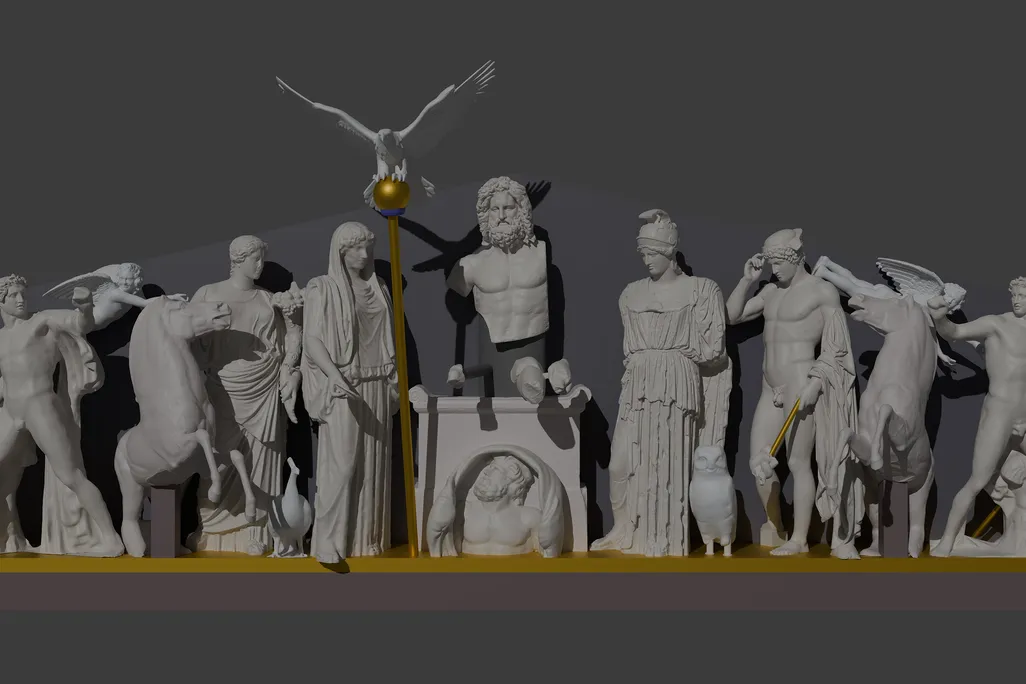
When the Parthenon was built some 2,500 years ago atop the Acropolis of Athens, one of the temple’s facades stood out for its striking imagery. Stretching for nearly 100 feet above the building’s eastern entrance, the marble-carved pediment depicted Athena being birthed from the head of a nearly 13-foot-tall Zeus; they were flanked on either side by 37 other intricately sculpted figures, including gods and goddesses. For its fine craftsmanship and potent symbolism, the pediment is widely considered by scholars to be one of antiquity’s most famous images.
But no one alive today has ever looked upon the scene in its original glory. Sometime between the fifth century C.E. and 1670, the pediment was largely destroyed—fires, earthquakes and humans all played roles in its destruction. Only 20 percent of the ruins were recovered, and these fragments have since been scattered to museums across the world. Piecing together what the original artwork may have looked like has intrigued historians for centuries. Now, a team of researchers believe they have finally reached a solution to the Parthenon puzzle.
Open this week at the Liebieghaus Sculpture Collection in Frankfurt, Germany, “Athena, the Stage is Yours: The Parthenon Puzzle” offers visitors a chance to see what the institution is calling the first-ever “archaeologically grounded proposal” for what the pediment once looked like.
“For around 200 years, archaeological research has sought to reconstruct the lost overall appearance of the Parthenon’s east pediment,” Philipp Demandt, the museum’s director, says in a statement. “With this exhibition, we are presenting our findings to the public for the first time and inviting visitors to take a fresh look at and discuss one of the most significant works of art from antiquity.”
Recreating the image took decades of dedicated research. The museum’s effort was led by Vinzenz Brinkmann and his wife, Ulrike Koch-Brinkmann, who are both archaeologists. They began by referencing the most complete, existing body of work about the pediment. In the early 20th century, Arthur Hamilton Smith, a curator at the British Museum, produced plaster casts of more than 200 small surviving fragments from the pediment and meticulously documented their known placements in relation to each other.
The duo created digital renderings of these pieces, which still left massive gaps in the overall pediment. They then began scouring archives around the world for unidentified clues to the original design. A breakthrough came during a trip to the Hermitage Museum in St. Petersburg, Russia, in 2014. There, they observed an ancient Roman sarcophagus with a relief on its lid depicting the birth of Athena. The scene resembled nearly exactly what scholars envisioned of the pediment.
Did you know? Colorful couple
Brinkmann and Koch-Brinkmann are also noted for their painstaking work to accurately recreate the original color schemes of classical white marble statues. For authenticity, they used the same mineral and organic pigments available to the ancients.
“It was really a chance discovery,” Brinkmann tells the Art Newspaper’s Catherine Hickley. “We noticed a figural relief on the lid of a sarcophagus that was clearly closely related to the composition of the east pediment. It refers to the few surviving figures from the corners of the pediment, such as Helios and Selene with their chariots, but also to figures that have repeatedly been proposed as having belonged to the east pediment, such as the Horae [and] Moirai.”
Brinkmann’s team studied nine sarcophagi in total, mostly in the Vatican Museum and elsewhere in Rome. “The Romans copied everything the Greeks did,” he explains to the Art Newspaper.
While no single sarcophagus showed the entire 39-figure scene, they each showed different aspects of the pediment, which the researchers were able to piece together digitally, with the help of 3D scanners. Earlier scholars noticed this connection between sarcophagi lids and the pediment, Brinkmann tells Deutsche Welle’s Katharina Abel. “But we really seized on the idea and never let go.”
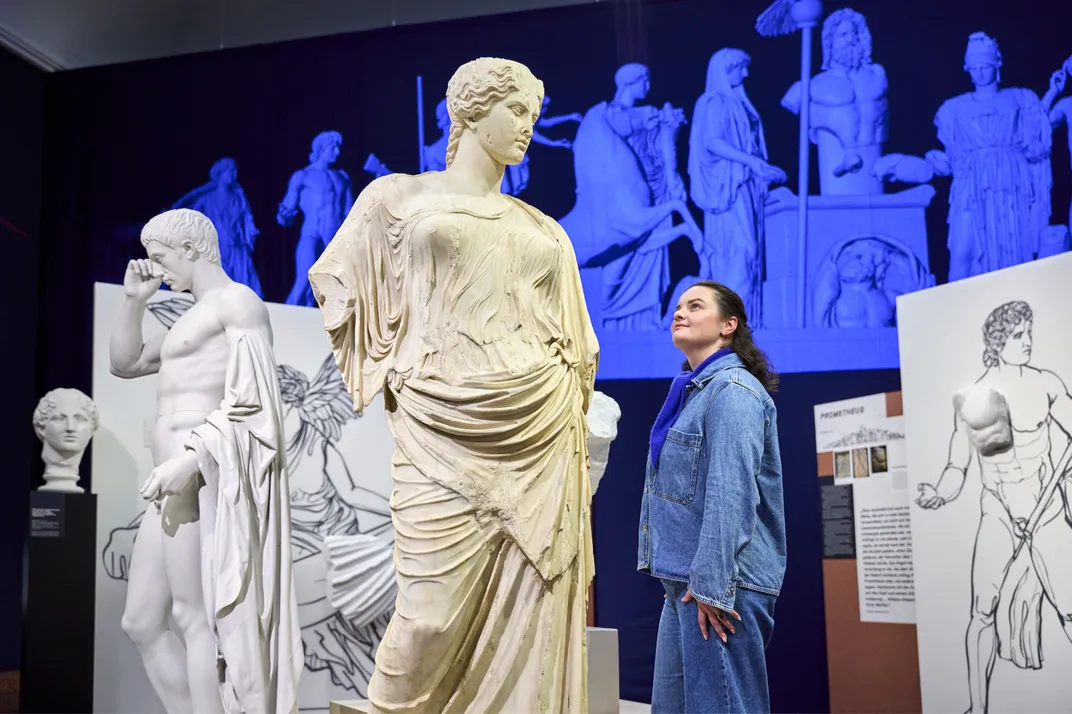
The researchers searched for missing artifacts that could piece together the lost scene. On the surviving fragments they studied drill holes and the edges of broken shards for clues about adjacent pieces. They referenced ancient texts for possible descriptions of the pediment’s positioning. They identified lost sculptures and worked with international institutions to ask and answer new questions as they arose.
“Piece by piece, the puzzle came together to form a new, archaeologically grounded overall picture of the Parthenon’s east pediment,” Brinkmann says in the statement.

Inside the exhibit, the reconstructed pediment is presented as a 13 foot-long, 3D-printed model, at a scale of 1:7.7 compared to the original. There are also life-size reproductions of the largely missing central figures, Zeus, Athena and Hera, based on surviving fragments and comparable sculptures. Casts of the well-preserved figures at opposite ends of the pediment—Helios, the sun god, and Selene, the moon goddess—mark the passing of time from day to night. A colorful animation created especially for the exhibition brings the tale to life through a retelling of the myth of Athena’s birth.
“Research belongs in the public sphere. In particular, a museum can demonstrate how scientific knowledge is generated by interpreting traces, asking questions and correlating different sources,” Ina Hartwig, who heads the city of Frankfurt’s Department of Culture and Science, says in a statement. “The exhibition makes this process immediately comprehensible to visitors.”
“Athena, the Stage is Yours: The Parthenon Puzzle” is on view at the Liebieghaus Sculpture Collection in Frankfurt through July 25, 2027.
