
‘Gulliver’s Travels’ Turns 300 This Week. Jonathan Swift’s ‘Profound Satire of Human Nature’ Is Still Just as Bitingly Relevant
Since it was first published in October 1726, the novel purporting to tell the fantastical travel tales of Captain Lemuel Gulliver has never left print. An exhibition of rare editions and adaptations in Dublin celebrates Swift’s most famous work

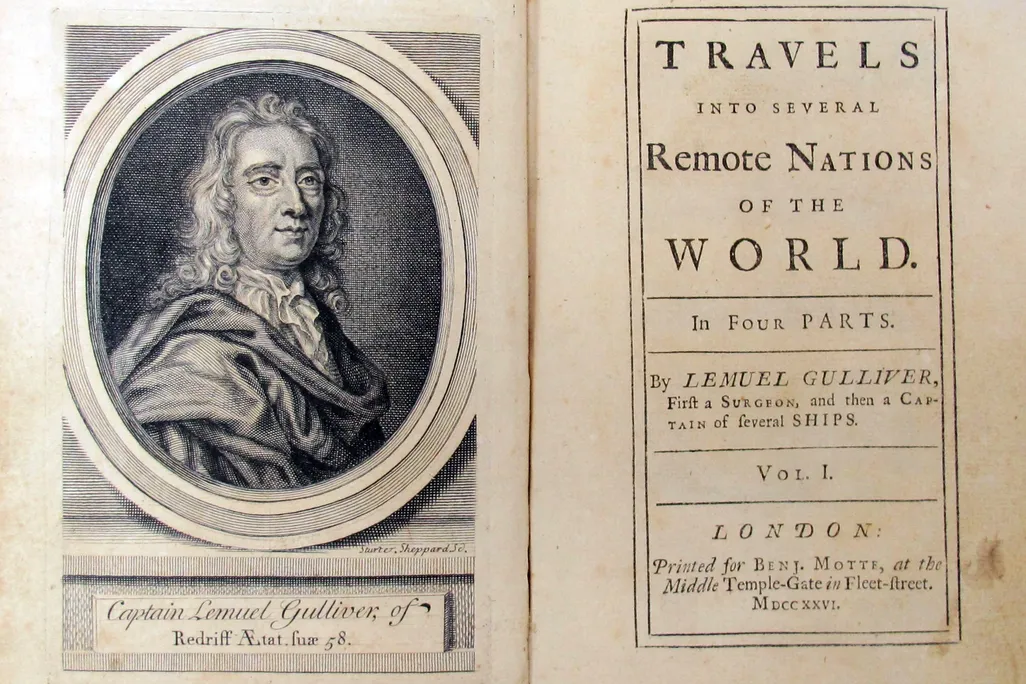
In the spring of 1726, a mysterious cloaked figure visited a London bookseller named Benjamin Motte with a manuscript in hand.
Transcribed in unfamiliar handwriting and apparently written by one “Lemuel Gulliver,” the text was called Travels Into Several Remote Nations of the World and told the story of a wayfaring sea captain who visits distant shores—including an island called Lilliput, home to six-inch-tall people—and whose misadventures appeared to poke fun at the elaborate oddities of human nature and British societal norms.
Motte enjoyed the tale enough to pay for its rights, even without knowing the real author. On October 28, 1726, he published the two-volume novel, which was met with instant acclaim. It wasn’t long before the book’s listed author, Gulliver, was revealed to be a pseudonym for Jonathan Swift, a Dublin-born Anglican clergyman and well-known writer and essayist.
Now, three centuries after the novel now known as Gulliver’s Travels first appeared on bookseller’s shelves, the literary world is still celebrating the novel as an enduring achievement in political satire and prose. Translated into dozens of languages while never once leaving print, the novel’s portrayal of class, morality and societal divisions has proved universally time-tested.
These provocations are front and center in “Gulliver at 300,” an exhibition at Trinity College Dublin, Swift’s alma matter. The show, which is also viewable online, brings together more than 100 versions of the story, from early editions and subsequent spin-offs to the many artworks it inspired.
“We have hundreds of editions and popularizations of Gulliver’s Travels in the collection ... from the 1726 edition, right up to the 21st century,” Stephanie Breen, the exhibition’s co-curator, tells RTÉ’s Aaron McElroy. “We showcase the work of the printers, engravers and illustrators who have responded to Gulliver’s Travels over the last 300 years.”
Highlights include the only known surviving copy of an abridgement to the novel, titled The Travels of Lemuel Gulliver, printed in Dublin in 1761; several 18th-century publications, not written by Swift, that sought to expand the world of Gulliver (what might be considered fan fiction today); a comic adaptation; as well as pop-up books, ephemeral booklets and other valuable deluxe editions.


To this day, the term “Swiftian” is synonymous with bitter satire. “Upon this great foundation of misanthropy … the whole building of my Travels is erected,” Swift once penned to fellow satirist Alexander Pope, per the London Times’ John Mullan. But scholars are still debating whether the author himself viewed humanity with such pessimism, or if he augmented these feelings in his fictionalized characters.
Some scholars argue that Swift’s unstable identity as member of Ireland’s elite Protestant minority helped shape his biting view of English authority. “His unique dual perspective within the prevailing power structures of his time enabled him to grasp the folly of believing that one frame of reference is the only one possible,” Clíona Ó Gallchoir, a literary scholar at University College Cork, writes for the Conversation.
Did you know? Coined words
Gulliver’s Travels was the origin of several colorful words in English, including “yahoo,” meaning a crass person, and “lilliputian,” after the miniature characters of the first voyage.
The exhibition’s organizers are confident that modern-day audiences, especially younger generations, will continue to find the novel and its messages relevant.
“The first readers of Gulliver’s Travels were very taken with its satire of prominent political figures and the machinations of power, Aileen Douglas, a literature scholar at Trinity and another co-curator of “Gulliver at 300,” says in a statement.
She adds: “For readers today, fearful of being displaced by AI, Swift’s profound satire of human nature, especially pride in rationality and progress, resonates strongly.”
“Gulliver at 300” is on view at Trinity College Dublin’s Old Library and online through December 2026.
