
Even Though They Don’t Have Brains to Rest, Jellyfish and Sea Anemones Sleep Like Humans
Sleep may have evolved to help reduce DNA damage in nerve cells long before they became centralized in the brain, a study suggests
/https://tf-cmsv2-smithsonianmag-media.s3.amazonaws.com/accounts/headshot/SarahKuta.png)
/https://tf-cmsv2-smithsonianmag-media.s3.amazonaws.com/filer_public/61/d7/61d763c5-9abe-4ea9-ae2f-48f82cd9438f/cassiopea_andromeda_in_its_natural_habit.jpeg)
Why do animals—including humans—sleep? This question has long puzzled researchers, because sleep is a risky behavior that makes organisms more vulnerable to predators and environmental hazards. It also uses up valuable time that could otherwise be spent eating, reproducing or tending to offspring.
Now, scientists say they are one step closer to solving the mystery. New research involving jellyfish and sea anemones, published January 6 in the journal Nature Communications, found that they spend about one-third of their time asleep, like humans, and suggests that the restful behavior evolved, at least in part, to help reduce DNA damage in nerve cells.
What’s more, the work supports the idea that “sleep was important even before a brain evolved,” study co-author Lior Appelbaum, a neurobiologist at Bar-Ilan University in Israel, tells Science’s Jack Tamisea.
/https://tf-cmsv2-smithsonianmag-media.s3.amazonaws.com/filer_public/ca/47/ca476484-1649-4e3a-87d6-3b47e2a08f4f/sleeping_jellyfish.jpeg)
For humans and other animals with central nervous systems—comprised of the brain and spinal cord—sleep supports brain health by clearing waste and consolidating memories. But creatures without brains sleep, too, so researchers wondered if sleep evolved before the advent of a central nervous system to serve some other biological function.
To probe that possibility, researchers investigated the sleep habits of the upside-down jellyfish and the starlet sea anemone, both of which hover on the seafloor in shallow water and use tentacles to snatch prey. These species lack brains, but they do have nerve cells—also known as neurons—throughout their bodies that detect stimuli, process information and coordinate basic actions like eating, moving and stinging. They’re part of an ancient group of organisms called cnidarians, which are believed to be among the earliest creatures to have neurons.

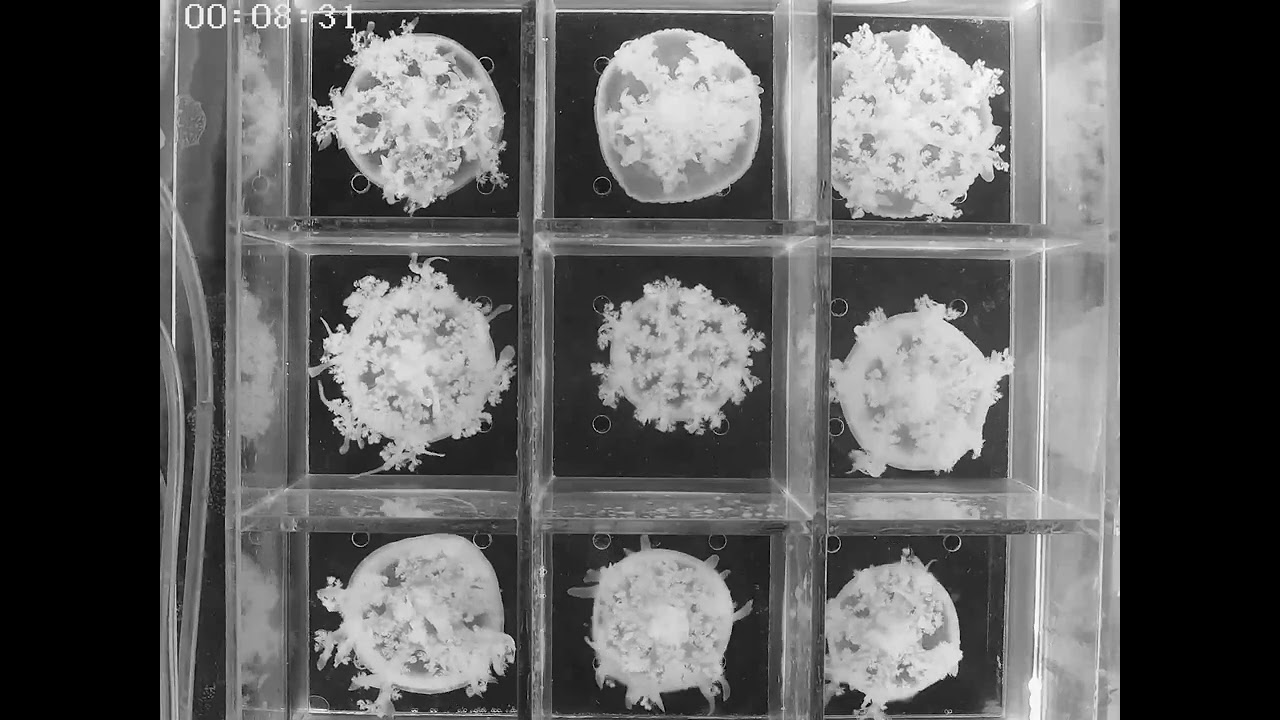
Scientists filmed upside-down jellyfish in laboratory tanks, using artificial lights to simulate daytime and nighttime conditions. During the day, the creatures pulsed their dome-shaped body structures called bells about 37 times per minute, on average, and reacted quickly when exposed to food or bright lights. At night, the jellyfish pulsed their bells roughly five fewer times per minute and took around twice as long to respond to the stimuli. Observations of jellyfish in one of their natural habitats—the shallow waters of Key Largo, Florida—revealed similar daytime and nighttime pulsation rates.
Researchers suspect these behavioral differences correlate with wakefulness and sleep. Based on that interpretation, the jellyfish slept for roughly eight hours each day, the team found. They mostly snoozed at night, but also took midday naps. When the scientists disrupted some of the lab creatures’ nighttime sleep, they snoozed roughly 50 percent longer than their undisturbed counterparts the next day, a phenomenon known as “sleep rebound.”

Additionally, the starlet sea anemones also appeared to sleep for roughly eight hours in laboratory tanks, though their internal clocks caused them to rest during the natural day and be more active at night, even when artificial lighting conditions were flipped. (The jellies, on the other hand, shifted their sleep schedule in response to an altered artificial night-and-day cycle).
When the team investigated the nerve cells of both species, they saw that DNA damage increased while the creatures were awake but decreased while they were asleep. And after they intentionally damaged their DNA—using ultraviolet radiation or a chemotherapy medication—the animals responded by sleeping more.
/https://tf-cmsv2-smithsonianmag-media.s3.amazonaws.com/filer_public/75/5e/755ed459-46a7-4848-b59d-108c4533eb3f/neural_network.jpeg)
The experiments indicate that sleep is crucial for protecting and repairing neurons, not just for supporting brain health. In the future, that takeaway could help researchers better understand connections between sleep and certain neurodegenerative diseases in humans, Appelbaum tells Nature’s Lynne Peeples. People with Alzheimer’s disease, for instance, often struggle to sleep at night.
Did you know? Poor sleep rate in people
Adults are recommended to sleep at least seven hours per day, but more than 35 percent of grown-ups in the United States aren’t getting that amount of snooze time, according to the Centers for Disease Control and Prevention.
Chiara Cirelli, a neuroscientist who researches sleep at the University of Wisconsin-Madison who was not involved with the new work, tells Nature that she was impressed by the study. “Every time somebody adds to the list of species that sleep, it is a very important step for the field,” she says.
But, for comparison, she wishes the researchers had kept some of the creatures awake after inducing the DNA damage to their neurons. She wonders if similar DNA repairs might be taking place while the creatures are awake but not actively learning.
/https://tf-cmsv2-smithsonianmag-media.s3.amazonaws.com/accounts/headshot/SarahKuta.png)