
Engineers Delicately Removed the Masts From This Bomb-Laden World War II Shipwreck in the River Thames. But 1,500 Tons of Explosives Are Still in Place
The operation marks a major milestone in efforts to address the risks posed by the sunken American military cargo ship, which still contains a massive cache of unexploded munitions

In August 1944, the American military cargo ship SS Richard Montgomery sank at the mouth of the River Thames with roughly 1,500 tons of bombs, ordnances and weapons still aboard. Now, more than eight decades later, officials have taken steps to reduce the risk of an explosion.
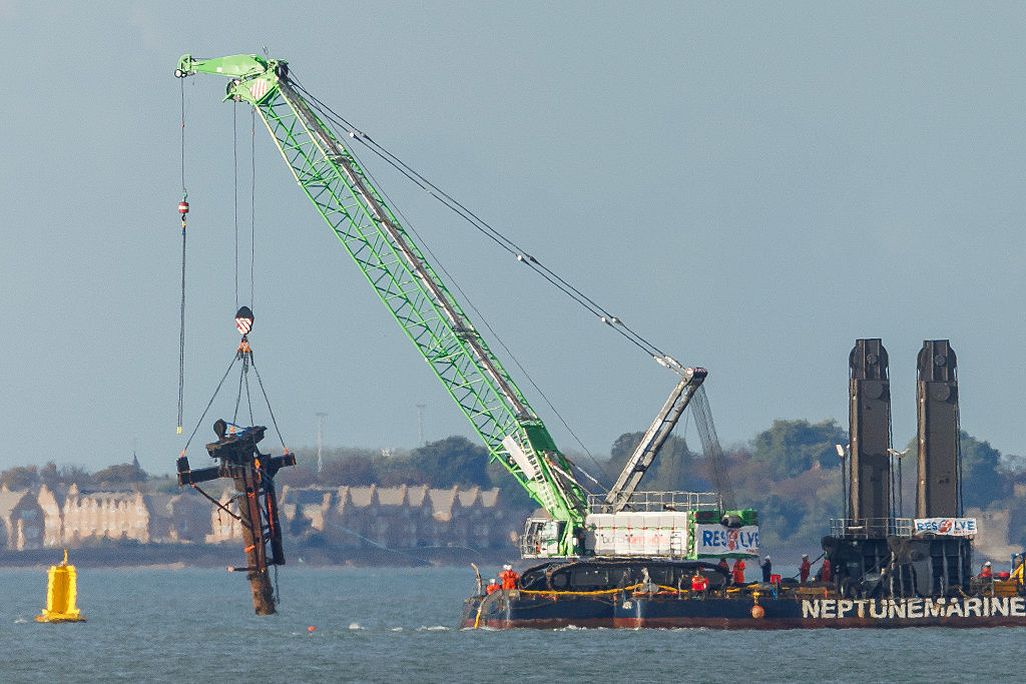
Engineers recently removed the vessel’s three masts, which had remained visible above the waterline near Sheerness, a coastal town about 50 miles east of London on the Thames Estuary. They were concerned that the towering steel structures might one day collapse onto the decks below, potentially triggering the World War II munitions still stored inside the Richard Montgomery’s damaged hull.
The masts were taken to the Historic Dockyard Chatham, a maritime museum and heritage site in Kent, for conservation and preservation, according to a statement delivered to Britain’s Parliament on October 19.
“This will help ensure that an important part of the region’s heritage is protected for future generations,” Keir Mather, minister for aviation, maritime and logistics, writes in the statement.
Meanwhile, the wreck will “continue to be subject to continuous monitoring and control,” he adds.

When it sank, the Richard Montgomery was participating in an Allied convoy delivering munitions to the United Kingdom and France. When the ship arrived in the Thames Estuary, it anchored off the coast of Sheerness while waiting to cross the English Channel.
However, on August 20, its anchor dragged in the shallow water and the ship ran aground on a sandbar. Salvage crews immediately began unloading the ship’s cargo, but a crack developed in the hull, allowing water to flood the front of the vessel.
Crews continued removing explosives until September 25, ultimately recovering about half of its explosive cargo. By then, however, the ship was taking on too much water, forcing them to abandon the effort. The vessel sank to the seafloor with its masts protruding from the water.
It’s not clear exactly which munitions were left onboard. However, experts think the ship—nicknamed the Monty—might still be full of 2,000-pound blockbusters, fragmentation bombs and white phosphorus smoke ordnances. The potential impact of an explosion is difficult to predict, with estimates ranging from minor damage to nearby shorelines to a tsunami-style tidal wave that could travel up the Thames. But any scenario would likely put local communities at risk.
Did you know? Toxic wreck
In 2022, scientists discovered that the V-1302 John Mahn, a German naval ship sunk by the British Royal Air Force in 1942, was leaking toxic chemicals like arsenic into the North Sea.
Ships aren’t allowed to get close to the wreck, with buoys marking the exclusion zone. However, the Monty is still close to busy shipping lanes and there have been reports of people entering the restricted area. Some officials also fear that the site could be targeted by terrorists or saboteurs, the Washington Post’s William Booth reports.
In recent years, the wreck had begun to “lean and deteriorate,” with some of the structures surrounding the masts starting to fail, Nolan Conway, project leader for Resolve Marine, the Florida-based company hired to remove the masts, tells CBS News’ Simon Ellery.
“The fear is the masts could have fallen onto the cargo itself, causing it to detonate,” he adds. “Some of the munitions are believed to be fused munitions with pressure fuses, so something like an impact could potentially set them off.”
So, the British government spent $12 million to have the masts carefully removed. Before they got to work, Conway’s team completed extensive surveys using radar, magnetometers and sonar to understand the wreck site.
Resolve Marine positioned a high-tech salvage barge by the wreck. Then, crews used a remotely operated diamond-wire saw to carefully cut each mast, per CBS News. The team also used a custom lifting frame to safely raise each mast free from the wreck without swinging or swaying.
Though they’re no longer attached to the Monty, the masts will help keep the vessel’s story alive at the Chatham Historic Dockyard, preserving a tangible connection to its wartime history and the sacrifices made by Allied forces during World War II.
“There’s a lot of interest in that ship,” Paul Barnard, deputy CEO of the Chatham Historic Dockyard, tells the Washington Post. “A lot of history and lore and speculation and, to be honest, rumor about what could happen next.”
