
Earth’s True North and South Poles Have Wandered Four Times Over the Past 320 Million Years, Study Suggests
The phenomenon, which involves the geographic poles, is distinct from when the magnetic poles move. The planet’s solid crust and molten mantle occasionally shift and subsequently reorient themselves during what’s called true polar wander

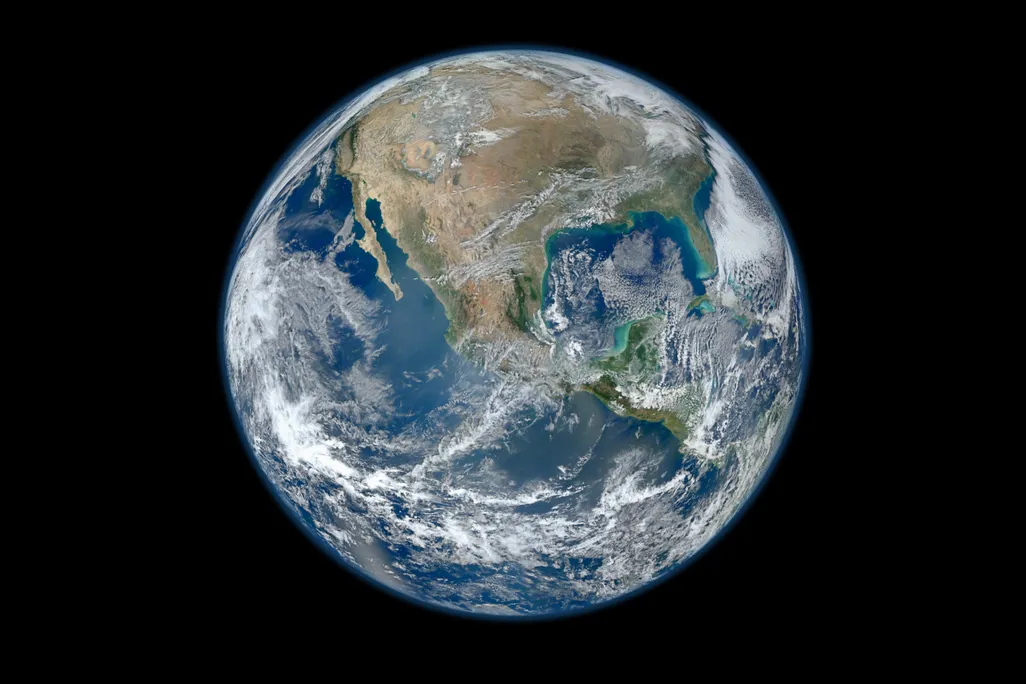
You may have heard that Earth’s magnetic poles can wander away from the planet’s true North and South Poles. But these geographic points are also mobile. In fact, they seem to have gone on four big journeys over the past 320 million years, according to a study published on October 1 in the journal Science.
Earth’s solid, outermost shell—the crust—shifts more than you might think. It floats atop a viscous rock layer called the mantle, which surrounds the planet’s core. Movements in the crust and mantle can change the distribution of the planet’s mass and disrupt Earth’s balance around its rotational axis. To reestablish balance, the crust and mantle reorient themselves around the core. Earth’s geographic poles slide around in the process, a phenomenon called true polar wander.
True polar wander is even taking place right now. “Based on satellite measurements, we know that this is happening today, at about ten centimeters a year, mainly because of melting ice caps,” lead study author Mathew Domeier, a geophysicist at the University of Oslo in Norway, tells Scientific American’s Jacek Krywko.
But investigating past episodes of this phenomenon is difficult because the movement of tectonic plates can be mistaken for true polar wander. Earlier studies have had inconsistent results, and researchers haven’t been sure whether the North and South Poles make continuous slow, steady shifts or take great strides in quick bursts.
So, Domeier and colleagues used a new strategy to track down rapid true polar wander: ancient sea-level changes. It works because our planet isn’t a perfect sphere. Its rock and ocean are fatter around the equator. When true polar wander takes place, the bulging belt of water stays still while landmasses move, meaning some dry regions of crust plunge underwater and some previously submerged regions become exposed to air.
The affected areas form a telltale pattern with four quadrants, somewhat resembling a four-leaf clover, per Scientific American. “This is a very strange pattern that is not caused by other Earth processes,” Domeier tells New Scientist’s James Woodford.
The researchers searched for this signature when running computer simulations of flooding dynamics on Earth over the past 320 million years. Four time points stood out: the Oligocene to Miocene about 20 million to 30 million years ago, the mid-Cretaceous about 90 million to 100 million years ago, the Late Jurassic to Early Cretaceous about 140 million to 150 million years ago, and the Early Jurassic about 190 million to 200 million years ago.
Did you know? Dramatic climate event
Researchers have previously suggested that true polar wander triggered an ice age that began around 3.2 million years ago.
“These findings refute the view of [true polar wander] as negligible or persistently slow,” the authors write in the paper. They also “highlight the need to consider [true polar wander] as an episodic control on sea level change and likely other global environmental and biological dynamics.”
These short, intense periods of moving crust and mantle could alter ocean currents and affect the climate, drastically changing ecosystems.
“This is a very exciting development that helps us link very deep Earth processes to changes in long-term climate and sea level on the planet,” says Sabin Zahirovic, a geoscientist at the University of Sydney in Australia who was not involved in the study, to New Scientist.
Still, researchers aren’t sure what triggers true polar wander events and the geographic poles’ extent of travel during each. “Trying to understand why these events happened at these times would be the next logical step,” Domeier tells Scientific American.
