Did Women and Children Collaborate With Male Artisans to Create China’s Terra-Cotta Army? Fingerprints Left on the 2,000-Year-Old Clay Warriors May Hold the Answer
A new study found that adult women and juveniles under the age of 15 accounted for 67 percent of the fingerprints analyzed. The research challenges long-held assumptions about the age and gender of the workers who sculpted Qin Shi Huang’s soldiers

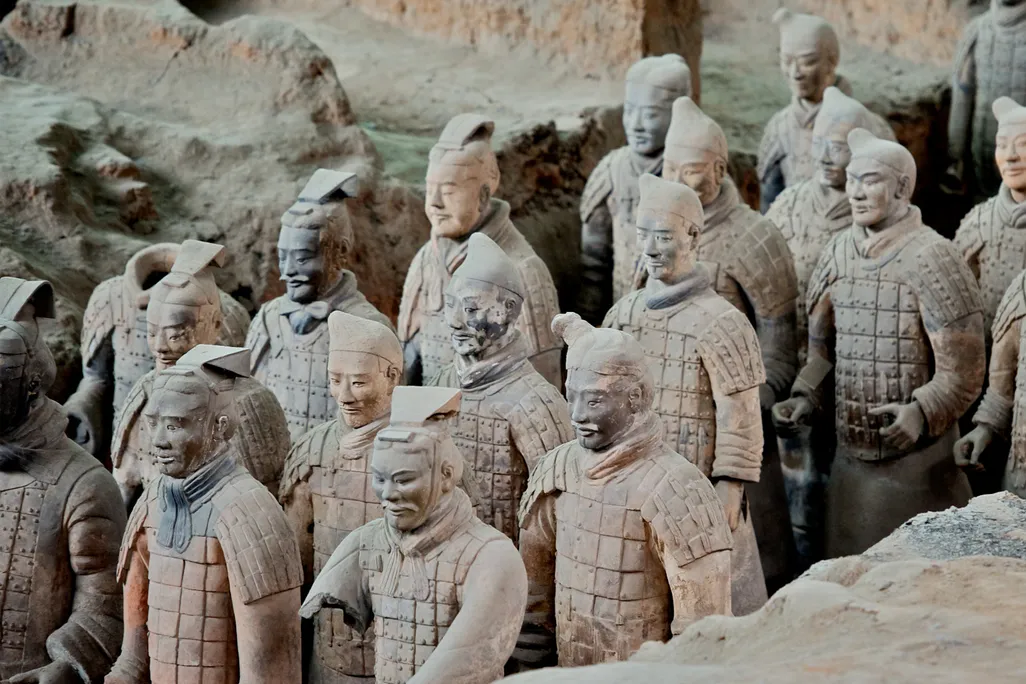
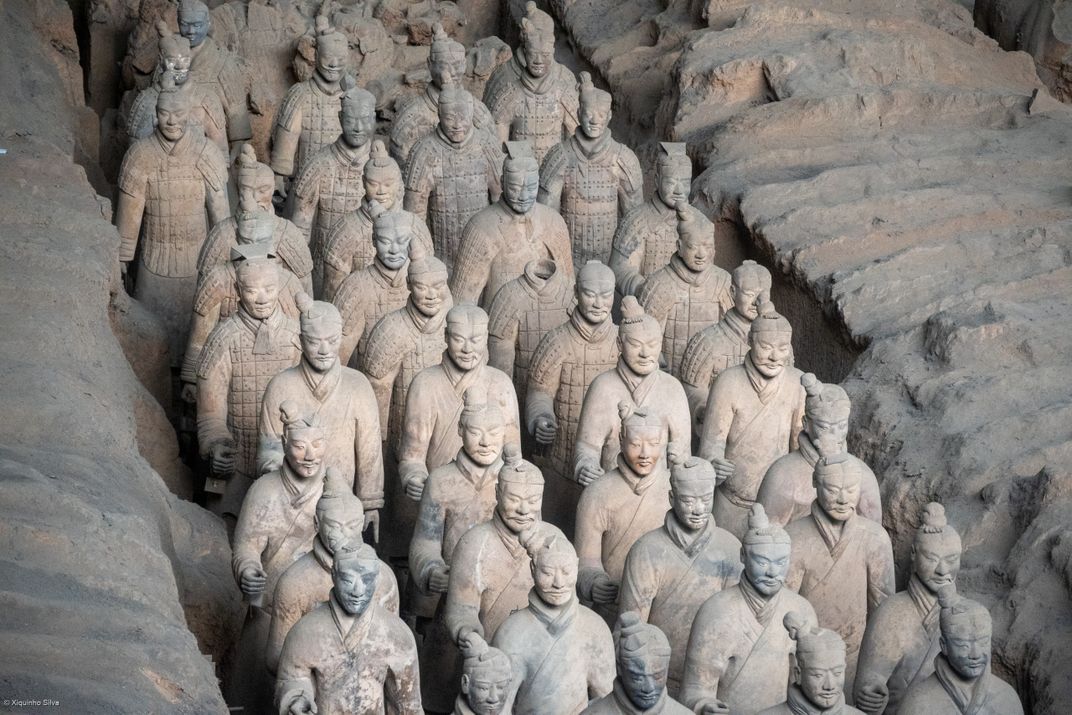
When China’s first emperor, Qin Shi Huang, died in 210 B.C.E., he was buried in style, with an army of some 8,000 terra-cotta warriors assigned to protect him in the afterlife. Forgotten for more than 2,000 years, the towering clay figures were only rediscovered in 1974, when farmers in northwest China stumbled onto them while digging a well. The sculptures are eerily life-like: The artisans who created them carefully carved the soldiers’ hair, eyes, ears, mouths, muscles and attire, ensuring that no individual is identical to another.
Experts generally agree that the clay soldiers’ torsos were modeled by hand, while their heads and hands were cast from molds. As art historian Wu Hung wrote in the 2003 book Chinese Sculpture, the process began with a rudimentary form crafted from coarse clay, which was then covered with layers of finer clay. Craftspeople carved details into this fine clay, adding touches that lent the figures their unique personalities. To finish the job, workers fired the sculptures, painted them in vivid colors and outfitted them with real weapons. “The distinctive appearance of each statue resulted from assembling a different set of components and from hand-finishing at the final stage,” Wu explained.
Researchers led by Xiaoxi Li, an archaeologist at the Emperor Qin Shi Huang’s Mausoleum Site Museum, have published a new analysis that may call into doubt the long-held assumption that the terra-cotta soldiers were created exclusively by adult men. As the authors write in the Journal of Cultural Heritage, “Our results provide the first biological evidence for a diverse workforce including adult females and juveniles.”
Did you know? Qin Shi Huang’s tomb
- Archaeologists have excavated sections of the emperor’s mausoleum, including the outer pits where the Terra-cotta Army was found, but Qin Shi Huang’s tomb remains unopened.
- Chinese officials have cited concerns about higher-than-anticipated mercury levels at the site, as well as the challenges associated with properly preserving the tomb once it has been exposed to the elements.
To gain a clearer sense of the workforce’s makeup, the team identified 79 well-preserved fingerprints found on 36 warriors. Of these prints, 45 percent appeared to come from adult women, with another 33 percent left by adult men. Juveniles accounted for the final 22 percent. (The paper defines juveniles as those under the age of 15, based on Qin dynasty records that suggest this was “the minimum age of criminal responsibility, as well as the threshold age for forced labor and military service.”)
Although scientists have long relied on fingerprint analysis to estimate an individual’s age or sex, the study argues that the traditional methods used have clear limitations. These assessments are often based on measurements of mean ridge breadth, or the average distance between raised lines in a fingerprint, and ridge density, which measures the average number of ridges in a set area of the print.
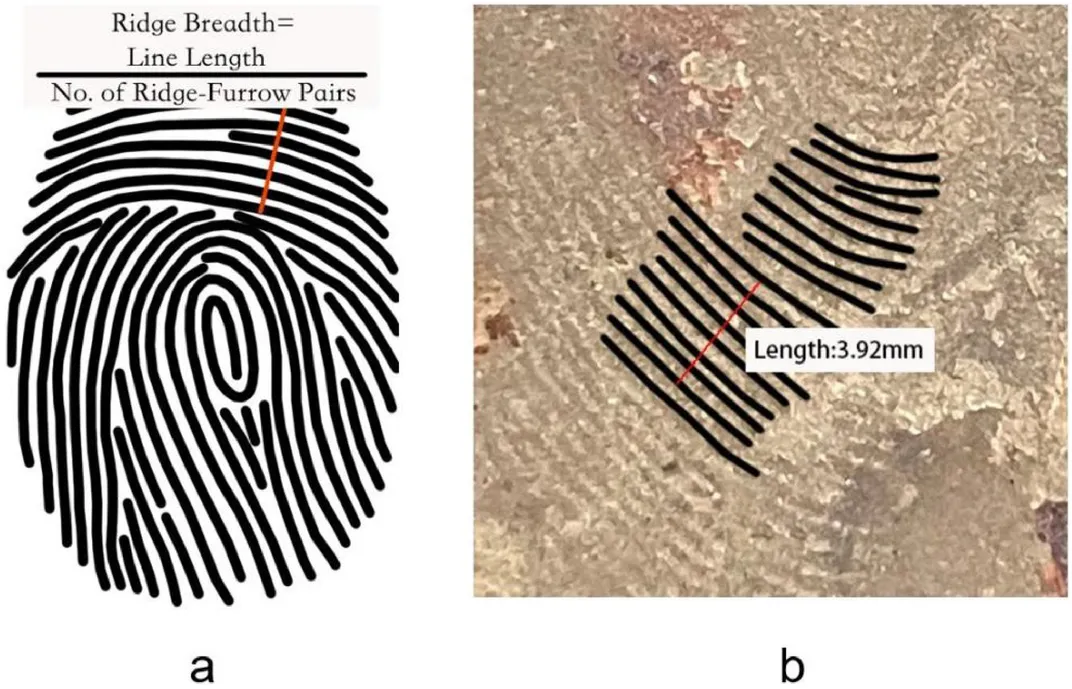
Adult men tend to have more space between fingerprint ridges than their female counterparts, resulting in a lower ridge density—but this pattern doesn’t hold true for adult women and teenage boys, whose prints can be virtually identical. The paper’s authors also point out that conventional methods fail to account for “interpopulation variation and post-firing ceramic shrinkage.”
The team addressed these limitations by using a Bayesian mixture model laid out by a separate group of researchers in a 2023 journal article. “Instead of classifying every print, the method looks at the whole batch,” Guillermo Carvajal writes for La Brújula Verde. “It works a bit like an opinion poll, which cannot know how each person voted but can estimate the result for the group. … It tests many possible mixes of ages and sexes against the measurements, keeps the ones that fit best, and returns ranges of probability instead of certainties.”
Although the researchers describe their findings as “compelling, biologically grounded evidence” of their theory, they caution against drawing sweeping conclusions based on the data.
While 44 percent of the fingerprints were attributed to women, this doesn’t necessarily imply that women made up the same percentage of overall craftspeople. The study’s sample size was relatively small, drawing from just one of three army pits. It’s also possible that a single individual left fingerprints on multiple sculptures. Finally, the authors note that inexperienced workers—probably including women and children—were more likely to leave behind fingerprints than trained artisans, who might have erased such traces after finishing their work.

Despite these caveats, the researchers note that their analysis lines up with written evidence from Qin dynasty lacquerware found in Hubei Province. Inscriptions on these artifacts include Chinese phrases that translate to “adult woman,” “young woman” and “young boy,” “indicating that women and children participated in lacquer production under state supervision,” the authors write in the study.
The sculpted warriors weren’t realistic portraits of real people, but they didn’t conform to standardized types, either. Instead, the figures formed part of a terra-cotta retinue intended to serve Qin Shi Huang after his death. “The goal of the army’s sculptors was to recreate reality by replicating its aspects with as much verisimilitude as possible, given the limits of medium, technique and representational capabilities,” art historian Ladislav Kesner wrote for the Art Bulletin in 1995. “The experience of the authentic world, which a tomb master could ‘believe in,’ can only be sustained if the style is sufficiently transparent.”
In addition to the clay warriors, archaeologists excavating the emperor’s mausoleum have unearthed sculptures of acrobats, civil servants and even waterfowl serenaded by musicians. “We find the underground pits are an imitation of the real organization in the Qin dynasty,” Duan Qingbo, then-head of the mausoleum excavation team, told Smithsonian magazine’s Arthur Lubow in 2009. “People thought when the emperor died, he took just a lot of pottery army soldiers with him. Now they realize he took a whole political system with him.”