
China Announces a Plan to Put Astronauts on the Moon by 2030, Revealing Details of Four Upcoming Missions
The country intends to launch three uncrewed test missions followed by a human lunar landing within the next few years. NASA hopes to send humans to the moon in 2028, though some experts have expressed doubt about that timeline

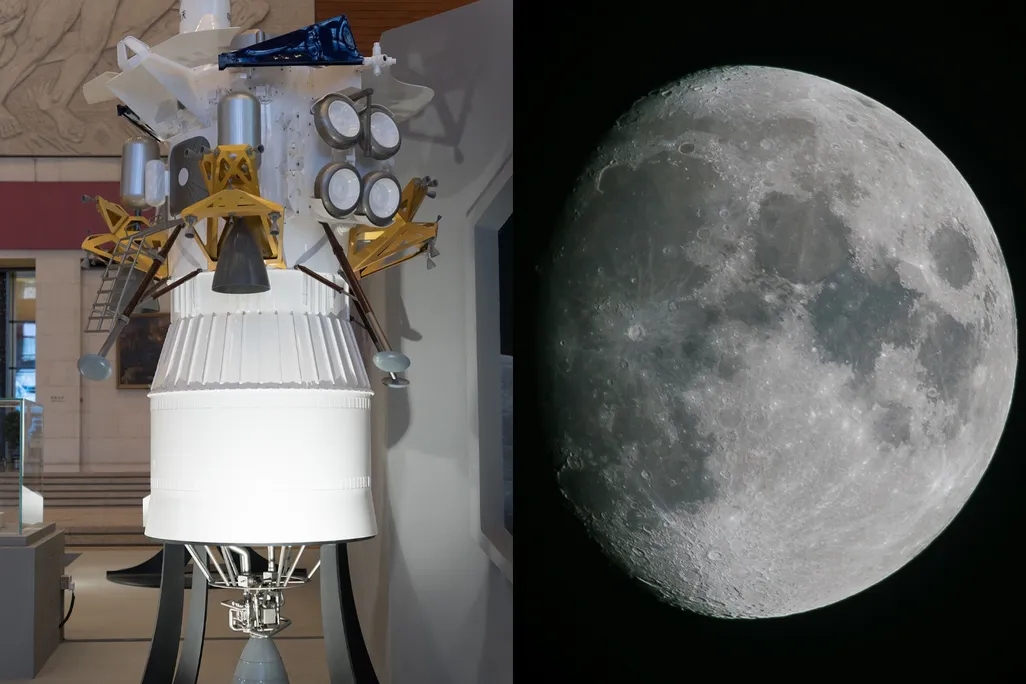
In the wake of a recent NASA update on the schedule of its upcoming Artemis 3 mission into Earth’s orbit, China has announced details about its own lunar program, shining a rare light on how the nation plans to land humans on the moon by 2030.
Wang Xiang, deputy chief designer of China’s manned space program and chief designer of the lunar exploration program, explained how the moon landing will be executed at the Seventh Manned Space Symposium in Beijing on Saturday, according to the state-run Chinese news agency Xinhua.
The release of details comes within the context of what’s widely seen as a new space race, this time between China and the United States. NASA is currently targeting 2028 for its highly anticipated lunar return, but many external experts are dubious that the agency will be able to stick to its timeline, reports Kenneth Chang for the New York Times.
China unveils detailed plan for manned moon landing China plans to land Chinese taikonauts on the Moon before 2030, with a crew of three, two of whom are expected to set foot on the lunar surface, according to information released at the 7th Human Space Symposium on Saturday. The mission will use a “two launches, one lunar landing” approach, involving two Long March-10 carrier rockets. Check the details. #ChinaSpaceMission #moon
— CGTN Frontline (@Frontlinestory) November 1, 2026
Wang said that China’s planned moon landing mission, slated for “before 2030,” will involve launching two separate Long March 10 rockets—one for a Mengzhou spacecraft, carrying a three-person crew, and the other for a Lanyue lunar lander. Once the two spacecraft reach the moon’s orbit, they will attach, or dock, and two of the Chinese astronauts, referred to as taikonauts, will move into the lander. The lander will then take them down to the surface of the moon.
There, the astronauts will use a Tansuo lunar rover to drive around, collect samples and carry out experiments, according to China Daily’s Zhao Lei. The third taikonaut will wait for them in lunar orbit, providing support from the Mengzhou spacecraft.
“It is notable that we will deploy a lunar rover on our first crewed landing mission,” Wang tells China National Radio, as reported by China Daily. “This will substantially expand our capability to conduct a wide range of operations on the lunar surface and enhance operational flexibility.”
But before this complicated feat, the Chinese Lunar Exploration Program will test out its technological capabilities in uncrewed missions, Wang explains in a CCTV interview. “In an unmanned state, we will validate as many key technologies of the entire crewed process as possible, including launch, orbiting the moon, docking with the Mengzhou spacecraft, landing and staying on the lunar surface, taking off again and re-docking with the Mengzhou spacecraft,” he says, translated by the outlet. “This is to ensure that the crewed flight is safe and reliable.”
Did you know? China’s lunar sample return
While China has not landed humans on the moon, it has seen success with robotic moon missions in recent years: The Chang’e-5 spacecraft brought samples of lunar soil to Earth in 2020, and in 2024, Chang’e-6 retrieved the world’s first-ever samples from the lunar far side.
China is working toward three uncrewed test missions before its crewed lunar landing, reports Arstechnica’s Eric Berger, citing presentation slides posted on social media. The first, expected early next year, is slated to launch the Mengzhou spacecraft into low-Earth orbit on a Long March 10A rocket. That will be followed by a lunar mission in 2028 involving the larger Long March 10 rocket and the uncrewed Lanyue lunar lander, which will land on and depart from the moon’s surface.
But the 2028 mission won’t be touch-and-go. Scientists back in China will use the opportunity to collect lunar data on features such as surface temperature and lunar dust conditions, according to CCTV. They’ve also opened a call for scientific experiments from other researchers to be included in the mission.
“Because it is an unmanned mission, we will have some surplus resources, and we must make full use of them. Through a selection process, we will choose scientific experiment projects that are meaningful and necessary to be conducted on the moon,” explains Wang, as reported by Bastille Post Global. “It is like giving them a ‘free ride’ to the moon to conduct corresponding scientific experiments or technical explorations, achieving the goal of benefiting multiple parties with a single flight.”
Then, 2029 will see another test mission in which two Long March 10 rockets will separately launch the Mengzhou spacecraft and the Lanyue lunar lander to the moon, where they will meet in lunar orbit. The long-awaited crewed lunar landing mission is expected to follow.
Both China and the U.S. hope to soon establish lunar bases near the moon’s south pole, which is thought to host valuable resources, including water ice. Last year, G. Scott Hubbard, a former director of NASA’s Ames Research Center, told the Los Angeles Times’ Michael Wilner that beating China to the moon would be “a stretch” for NASA.
“It’ll take an intense effort by the best engineers and appropriate funding,” he added. But “it’s not inconceivable.”
