
Canadian Poet Anne Carson Brings Ancient Wisdom to Modern Audiences. Now, She’s a Nobel Laureate in Literature
The 76-year-old poet, translator and essayist is renowned for her “bold and inventive” approach to blending poetry, prose and everything in between, leading to what the Swedish Academy calls “new forms for contemporary literature”
/https://tf-cmsv2-smithsonianmag-media.s3.amazonaws.com/accounts/headshot/SarahKuta.png)
/https://tf-cmsv2-smithsonianmag-media.s3.amazonaws.com/filer_public/0f/73/0f73ec3d-c197-40ef-87b4-f79a097a5919/gettyimages-2298578783.jpg)
Anne Carson has been awarded the 2026 Nobel Prize in Literature for her genre-bending works that range from poetry and ancient Greek translations to collaborations with dancers and musicians.
The Swedish Academy recognized the 76-year-old Canadian poet, essayist and translator on October 8 for “her bold and inventive oeuvre that, in playful dialogue with the classical tradition, has created new forms for contemporary literature.”
Throughout her career, Carson has repeatedly taken texts and ideas from the ancient world and made them feel contemporary, using unconventional forms and a modern voice to probe enduring questions about love, loss, desire and identity.
The Nobel Committee for Literature praised Carson’s boundary-defying approach, which has led “to playful and ironic works that move not only between classical and modern poetry but also between different genres and art forms,” chair Anders Olsson said during the award announcement.
Mark Carney, Canada’s prime minister, also complimented Carson’s unique style, saying in a statement that by “drawing on ancient traditions with bold imagination and originality,” Carson had “reimagined the classics with wit, imagination and a style entirely her own.”
Carney adds, “She has brought ancient stories to new audiences and transformed the way we think about literature.”
Did you know? Canadian writers
Carson is the third Canadian-born writer to win the literature prize, following Saul Bellow in 1976 and Alice Munro in 2013.
Carson’s 1986 debut book-length essay, Eros the Bittersweet, examined the pleasure and pain of desire in ancient Greek literature, while “The Glass Essay,” a long, lyrical poem published in 1995, explored the aftermath of unrequited love and grief.
The author brought a similarly inventive approach to Autobiography of Red, her 1998 verse novel that transformed the myth of Heracles and the giant Geryon into a coming-of-age story about a gay teenager and his heartbreaking romance. The book has sold nearly 100,000 copies in the United States, according to its publisher. Red Doc>, published in 2013, resumes the story, following the now-middle-aged characters on a road trip.
Carson’s work has continued to move freely between poetry, prose, myth and biography. Men in the Off Hours, a 2000 collection of poetry and prose, won Canada’s inaugural Griffin Poetry Prize, while the performance piece Norma Jeane Baker of Troy brought together the stories of two women separated by thousands of years: Marilyn Monroe and Helen of Troy.
Carson’s 2024 poetry collection, Wrong Norma, a finalist for a National Book Award, ranged from compositions about her father to pieces about snow and Roget’s Thesaurus. The subjects had no obvious connection. “That’s why I’ve called them ‘wrong,’” the poet told the Nation’s Emily Wilson in 2024.
Over the years, Carson has “moved closer to bizarreness for the sake of bizarreness,” Daisy Fried wrote in a 2013 review of Red Doc> for the New York Times. “But she still pulls it off, mainly because the impulse behind it is mischief. ‘Can I get away with this?’ she seems to ask. And she does—because it’s fun. She’s having fun.”
Carson has also translated and reimagined foundational works of ancient Greek literature, including fragments by the poet Sappho in If Not, Winter; Sophocles’ plays Electra and Antigone; and Euripides’ The Bacchae. The Nobel Committee praised these translations as “independent works in their own right.”

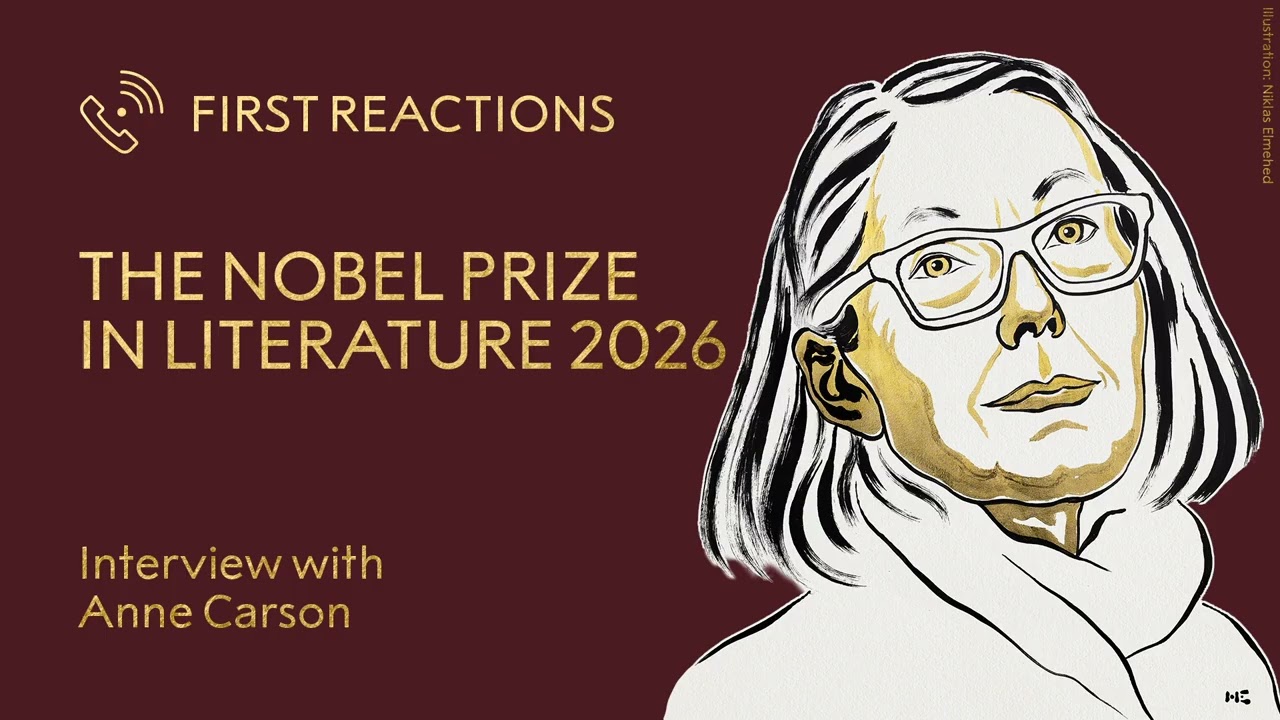
Born in Toronto in 1950, Carson discovered ancient Greek texts in high school and quickly became fascinated with the language.
“[It] seems different than other languages,” Carson told NPR’s Scott Simon in 2016. “It seems, somehow, more original, more like being in the morning of language. And that’s partly because the words are new. Those people are inventing ways of thinking about stuff, but also because we have thousands of years of building the words into other things, using their words to build out our words.”
Carson studied at the University of Toronto, then taught classics at the University of Calgary and McGill University while establishing herself as a writer. As her career blossomed, Carson also held positions at the University of Michigan, Princeton University, Cornell University and New York University.
In 2024, Carson, who rarely shares much about her personal life, revealed that she had been diagnosed with Parkinson’s disease and had taken up boxing to help manage the condition.
“When I try to produce a complicated movement like a one-two-four-five combination in boxing (left jab, right cross, right hook, left uppercut), I can feel the neurons in my brain struggling and striving,” Carson wrote in an essay for the London Review of Books. “Yes, I can feel it.”
Carson and her partner, visual artist Robert Currie, live part-time in Iceland, where they gained citizenship in 2022. “She means a lot to the scene here,” Ragnar Kjartansson, a multidisciplinary Icelandic artist, tells the New York Times’ Alex Marshall. “She’s a force, and everyone’s really happy.”
When Ingrid Carlberg, the Swedish Academy’s secretary, called Carson to deliver the good news, the poet said she was in Iceland “listening to the wind.”
“She was taken by surprise but very happy,” Carlberg said during a livestream of the award announcement.
Later, in a telephone interview with the Nobel Prize’s outreach team, Carson reiterated that winning the award “seems a little insane. I think you’re all insane.”
The Nobel committees are announcing the winners of their six award categories this month, starting with the prize in physiology or medicine on October 5 and ending with the economics prize on October 12. Each award comes with a cash prize of 12 million Swedish kronor (about $1.2 million).
/https://tf-cmsv2-smithsonianmag-media.s3.amazonaws.com/accounts/headshot/SarahKuta.png)