
Belugas Can Recognize Themselves in Mirrors, Joining a Short List of Nonhuman Species That Show Signs of Self-Awareness
The researchers hope that this new understanding of cognition in the toothed whales will increase human empathy and concern for the animals, leading to more efforts to protect them
/https://tf-cmsv2-smithsonianmag-media.s3.amazonaws.com/accounts/headshot/SarahKuta.png)
/https://tf-cmsv2-smithsonianmag-media.s3.amazonaws.com/filer_public/a7/84/a7845c48-ed26-4e29-89c3-3e71ff7bf62b/beluga_whale_1_use_mildener_et_al-2_copy_2_png.png)
Belugas are highly intelligent marine mammals with intricate communication systems and strong social bonds. Now, new research suggests that the toothed whales are also self-aware.
According to a study published May 20 in the journal PLOS One, some belugas appear to recognize themselves in mirrors, a feat that puts them on a small but growing list of nonhuman species capable of self-recognition.
“Belugas demonstrate a high level of self-awareness and a sense of self,” study co-author Diana Reiss, a cognitive psychologist at Hunter College, City University of New York, tells IFLScience’s Rachael Funnell. “This level of consciousness also includes the comprehension that the mirror can be used as a tool to view oneself.”
An estimated 136,000 mature belugas live in Arctic and sub-Arctic waters, including off the coast of Alaska. The International Union for Conservation of Nature considers them a species of least concern, but the charismatic, melon-headed marine mammals face numerous threats, including disturbances from fisheries, shipping, oil and gas exploration and climate change.
For years, scientists thought mirror self-recognition was unique to humans—but that’s no longer the case. Since the 1970s, researchers have shown that chimpanzees, bonobos, orangutans, gorillas, bottlenose dolphins, Asian elephants, Eurasian magpies, cleaner wrasse fish and now belugas can also recognize themselves in mirrors. Broadly speaking, the capability seems to be a hallmark of species that are social and empathetic.
Did you know? What’s in a name
The scientific name for belugas is Delphinapterus leucas. Their genus, Delphinapterus, means “dolphin without a fin.” Instead of a dorsal fin on their back, belugas have a dorsal ridge, which allows them to swim under sheets of floating sea ice with ease—an adaptation that helps them hide from orca predators.
Reiss and her colleagues tested mirror self-recognition among four captive belugas housed at the New York Aquarium of the Wildlife Conservation Society: three adult females named Kathy, Marina and Natasha, plus Natasha’s daughter, Maris, who was 7 at the time. None of the animals had prior experience with mirrors, nor had they participated in cognitive studies, though they had interacted with semi-reflective windows in their pools.
The long, slender whales had access to three interconnected, above-ground concrete pools in an outdoor complex. In one of the pool’s windows, the scientists installed a two-way mirror, which is reflective on one side and see-through on the other. Then, they set up a camera to record the creatures’ interactions with the shiny new object. As a control, they repeated the experiment with a piece of transparent plexiglass installed in the same place.
Two of the whales—Kathy and Marina—spent little time at the mirror. But Natasha and Maris seemed intrigued.
During their first two-hour encounter with their own reflections, Natasha and Maris started by clapping their jaws and jerking their heads upward, social behaviors typically associated with aggression and intimidation. It was as if they thought they were face-to-face with another whale, rather than their own reflection.
Then, they began moving their heads around—nodding them up and down, moving them in semicircles and shaking them horizontally. Researchers describe these as “contingency testing” behaviors, unusual or repetitive movements designed to test whether the whale in the mirror was mimicking them.
During their second session, Natasha and Maris continued approaching the mirror but began exhibiting new behaviors. They looked at themselves, peered inside their own mouths, watched themselves do barrel rolls, and flapped their pectoral fins. They also blew and bit bubbles.

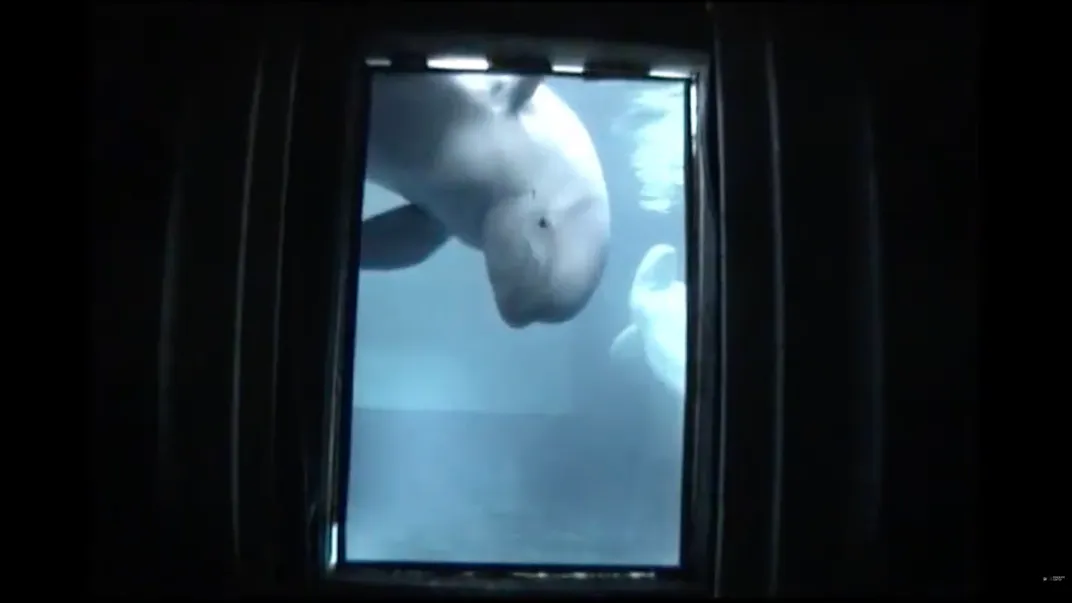
The researchers also drew marks on parts of the creatures’ bodies that the whales couldn’t see unless they looked in the mirror. Maris didn’t use the mirror to find any of her marks. But Natasha swam laps with her marked side facing the mirror and even pressed the mark up against it. To the researchers, these behaviors were enough to give Natasha a passing grade on the “mark test,” providing further evidence of her ability to recognize herself in a mirror.
“We were quite excited to observe how Natasha responded to seeing the temporary visual mark,” Reiss tells IFLScience.
The findings didn’t surprise Masanori Kohda, a biologist at Osaka Metropolitan University in Japan, who has studied mirror self-recognition in cleaner wrasse fish but was not involved with the beluga research.
Kohda suspects that any creature capable of recognizing other individual members of its species can probably also recognize itself in a mirror. “From this perspective, the present report of [mirror self-recognition] in belugas seems quite expected,” Kohda tells National Geographic’s Cara Giaimo. “That said, it is of course still a valuable study.”
The discovery not only adds to scientists’ understanding of beluga cognition but may also help bolster efforts to protect the species. The researchers hope this and other discoveries will increase empathy and concern for cetaceans—the group that includes dolphins, whales and porpoises—leading to strong global protections, per IFLScience.
/https://tf-cmsv2-smithsonianmag-media.s3.amazonaws.com/accounts/headshot/SarahKuta.png)