
Astronomers Detect the Oldest Known Fast Radio Burst, Spewed From an Ancient Galaxy Just Three Billion Years After the Big Bang
The universe formed 13.8 billion years ago, so this far-traveled burst of radio waves can help scientists learn more about the early cosmos. However, researchers still aren’t sure what produces these strange flashes

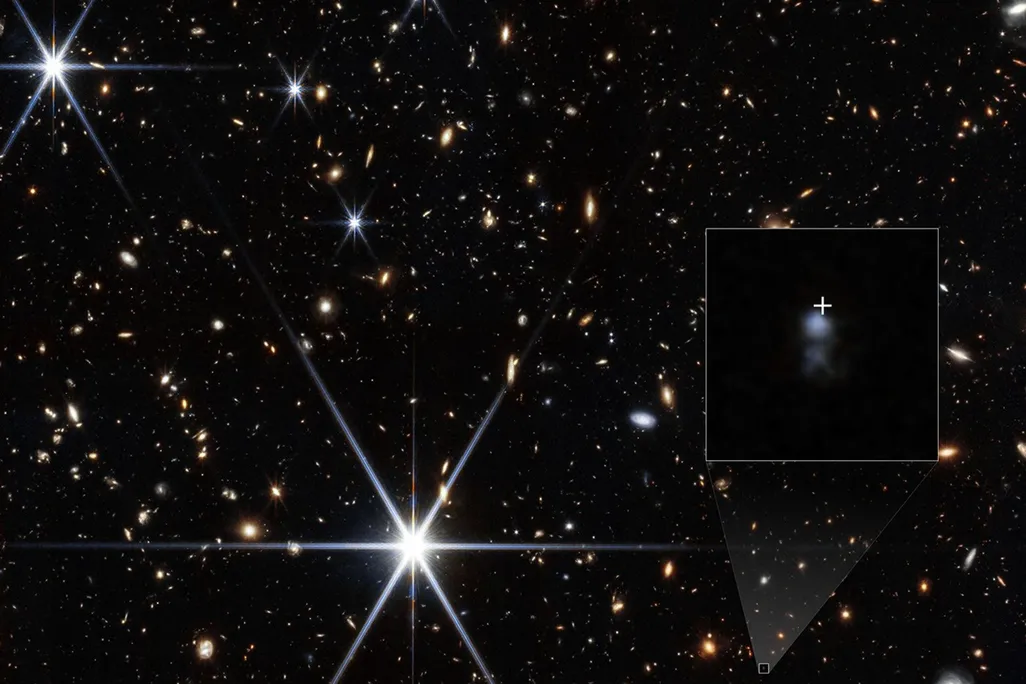
About ten billion years ago, in a faraway galaxy, some astronomical object released a brief but extremely powerful burst of energy into the universe. Now, scientists have detected that flash and figured out where it came from.
The findings, published in the journal Science on October 8, mark the oldest fast radio burst (FRB) ever detected. The mysterious flash was produced during the early universe, so it can help scientists better understand the ancient cosmos.
“If you put this in human perspective, when the light left the source, the sun didn’t exist, the solar system didn’t exist, no humans existed,” says study co-author Manisha Caleb, an astrophysicist at the University of Sydney, to Jacinta Bowler at the Australian Broadcasting Corporation. “Civilization formed and we built radio telescopes, and then we just happened to look at the right patch of sky at the right time.”
Quick fact: Solar system origins
The solar system formed about 4.6 billion years ago. A dense cloud of gas and dust collapsed and formed a swirling disk of material. It continued pulling in more space stuff until immense pressure in the core birthed the sun.
FRBs are short but powerful flashes of radio waves. The first one was discovered in 2007, and thousands of them have been detected ever since. However, scientists still aren’t sure what produces the outbursts. One possibility is that they originate from the merging of two neutron stars, extremely dense remnants of dead giant stars. Another hypothesis is that they’re emitted by magnetars, rare types of young neutron stars with powerful magnetic fields. Researchers previously showed that at least one FRB probably came from a magnetar, but that doesn’t mean all of them are made by these strange stellar leftovers.
Detecting and measuring FRBs, as well as the galaxies they came from, can help solve this puzzle, says study co-author Themiya Nanayakkara, an astrophysicist at the University of Sydney, to Scientific American’s Adam Kovac. The MeerKAT radio telescope array in South Africa detected the newly described flash of radio waves, dubbed FRB 20240304B, in March 2024. The different frequencies of energy within the burst—like the rainbow produced when white light passes through a prism—arrived at different times, suggesting that the FRB traveled through a lot of plasma in outer space before reaching Earth. (The greater the dispersion of frequencies, the longer the distance traveled.)
Then, the researchers used NASA’s James Webb Space Telescope (JWST) to pinpoint the FRB’s origins. Analyses revealed that it came from a primitive galaxy that formed roughly three billion years after the Big Bang, which happened 13.8 billion years ago.
“We thought it would be a big, nicely formed galaxy with lots of stars, and instead it was a little dwarf galaxy, although it was actively forming stars,” Caleb says in a statement. It also had a low amount of metal. That’s consistent with the idea that FRBs originate from magnetars, Nanayakkara and Caleb write for the Conversation, hinting that FRB 20240304B came from one.
While the findings don’t definitively solve the mystery of what exactly produces FRBs, they’re useful in other ways. Scientists can use the flashes to learn more about the distant universe, based on how they were affected by the material they passed through during their journeys to Earth.
“Our discovery is particularly important because we have shown that we can do this across approximately 80 percent of cosmic history,” Nanayakkara explains to Scientific American. “The further back we push FRB detections, the further we can map this otherwise unseen matter.”
Matthew Bailes, an astrophysicist at Swinburne University of Technology in Australia who wasn’t involved in the research, tells Donna Lu at the Guardian that the new study is “a validation of how powerful the FRBs are for probing the universe.”
The next step, according to the study authors, is to find more of them. They estimate that the MeerKAT telescope can detect several ancient FRBs each year, per the statement. The team has also secured time to use the JWST to identify the sources of other old FRBs.
“The more distant FRBs we find, the stronger the constraints we can place on the objects and emission mechanisms that produce them, the environments in which they occur and the distribution of matter across the universe,” Nanayakkara tells Scientific American.
