
Astronomers Accidentally Find a Rare Triple-Star System That They Say Shouldn’t Exist. It’s Located Just 28 Light-Years From Earth
The system, called Welopō’ai, includes a red dwarf and two white dwarfs. One of the white dwarfs—a dense stellar leftover—is extremely close to the reddish-orange star, and scientists say the progenitor star that died should have engulfed the red dwarf

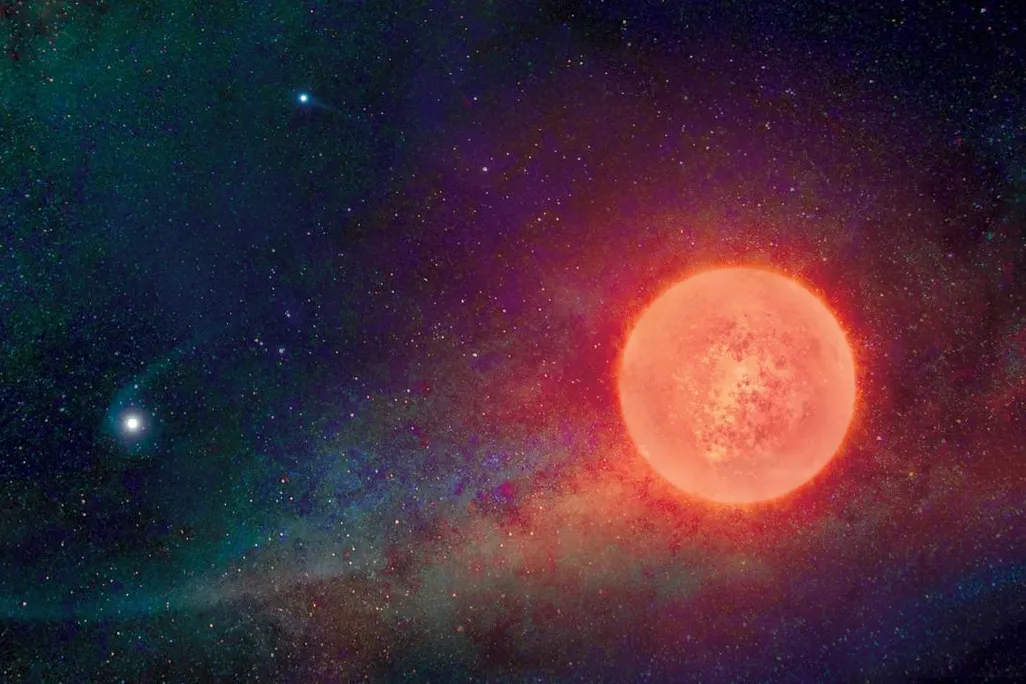
Astronomers searching for exoplanets—worlds beyond our solar system—accidentally uncovered something much stranger. The team stumbled upon an odd triple-star system located merely 28 light-years from Earth. The findings, described November 19 in the journal Astronomy & Astrophysics, challenge scientists’ understanding of how stellar systems work, since this weird one shouldn’t be possible based on our current knowledge.
“It’s a freak thing. It was an annoying object,” lead author Étienne Artigau, an astrophysicist at the University of Montreal in Canada, tells CBC News’ Nicole Mortillaro. “It’s not what we were looking for.”
Artigau and colleagues had been hunting for faraway planets with a special instrument on the Canada-France-Hawaii Telescope on Mauna Kea, a volcano on Hawaii’s Big Island. It helps researchers identify distant worlds by measuring minuscule changes in a star’s velocity, which can be caused by orbiting planets. But when the instrument turned toward a neighboring red dwarf, a small, cool, orange-ish type of star, the scientists found that its velocity variations were much greater than expected—more than 1,000-fold.
“Typically, we measure fluctuations in a star’s velocity of just a few meters per second. In this case, however, we detected a shift of nearly 16 kilometers per second,” study co-author Atanas Stefanov, an astrophysicist at the University of Geneva in Switzerland, says in a statement. “That was when we realized that what we had encountered was not an ordinary planet, but a much more massive companion.”
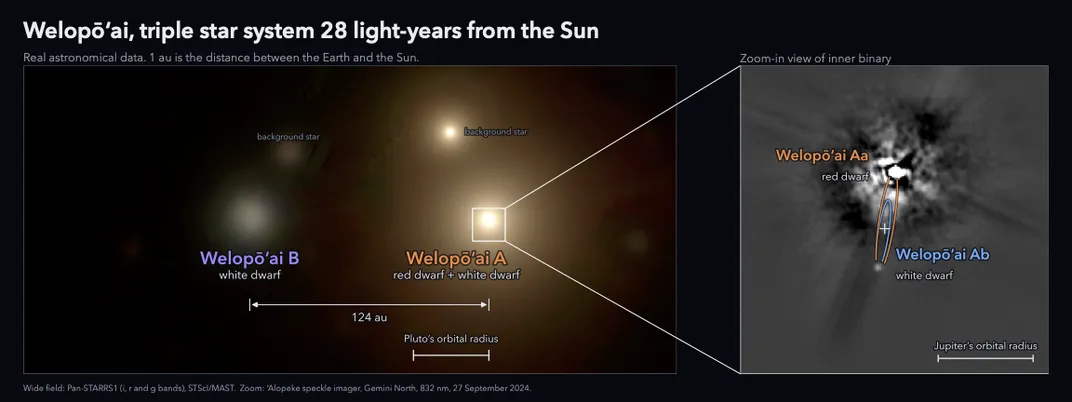
Analyses suggested the mysterious satellite must contain more than half the mass of our sun. This high mass and low brightness pointed toward a dead star. So, the researchers conducted follow-up observations in 2023 and 2024 using an instrument on the Gemini North telescope on Mauna Kea. That allowed them to directly detect the culprit behind the dramatic velocity variations: a white dwarf. It’s a dense stellar core left behind by a deceased low- to medium-mass star, like the sun.
This newly discovered white dwarf is quite close to the red dwarf, orbiting at a maximum distance of about 4.6 times the space between the sun and Earth. However, researchers already knew the central star hosted a much more distant white dwarf, and the team estimates it circles the inner pair at about 124 times the distance between our star and our planet. The previously known white dwarf appears to loop around the star duo, while the newly discovered one and the red dwarf orbit close to each other in a binary system.
While astronomers have spotted white dwarf pairs before, Keith Cooper reports for Space.com, a triple system with two white dwarfs and a regular star is exceptionally rare. In fact, this system, dubbed Welopōʻai, is the only one of its kind known in the sun’s neighborhood, according to a separate statement. Astronomers haven’t discovered anything similar within 100 light-years of our planet.
Fun fact: Name meaning
Welopōʻai combines the Hawaiian words welo, meaning an inherited or family trait, and pō‘ai, an orbit or circular path. Together, the name translates to a “path of family traits.”
Welopōʻai is even more mysterious because, according to astrophysicists’ current understanding, it is an impossible stellar system. The star that became the newly discovered white dwarf was originally about 1.4 times as massive as our sun. As it neared the end of its life, it should have ballooned to several hundred times its initial size. Researchers would have expected the enlarging star to engulf the nearby red dwarf and possibly even merge with it.
But surprisingly, that didn’t happen in Welopōʻai. The red dwarf seems to be alive and well, following a wide, stable orbit.


“This system should not exist,” study co-author Patrick Dufour, an astrophysicist at the University of Montreal, says in the second statement. “We have no clean explanation for how it got here. That is the question driving our next observations.”
Even the faraway white dwarf may have once been less of a third wheel, Paul Delaney, an astrophysicist who retired from York University in Canada and wasn’t involved in the study, tells CBC News.
“I would bet that they were relatively proximate to each other and then they did engage in a bit of gravitational embracing, and the farther white dwarf today was much, much closer in its heyday.”
