
Arizona’s Otherworldly ‘Wonderland of Rocks’ Is Now America’s Newest National Park
Chiricahua National Monument in southeastern Arizona is now Chiricahua National Park, the 64th national park in the United States. Its striking geologic landscape and biodiversity have drawn humans for thousands of years

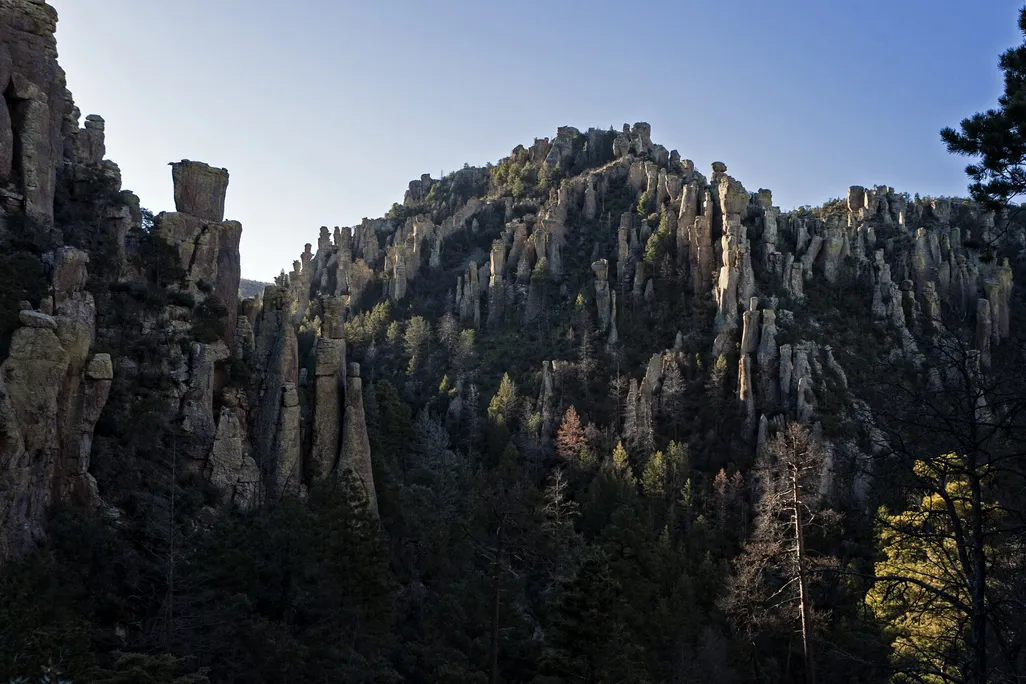
America’s newest national park protects thousands of years of human history, nearly 200 species of birds and towering stone spires formed by an ancient volcanic eruption.
Chiricahua National Monument in southeastern Arizona is now Chiricahua National Park, bringing the total number of national parks in the United States to 64. Nicknamed the “Wonderland of Rocks,” the site has been a national monument since 1924 but was officially redesignated as a national park this week.
Chiricahua—pronounced “cheery-cow-uh”—is the country’s first new national park in six years, following the establishment of West Virginia’s New River Gorge National Park and Preserve in 2020.
The 12,000-acre park protects part of the Chiricahua Mountains, one of several “sky islands,” or isolated mountain ranges that rise up from the surrounding deserts of southeastern Arizona and northern Mexico. Located about 120 miles from Tucson, it sits at the intersection of four major ecosystems: the Rocky Mountains, Sierra Madre, Sonoran Desert and Chihuahuan Desert.
In a statement, Secretary of the Interior Doug Burgum described Chiricahua as “one of America’s most extraordinary landscapes.” Designating it a national park, he added, will “shine a national spotlight on one of Arizona’s hidden gems, creating opportunities to welcome more visitors, strengthen local economies and share this incredible landscape with more Americans.”
In 2025, Chiricahua National Monument welcomed 70,406 visitors, ranking 254th out of 399 National Park Service sites. Business owners, outdoor groups, politicians and others hope that number will increase following its national park designation, Henry Brean reports for the Arizona Daily Star.
Chiricahua’s unique geology is a big part of the appeal for visitors. About 27 million years ago, a massive volcanic eruption blanketed the region in ash and debris. Over time, that material hardened into a rock layer called rhyolitic tuff. Millions of years of wind, rain, freezing temperatures and other natural forces gradually wore it away, carving the landscape into a maze of towering stone spires, balanced boulders and narrow passageways.
“It has spectacular vistas,” Emily Burns, program director for the Sky Island Alliance, a regional conservation nonprofit, tells USA Today’s Ignacio Calderón and Janet Loehrke. “It has a beautiful canyon and then these rock formations that are a little mind-boggling to understand how they formed over geologic history.”
Visitors can explore the otherworldly landscape via the park’s 17 miles of hiking trails. As Sylvia Dekker writes for Outside magazine, trekking through the national park feels like “being dwarfed by a sea of massive navigation cairns and those knobby towers of dribbled sand children make at the beach.”
Scenic drives, stargazing, horseback riding and camping are also popular ways to experience the park. Surrounded by the 1.78-million-acre Coronado National Forest, it’s also a haven for wildlife, giving animal lovers the chance to spot everything from Coues deer and javelina to black bears, mountain lions, coatimundi, skunks and 16 species of bats.
Birdwatchers also flock here to see the migratory species that pass through on their way to and from Mexico and Central and South America, as well as the many resident species that live in the area year-round. Around 200 bird species have been documented in the park.
Human history in the Chiricahua region stretches back at least 12,000 years, when paleoindians hunted big game in the area. Later, hunter-gatherers took advantage of its diverse plants and wildlife before some communities turned to agriculture.
The Chiricahua Apache lived across a vast territory spanning present-day southeastern Arizona, southwestern New Mexico and northern Mexico. Conflict with the U.S. government eventually culminated in the Apache’s forced removal in the late 19th century. The area was also home to Buffalo Soldiers, homesteaders, immigrants and Civilian Conservation Corps laborers.
Today, the park offers visitors a chance to experience this landscape much as generations before them have. One of the biggest perks of visiting Chiricahua is the ability to “immerse yourself in a place that seems relatively unchanged over the millennia,” Matthew Nelson, executive director of the nonprofit Arizona Trail Association, tells USA Today.
“[It’s] just such a break from modern day technology and the pace of our lives,” Nelson adds. “Being in the rocks in Chiricahua encourages people to just slow down and to listen to the wind and to study the rock features and to be reminded of the beauty that exists in nature.”
