
Archaeologists Found a 3,300-Year-Old Sword at the Bottom of a Volcanic Lake in Italy—and It’s Still Sharp
The remarkably well-preserved 13th century B.C.E. weapon was found submerged in Lake Mezzano, once home to a Bronze Age village on stilts

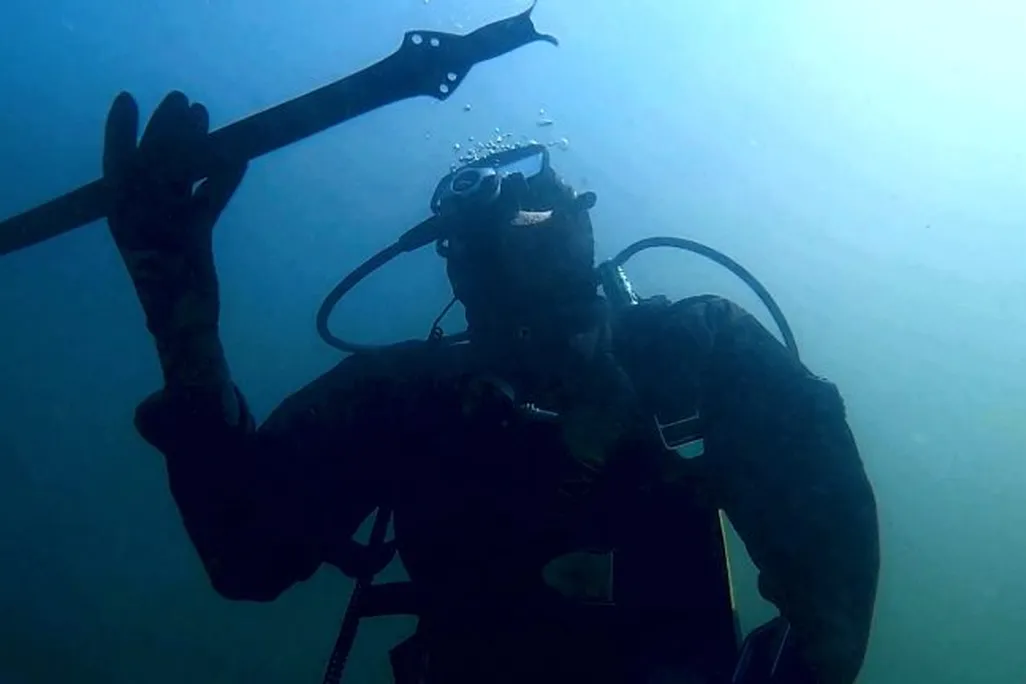
Archaeologists have pulled a 3,300-year-old sword from a lake in Italy—and it’s still sharp.
The bronze weapon was discovered at the bottom of Lake Mezzano, a small volcanic lake in central Italy, roughly 60 miles northwest of Rome.
It’s the third sword discovered in the lake since the 1970s, according to an announcement from Italy’s Superintendence of Archaeology, Fine Arts and Landscape for the Province of Viterbo and Southern Etruria.


Archaeologists think that between 1700 and 1150 B.C.E. the lake was home to a Bronze Age pile-dwelling village, a community lofted above the water on stilts.
The sword is thought to date to the 13th century B.C.E., which corresponds with the Late Bronze Age. At that time, the people living in central Italy maintained trade and connections with communities throughout the peninsula and across the Mediterranean. In that context, the researchers say, weapons were more than just combat tools—they were also symbols of prestige, identity and power.
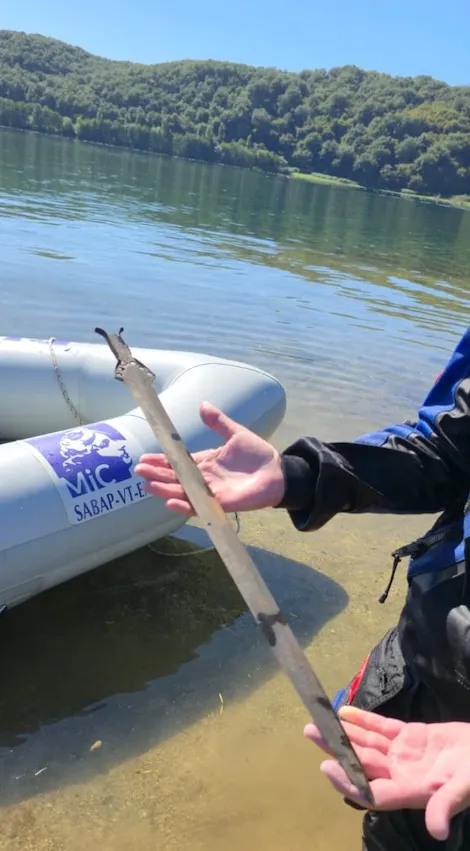
Archaeologists found the sword while excavating a largely unexplored area on the lake’s southern shore. During the same expedition, they found intact vases and numerous bronze artifacts, including axes, arrowheads, daggers, spearheads, pins and a razor. They found the sword and the razor lying near each other, which suggests they may have once belonged to the same person, possibly a high-status individual or an elite warrior.
Similar discoveries across Europe suggest that ancient people sometimes deliberately deposited weapons and other metal objects in lakes, possibly as part of religious rituals or offerings. According to Live Science’s Kristina Killgrove, the sword may have been tossed in the lake as an offering to a god.
Geologist Lamberto Ferri Ricchi first discovered the now-submerged village in 1971, when he found the remains of three prehistoric pile-dwellings submerged between nine and 30 feet deep. He returned several years later at the request of regional archaeology officials and uncovered roughly 50 vases, three bronze axes, skeletal remains, wooden planks, millstones and other artifacts.
Excavations continued into the mid-1990s, then came to a halt for nearly three decades until funding became available again. Last year, archaeologists returned to the site and mapped more than 600 wooden posts they believe once held up the Bronze Age settlement. The posts were embedded into the clay lakebed at various depths, ranging from eight feet to more than 32 feet deep. Researchers suspect the newly discovered posts represent roughly a third of the entire settlement.
Did you know? Weapons in water
Across Europe, similar discoveries have been made in bodies of water, including a 1,000-year-old Viking sword in an English river, an Iron Age sword in a Swedish lake and rust-covered medieval sword in Poland’s Vistula River.
During the 2025 expedition, they also recovered numerous artifacts, including axes, spearheads, brooches, rings, a pin and a sickle. They also found bronze ingots that may have been used in casting, suggesting that residents were producing metal objects within the village.
Researchers are still trying to interpret the findings of their latest expedition. In the meantime, they say they plan to display the newly discovered artifacts during an upcoming exhibition, per the statement. They also hope to continue their research in Lake Mezzano to gain an even deeper understanding of the people who once lived there.
