
An Endangered Kemp’s Ridley Sea Turtle Named Pancake Makes a Triumphant Return to the Ocean After Months of Rehabilitation
The cold-stunned turtle was rescued last fall on Cape Cod and has since made a full recovery. The reptile, whose sex remains unknown, is estimated to be between 2 and 5 years old and weighed 11 pounds at the time of release
/https://tf-cmsv2-smithsonianmag-media.s3.amazonaws.com/accounts/headshot/SarahKuta.png)
/https://tf-cmsv2-smithsonianmag-media.s3.amazonaws.com/filer_public/0b/4c/0b4c5c07-6f4e-41b1-9e45-40d5b79cac11/pancake_release_-_credit_mary_dixon_wcs_2.jpeg)
Last fall, a weak and inactive Kemp’s ridley sea turtle was found on a beach in Massachusetts, a victim of “cold-stunning” caused by frigid water. After months of rehabilitation, the juvenile turtle—affectionately nicknamed Pancake—has now made its triumphant return to the Atlantic Ocean.
On the afternoon of July 23, as crowds of adoring fans chanted its name, the endangered creature was released into the water outside the Wildlife Conservation Society’s New York Aquarium in Coney Island.

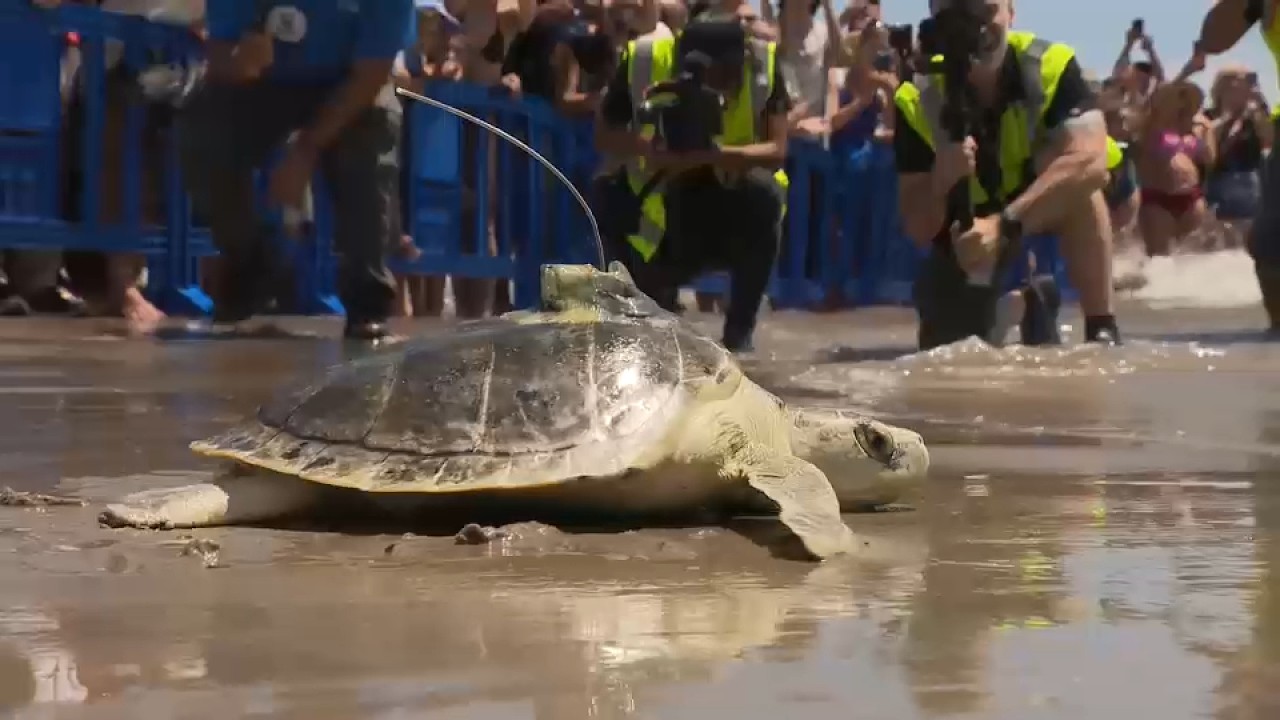
Pancake, estimated to be between 2 and 5 years old, was found on November 22, 2025, at Duck Harbor Beach in Wellfleet, a town on Cape Cod. The animal was initially taken to the New England Aquarium for emergency care before being transferred to the Atlantic Marine Conservation Society’s Sea Turtle Care Facility in Westhampton Beach.
The turtle, whose sex remains unknown because it requires a blood test, regained its strength by feasting on shrimp and clams. By the time Pancake was released, it weighed 11 pounds and was demonstrating “strong swimming behavior while actively pursuing food,” according to a statement from the Wildlife Conservation Society.
/https://tf-cmsv2-smithsonianmag-media.s3.amazonaws.com/filer_public/e0/1d/e01d278f-203b-4752-bc02-c68360ae9e28/bj_siasoco_0346_kemps_ridley_sea_turtle_release_pancake_20260723.jpg)
“We have to monitor their behavior and get them up to what we consider operating speed, where they’re eating, feeding on their own,” Rob DiGiovanni, a marine biologist with the Atlantic Marine Conservation Society, tells WABC-TV’s N.J. Burkett. “And Pancake was looking really well. And then time for us to go back out into the wild so they could do really well out there.”
Before they released Pancake, experts attached a satellite transmitter to the top of its shell. The device will function for up to 90 days, sharing Pancake’s location in real time.
/https://tf-cmsv2-smithsonianmag-media.s3.amazonaws.com/filer_public/0b/5b/0b5bedd1-d83b-4d22-a2d0-eb4d1c4071ac/amseas_pancake_dscf1730.jpg)
Aaron Gouveia, a spokesperson for the Massachusetts Audubon Society, the organization that rescued Pancake last fall, was thrilled to hear the creature had made a full recovery and could return to the wild.
“This is the great part about what we do when we find these turtles on the beaches of Cape Cod,” Gouveia tells MassLive’s Liesel Nygard. “It’s what we do this for, and it’s just fantastic.”
/https://tf-cmsv2-smithsonianmag-media.s3.amazonaws.com/filer_public/ed/0b/ed0bf598-7946-4b9a-bdc0-03fce0f62767/amseas_pancake_img_8929.jpg)
It’s not uncommon for cold-stunned sea turtles to be found on beaches in Cape Cod in the fall. Several species of sea turtles spend the spring and summer feeding in the rich coastal waters of New York and New England. Come autumn, when the weather starts to get colder, they instinctively head south toward warmer waters. But some reptiles end up getting stuck in Cape Cod Bay, prevented from continuing their migration by the long, curving arm of the Cape Cod peninsula.
Since sea turtles are cold-blooded, or ectothermic, they use external sources to regulate their body temperature. As the water around them cools, their body temperature also plummets—to the point that they become lethargic and unable to swim. Some, like Pancake, are washed ashore and rescued. But others are not so lucky and die at sea.
Kemp’s ridley turtles are the smallest species of sea turtles in the world. Adults weigh between 85 and 100 pounds, and their shells reach lengths of about two to two and a half feet.
Decades ago, tens of thousands of adult Kemp’s ridley turtles nested along the Gulf of Mexico. But the population declined dramatically between the late 1940s and the mid-’80s because of egg overharvesting, the killing of adults and juveniles for meat and other products, and accidental entanglement in commercial and recreational fishing gear. By 1985, fewer than 250 nesting females remained.
Did you know? More good news for sea turtles
In addition to Pancake, five other Kemp’s ridley sea turtles—all named after fonts—also returned to the ocean last week. Times New Roman, Papyrus, Gigi, Walter Turncoat and Punk Kid were tagged and released after seven months of rehabilitation at the New England Aquarium’s Sea Turtle Hospital in Quincy, Massachusetts.
Thanks to concerted conservation efforts, the species has slowly rebounded in recent decades. Today, an estimated 7,000 to 9,000 nesting females live in the Gulf of Mexico. But the species remains endangered in the U.S. and is categorized as critically endangered by the International Union for Conservation of Nature. That’s a big reason why Pancake’s release was such a cause for celebration, Maia Austin, a marine biologist with the Wildlife Conservation Society, tells Popular Science’s Laura Baisas.
“They have been a really big conservation success story, in that they had a really big population crash in the ’70s, and through a lot of great international conservation efforts, it’s really rebounding,” she says. “So, I think every individual that we can help is a great success for all of us.”
/https://tf-cmsv2-smithsonianmag-media.s3.amazonaws.com/accounts/headshot/SarahKuta.png)