
African Elephants Shape the Savanna Ecosystem—and Continue Doing So Long After They’ve Died, Study Suggests
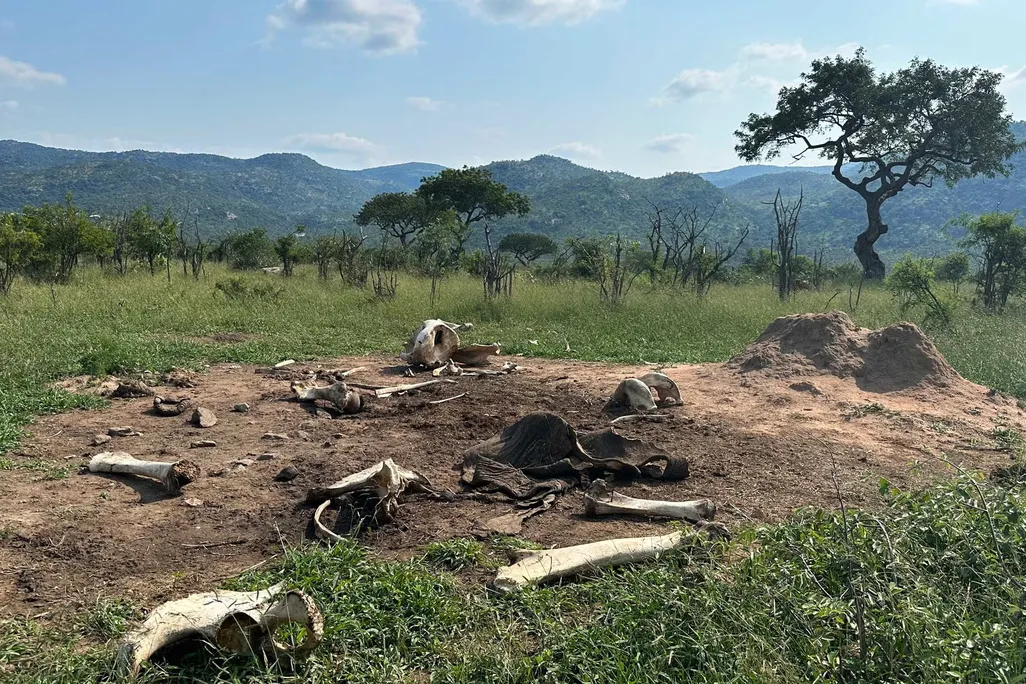
At first, plants below an elephant carcass die. Soil microbes and plants grow back soon after, but only a few select species. Herbivores later come in to munch on the nutrient-rich greens

African savanna elephants are considered ecosystem engineers. For up to roughly 70 years, each massive animal rips through trees and brush, digs wells in the ground and spreads seeds in its poop.
But even after their lives have ended, the hulking pachyderms continue making contributions to the environment, according to a study published October 12 in the journal Proceedings of the National Academy of Sciences. Scientists found a surprising chronology of events—involving microbes, plants and animals—near elephant remains that persists for at least eight years. The work highlights a relatively new line of research into how mega-carcasses affect the land.
“We are really only fairly recently starting to get a handle on how large animals shape their ecosystems altogether, even in life,” Amanda Subalusky, an ecologist at the University of Florida who did not participate in the study, tells the Washington Post’s Meghan Bartels. “We are just beginning to scratch the surface on the role that their carcasses play.”
When an elephant named Alexander at Kruger National Park in South Africa died in 2009, study co-author Dave Thompson, a biodiversity scientist at the South African Environmental Observation Network, and a colleague started wondering how the carcass might affect the soil and food web, according to a statement.
That curiosity turned into a larger effort to investigate soil chemistry, microbiology, biodiversity and herbivores feeding near 40 elephant carcasses in the park between 2023 and 2025. The animals had died between eight days and almost eight years before sample collection.
Analyses revealed that initially, the large animal’s body kills off all biomass directly beneath it. Scavengers also swoop in to feast on the carcass, clearing the surrounding area. The remains leak nutrients into the ground, drastically boosting their levels. “At really fresh carcass sites, soil nitrogen concentrations can be up to 3,000 times higher” than locations without a carcass, says lead author Courtney Reed, an ecologist at Princeton University, in the statement. “That’s just insane.”
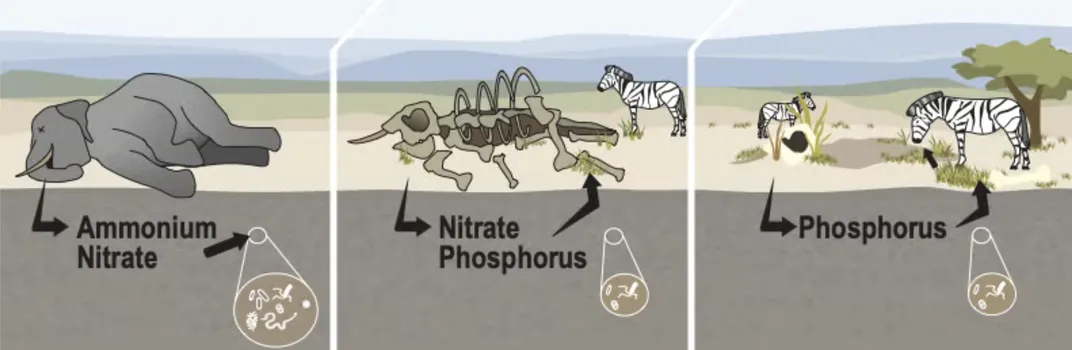
The flood of nutrients isn’t a good thing for plants. The sheer amount is toxic and stops their growth. On the other hand, microbial activity in the soil increases, though only in a small number of species.
Once the nutrient concentrations eventually go down, plants behave similarly to the microbes, with just some fast-growing species taking over the hyperlocal environment for at least around eight years. These greens are particularly nutritious and attract grazing animals, which keep coming back to the site and fertilizing the land with their poop.
“You have herbivores like zebra and buffalo and rhinos who are all coming in, and they’re selectively chewing on these nitrogen-rich grasses,” says Reed, who conducted the research while at the University of California, Santa Barbara, to Dave Seglins on the CBC’s “As It Happens.” “So, you actually get this burst of herbivore activity that continues for years after the elephants died.”
Did you know? African elephant species
There are two species of African elephants. Savanna elephants are larger and have outward-curving tusks, while forest elephants are darker and have straighter, downward-pointing tusks.
The phenomenon somewhat resembles what happens when a whale dies. Its body sinks to the bottom of the ocean—a process called whale fall—and can fuel a jump in biodiversity and activity from all the organisms it attracts. It provides a plethora of nutrients in the deep ocean, where they’re scarce. But an elephant body delivers such a high concentration of nutrients in a fertile location that it instead causes a years-long biodiversity cold spot for microbes and vegetation.
Interestingly, the savannas might be especially prone to a strong, long-lasting ecological cascade. A mega-carcass might have a weaker impact in a more dynamic ecosystem, like a forest or wetland with lots of rain, or in a desert where droughts limit microbial and plant activity. The team hopes to test these ideas in sub-Saharan Africa, and they’ll continue monitoring the carcass sites in Kruger National Park to see how the land keeps changing.
“There are hidden processes occurring underground all across our landscapes,” says Philip Barton, an ecologist at Deakin University in Australia, who wasn’t involved in the study, to the Washington Post. “And they are critical to driving ecosystem structure and function.”
