
African Elephants Often Produce Choruses of Low-Pitched Rumbles. Now, Scientists Are Using A.I. to Decode the Joint Vocalizations
New research suggests the animals’ overlapping calls serve as coordinated group messages and may contain additional information beyond what’s encoded in individual rumbles
/https://tf-cmsv2-smithsonianmag-media.s3.amazonaws.com/accounts/headshot/SarahKuta.png)
/https://tf-cmsv2-smithsonianmag-media.s3.amazonaws.com/filer_public/ae/3a/ae3af91c-fb5c-41e0-bfdf-126654446828/african_bush_elephants_loxodonta_africana_female_with_six-week-old_baby.jpg)
Elephants communicate in a variety of different ways, from body language and gestures to their iconic trumpeting sounds. These massive creatures also emit low-pitched rumbles—some below the range of human hearing—which can travel long distances through the air and the ground. The rumbling often occurs together in choruses.
Now, a study published October 1 in the journal Scientific Reports suggests that these joint vocalizations aren’t simply a jumble of elephants calling at the same time. Instead, they appear to serve as coordinated group messages and may contain additional information beyond what’s encoded in individual rumbles.
In the study, scientists used a form of artificial intelligence called machine learning to analyze 902 recordings of rumbles made by wild African savanna elephant family groups in Amboseli National Park, Kenya. The audio, which included single and chorused rumbles, was collected between 1986 and 2022.
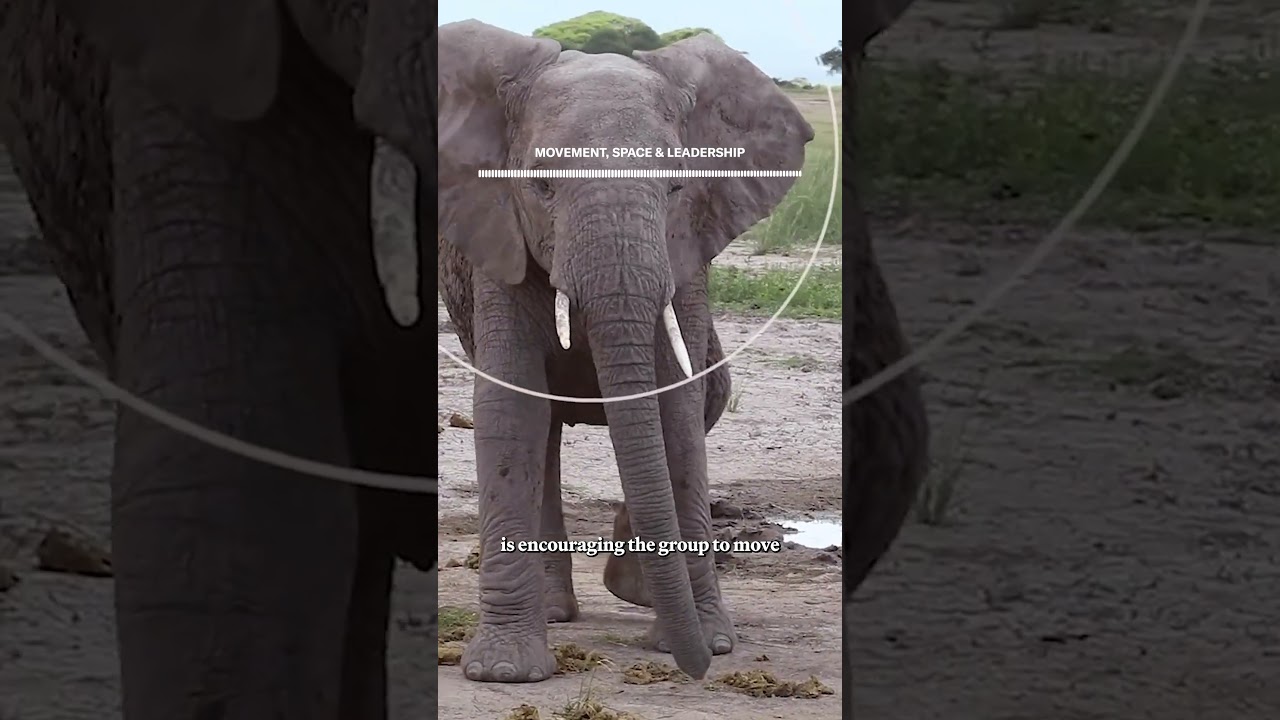
The calls were made during six specific social contexts: “coo” rumbles from females to calves; “contact” rumbles between separated individuals; “let’s-go” rumbles to facilitate group movements; “cadenced” rumbles while eating, resting or moving slowly; “little-greeting” rumbles between closely bonded individuals; and “greeting” rumbles during reunions.

_female_with_six-week-old_baby.jpg)
The algorithm predicted the elephants’ activities based on their rumbles better than chance, but it still made plenty of mistakes. Even so, “it is pretty exciting that we’re able to train a model to look at an entire chorus and have some interpretation of exactly what’s going on,” study co-author Sara Keen, a behavioral ecologist at the Earth Species Project, a nonprofit that aims to use A.I. to decode animal communication, tells Scientific American’s Jackie Flynn Mogensen.
Overall, the study’s findings suggest that, like individual rumbles, choruses contain information about who is calling and what they’re doing. In some instances, choruses may provide “an additional layer of more fine-grained information” that can’t be gleaned from individual rumbles alone, the scientists write in the paper.
For example, the analyses revealed that individual rumbles within choruses became more acoustically similar in certain situations. This phenomenon, known as “vocal convergence,” is like “what humans do in conversation, where you almost start to adopt the speaking patterns or accents of whoever you’re interacting with,” Keen tells New Scientist’s Christa Lesté-Lasserre.
Vocal convergence occurred only during the cadenced, contact and greeting rumbles, so the researchers think it might play some role in helping elephant families coordinate group behaviors. However, they say more research is needed to test this idea.
Did you know? Say my name
Research suggests African savanna elephants might also call one another by name.
Andrew McLean, an independent animal behavior researcher and member of the International Union for Conservation of Nature’s Asian Elephant Specialist Group, tells New Scientist the findings are “fascinating” but “not really surprising, given how intensely social elephants are.”
African savanna elephants aren’t the only animals whose sounds researchers are studying with the help of A.I. algorithms, which can find patterns and process vast amounts of information much faster than humans can. Scientists have also used these types of tools to identify mosquitoes’ species, sex and feeding status based on their noises; discover the sperm whale phonetic alphabet; learn that marmoset monkeys call one other by name; and decode the vocalizations of crows.
“If it’s used responsibly, A.I. can transform what we can do with the data we collect,” Stephanie King, a behavioral biologist at the University of Bristol in England, tells the Guardian’s Amy Martin.
/https://tf-cmsv2-smithsonianmag-media.s3.amazonaws.com/accounts/headshot/SarahKuta.png)