
A Small Rodent Hero Left a Giant Legacy. Now, Cambodia Honors This Famous Bomb-Sniffing Rat With a Seven-Foot Statue
Magawa the African giant pouched rat cleared more 1.5 million square feet of land mines during his five-year career, making him one of the most successful bomb-sniffing rodents in the country’s history
/https://tf-cmsv2-smithsonianmag-media.s3.amazonaws.com/accounts/headshot/MicheleDebczak.png)
/https://tf-cmsv2-smithsonianmag-media.s3.amazonaws.com/filer_public/c9/c9/c9c98318-c5c7-4488-9fc8-1504e7708478/rat.jpg)
Cambodia recently honored an unlikely hero: an African giant pouched rat named Magawa. The rodent sniffed out more than 100 undetonated explosives across the country during his lifetime, and on April 3, officials commemorated his service by unveiling a seven-foot statue in his likeness.
Giant pouched rats have an excellent sense of smell, but few have put their abilities to use on the same scale as Magawa. As Claire Keenan reports for BBC News, the rat was trained by APOPO, a Belgian organization that teaches animals to sniff land mines and diseases like tuberculosis and sent him to work in Cambodia in 2016 when he was about two years old.
His job involved identifying chemicals in unexploded ordnances and alerting his handlers to their location. Because of his light weight, Magawa could safely walk over areas that were potentially dangerous for humans. He was also fast, capable of searching an area roughly the size of a tennis court in just 20 minutes. When Magawa smelled a mine, he would scratch at the surface and receive a reward, often a peanut or banana slice.
Did you know? Other animal heroes
In addition to rats, people also train dogs to help sniff out land mines in active and former conflict zones. For example, canine bomb detectives are at work in Ukraine.
A series of conflicts starting with the Vietnam War in the 1960s and spanning several decades left Cambodia littered with millions of land mines. Today the Southeast Asian nation has the highest rate of mine amputees per capita, with more than 40,000 people losing limbs to the bombs, according to APOPO.
Ridding the country of explosives has been a massive, international project. Earlier this year, Cambodian Prime Minister Hun Manet announced that more than 1,300 square miles of explosive remnants of war had been cleared since 1992. Trained, bomb-sniffing animals like Magawa have been instrumental in that effort. Over his five-year career, Magawa cleared more than 1.5 million square feet of land mines and other explosives, making him one of the most successful bomb-sniffing rats in APOPO’s history.
“His contribution allows communities in Cambodia to live, work, and play; without fear of losing life or limb,” APOPO said in a statement announcing the rat’s death in 2022.
/https://tf-cmsv2-smithsonianmag-media.s3.amazonaws.com/filer_public/b8/1a/b81ae014-7960-4f82-a4b2-aa1987feb45c/gettyimages-2268999771.jpg)
In 2020, he became the first rat to receive a gold medal for bravery from the People's Dispensary for Sick Animals (PDSA). Magawa retired for age-related reasons in 2021 before dying about a year later at age 8. In his later years, Magawa helped train other rats to detect ordnance in teaching by example.

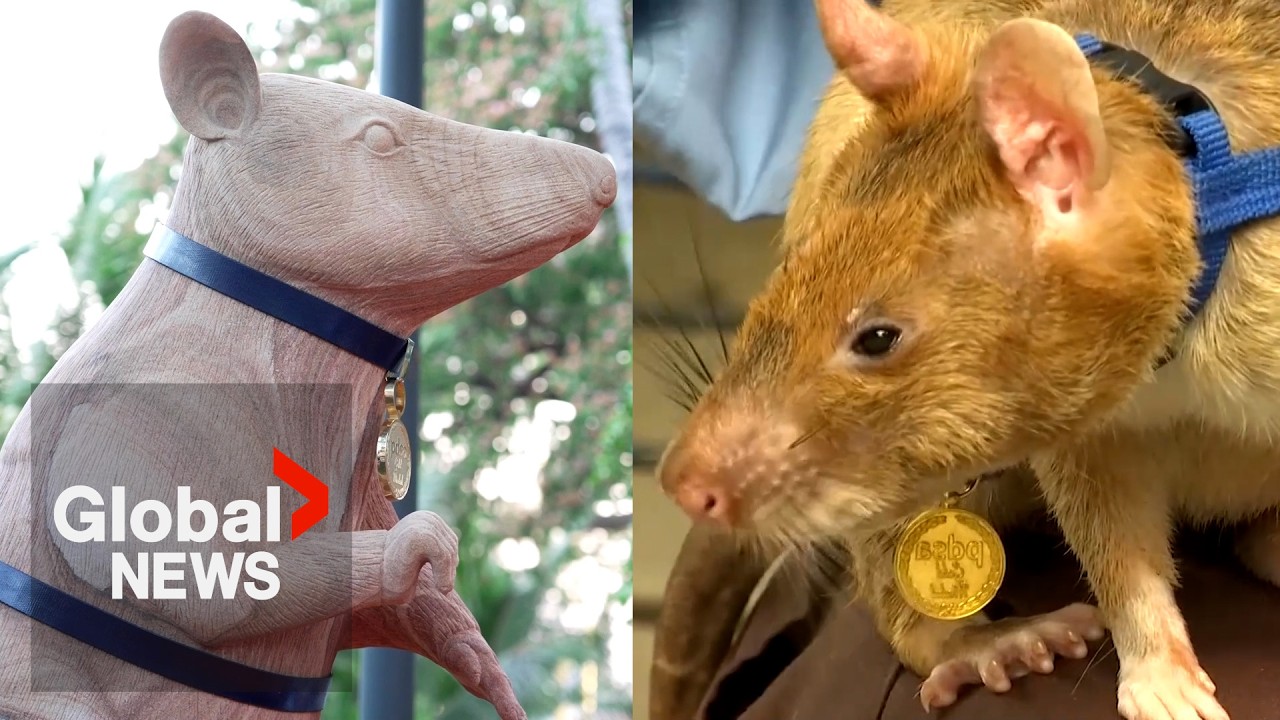
Though he’s no longer around to contribute his bomb-sniffing talents, his legacy lives on with the new monument in Siem Reap. Carved from stone by Cambodian artists, the statue depicts Magawa standing upright and wearing his gold medal. The unveiling ceremony was held ahead of the International Day for Mine Awareness on April 4, with government officials and survivors of land mine explosions in attendance.
“Magawa was one of the best rats we’ve ever had,” APOPO program manager Michael Raine tells Sydney Page of the Washington Post. “He was curious, very composed and quick at work. He knew his job.”
The work of Magawa dedicated his life to isn’t over: Raine says that Cambodia aims to be completely land mine-free by 2030. Already, a new rat is following in his tiny footsteps; Ronin set a Guiness world record in 2025 for the most land mines detected by a rat in a lifetime.
/https://tf-cmsv2-smithsonianmag-media.s3.amazonaws.com/accounts/headshot/MicheleDebczak.png)