
A Rare Surviving Letter From Martha Washington Sheds Light on Her Young Daughter’s Struggle With Epilepsy
Recently obtained by the Library of Congress, the 1760 letter offers positive news about the health of four-year-old Martha Parke Custis, known as Patsy, the stepdaughter of George Washington

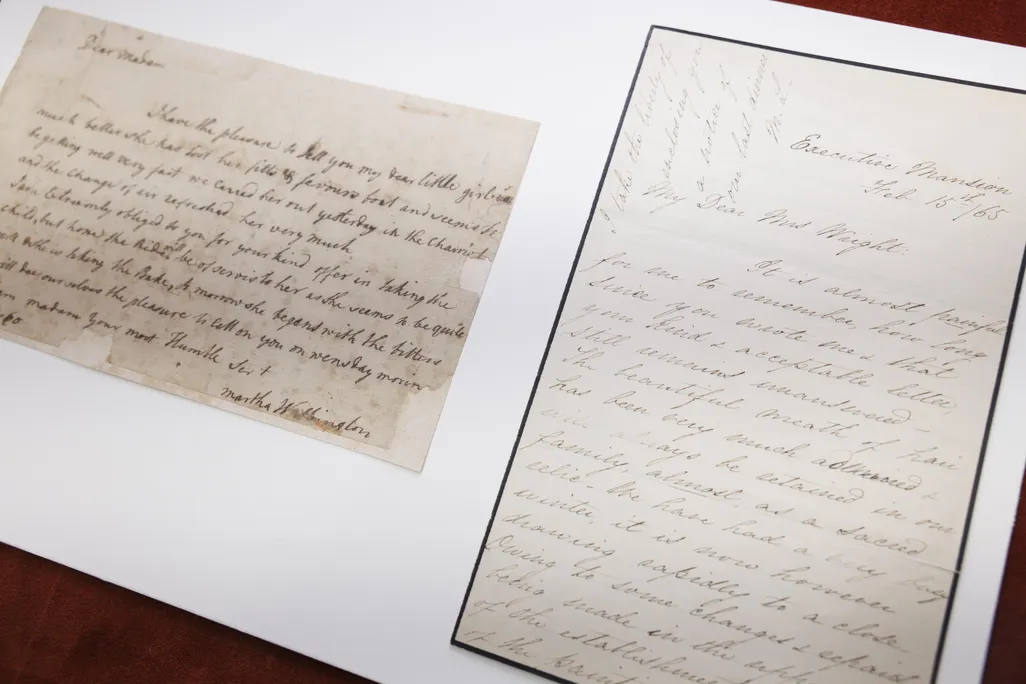
More than 260 years ago, Martha Washington wrote to a friend with encouraging news about her young daughter’s health. Now, that letter has found a new home at the Library of Congress, offering a rare glimpse into the family’s private life.
Martha penned the note on September 29, 1760. Writing to Margaret Bolan Green, she provided an update on her four-year-old daughter “Patsy.”
“I have the pleasure to tell you my dear little girl is much better,” she wrote. “She has lost her fitts & fevours bout and seems to be getting well very fast.”
The Library of Congress purchased the letter for $47,500 in June during a Heritage Auctions sale, with funding from the James Madison Council’s Edwin L. Cox Legacy Trust, a permanent endowment that helps the library acquire materials. The library already had 11 of Martha’s letters, but this is the first that bears her handwriting.
“Very few of Martha Washington’s letters survive, as she appears to have destroyed most of her own private correspondence,” Elizabeth Novara, the American women’s history specialist for the library’s Manuscript Division, writes in a blog post. “Even brief documentation of her relationships with family and friends, as may be found in this letter, is important to understanding women’s lives during this time period.”
“Patsy”—whose full name was Martha Parke Custis—was one of the four children Martha had with her first husband, Daniel Parke Custis. The two had been married for just seven years when Custis died from a sudden illness in July 1757, at the age of 45. Two years later, at age 27, the widowed Martha married George Washington. Together, they raised the two surviving children from Martha’s first marriage, Patsy and John “Jacky” Parke Custis. (The other two, Daniel Parke Custis and Frances Parke Custis, died while their father was still alive.).
Did you know? Martha’s grandson
Historians believe that William Costin, a prominent member of Washington, D.C.’s free Black community, was likely Martha Washington’s grandson—the child of her son from her first marriage, Jacky, and an enslaved woman.
Martha wrote the letter after George Washington had served as commander of the Virginia Regiment during the French and Indian War but before he had become the nation’s first president. Historians now suspect that Patsy’s “fitts & fevours” were symptoms of epilepsy, a neurological disorder caused by abnormal bursts of electrical activity in the brain. But, at the time, doctors didn’t understand her affliction.
“There’s no doubt that [Patsy] had epilepsy,” Kevin Butterfield, acting chief of the library’s manuscript division, tells the Washington Post’s Michael E. Ruane. “In her preteen and teen years it really accelerated.”
The Washingtons consulted numerous doctors and tried a variety of remedies to stop Patsy’s seizures, including an iron ring worn on one finger, bloodletting, trips to mineral springs and treatments with mercury and ether. They also gave her cinchona bark, commonly used to treat malarial fevers, and bitters, a remedy for stomach ailments.
But Patsy’s epilepsy only worsened. In the summer of 1770, when Patsy was 14, her stepfather kept track of her epileptic fits. His log revealed that she had seizures on 26 out of 86 days, sometimes suffering two per day.
In the end, it was a seizure that killed Patsy. She died at age 17 on June 19, 1773, at Mount Vernon “without uttering a Word, a groan or scarce a Sigh,” George Washington wrote the next day. The death of the “Sweet Innocent Girl” was a “sudden, and unexpected blow” that “almost reduced my poor Wife to the lowest ebb of Misery,” he added.
The Library of Congress also recently acquired a letter written by First Lady Mary Todd Lincoln. She penned the note to Caroline R. Wright, the wife of the former governor of Indiana, on February 15, 1865, two months before her husband was assassinated.
In the letter, she mentions a “beautiful wreath of hair,” which scholars suspect is a reference to the “Hairy Eagle,” an intricate sculpture created from the locks of several politicians and their wives, including the Lincolns. Wright commissioned the piece to be used as a fundraiser for sick and wounded Civil War soldiers.
The letter also references a recent White House dinner and renovations to the Executive Mansion that would prevent the Lincolns from hosting visitors in early March. Mary Todd Lincoln suggests Wright might stay at Willard’s Hotel, now the site of the Willard InterContinental, during a visit that historians think might coincide with Abraham Lincoln’s second presidential inauguration on March 4, 1865.
Together, the two newly acquired letters help the Library of Congress “tell fascinating stories that we simply couldn’t tell before,” Butterfield says in a statement. “What is already the world’s richest and most expansive collection of materials related to American history is constantly growing—sometimes one letter at a time.”
