
A Gene Variant Inherited From Neanderthals Might Affect Modern Humans’ Brain Size and Provide Protection Against Schizophrenia
About 20 percent of people alive today with European ancestry carry at least one copy of the variant, according to a new study. It’s associated with a smaller occipital lobe, a region that processes visual information, and up to a nearly 10 percent lower risk of schizophrenia

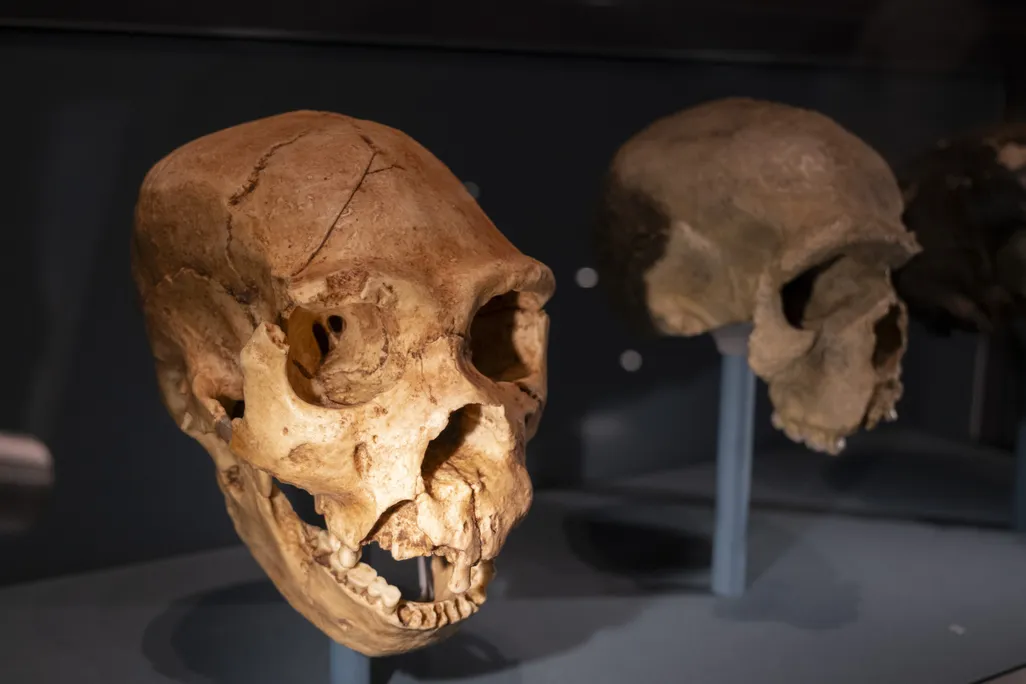
Tens of thousands of years ago, Homo sapiens interbred with Neanderthals, resulting in billions of humans alive today carrying traces of these extinct cousins in their DNA. The bits of Neanderthal ancestry can affect mood, metabolism, disease risk and other traits.
Now, new research suggests one of those inherited genetic variants is associated with a slightly shrunken brain region and lower risk of schizophrenia, according to a study published in the Proceedings of the National Academy of Sciences on November 16. The findings further highlight the enduring impacts of modern humans’ trysts with Neanderthals.
“This is a very important variant,” says Davide Marnetto, a computational biologist at the University of Turin in Italy who wasn’t involved in the research, to Michael Marshall at Nature. “Its effect is really one of the most beautiful and strong that I’ve ever seen.”
Neanderthals had larger skulls than modern humans, and they were more elongated front-to-back, hinting at a different brain tissue layout. Evolutionary geneticists Hugo Zeberg and Svante Pääbo, of the Max Planck Institute for Evolutionary Anthropology in Germany, suspected the occipital lobe—which sits at the back of the brain and processes visual information—had something to do with that distinct shape.
So, the research duo investigated gene variants known to affect occipital lobe size in people of European descent, whose DNA typically contains around 1 to 2 percent Neanderthal ancestry. Then, they looked at which variants were not present in people of sub-Saharan African descent, who have little to no Neanderthal DNA because their ancestors didn’t mingle with the extinct hominins, which evolved in Europe and Asia.
The work revealed a genetic variant that affects the DAAM1 gene, which is linked to brain development. This variant upstream of DAAM1 was seen in all five available genomes—complete sets of genetic instructions—from Neanderthals, the team found. Importantly, it wasn’t present in the two tested genomes from Denisovans, another extinct cousin that interbred with humans. The scientists estimate that about 20 percent of people of European descent carry at least one copy of the variant, reports Science’s Michael Price.
Did you know? Nobel prize
Pääbo received the 2022 Nobel Prize in Physiology or Medicine for figuring out how to extract and analyze DNA from 40,000-year-old-Neanderthal bones.
Using data from the U.K. Biobank, which contains genetic information from about half a million participants, the team examined how the Neanderthal gene variant affects people today. Analyses revealed that having one copy—inherited from one parent—is associated with a 0.85-cubic-centimeter reduction in occipital lobe volume, whereas inheriting it from both parents doubles the shrinkage. That seems a bit surprising since Neanderthals are thought to have had bigger brains than Homo sapiens.
“It sounds paradoxical, but it probably is not unexpected,” since traits like brain size are influenced by hundreds, or even thousands, of genes, says Joshua Akey, a geneticist at Princeton University who wasn’t involved in the work, to Nature. “Neanderthals could have an overall larger occipital lobe, but they still contain some variants that contribute smaller sizes and some that contribute larger sizes,” he explains, and Homo sapiens may have inherited a variant that contributes to a smaller size.
Having two copies of the Neanderthal variant was also associated with a nearly 10 percent reduction in schizophrenia risk, though the exact mechanism behind that effect is unclear. Future research in animals or brain organoids could provide more information, Zeberg tells Science, “but the honest answer is we don’t understand the exact mechanics at this point.”
Still, the findings align with research by Karen Berman, a neuroscientist at the National Institute of Mental Health, and colleagues, who reported in 2021 that people with more Neanderthal ancestry have lower rates of schizophrenia. The new study helps scientists further “understand the repercussions of the echoes of this genetic material in our present genetic underpinnings,” she tells the outlet.
Additionally, Zeberg and Pääbo examined the variant’s potential associations with intelligence, bipolar disorder, depression, ADHD and autism spectrum disorder. They found no link between these traits and the fragment of Neanderthal DNA, and they note that their findings suggest that the size of a brain region shouldn’t be equated with cognitive abilities.
The researchers are now continuing to sift through data to better understand Neanderthals’ fingerprints on modern humans’ genetic makeup, and they hope to turn up additional exciting discoveries.
“You might hear from us again,” Zeberg tells Jackie Flynn Mogensen at Scientific American.
