
A Farmer in Egypt Stumbled Upon a Pink Stone and Called the Authorities. They Found the Remains of Two Colossal Statues of Ramses II Beneath the Property
Archaeologists recovered the head of one statue that might have measured nearly 28 feet tall. It could point to a major building site commissioned by the pharaoh

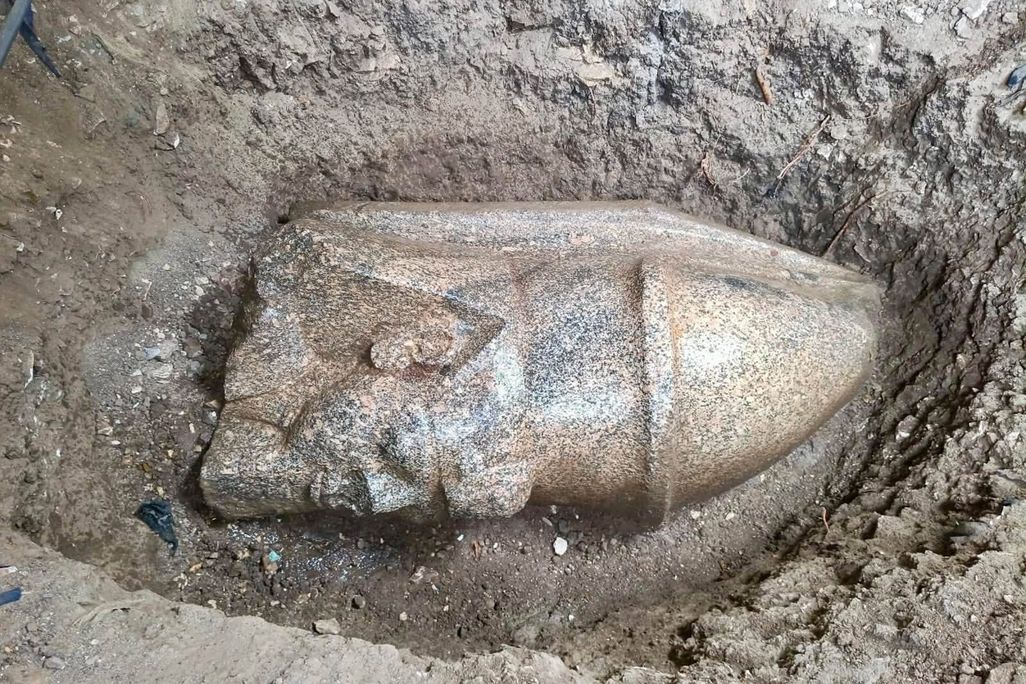
Farmer Khaled al-Shahat was working on his land in Egypt’s Nile Delta when he stumbled upon something unexpected in the dirt—a pink stone that appeared to be covered in hieroglyphic inscriptions. Realizing he might have found something special, he got in touch with the authorities, who sent a team of archaeologists to investigate.
Now, the Egyptian Ministry of Tourism and Antiquities has revealed the full extent of Shahat’s chance discovery. In addition to the inscribed stone, they say they have unearthed the remains of two massive statues of pharaoh Ramses II from Shahat’s property.
“I was surprised and happy when they discovered more antiquities,” Shahat tells CBS News’ Ahmed Shawkat. “They told me this might change the history of the area.”
Archaeologists found a five-foot-tall head that they believe once topped a colossal statue of Ramses II, who ruled over ancient Egypt from 1279 B.C.E. to 1213 B.C.E. The king is depicted wearing a double crown, a royal headpiece that symbolized his power over both Upper Egypt and Lower Egypt. In addition to the head, they also found the remains of the upper section of the statue’s back pillar, which is inscribed with Ramses II’s formal royal title, “Hor Ka Nakht Mery Maat,” per CBS News. Based on the size of the head, officials think the full statue, including the base, may have stood nearly 28 feet tall.
They also found part of a second Ramses II statue measuring nearly eight feet tall. The base and legs are missing, but officials did find the head clad in a nemes, a striped headcloth commonly worn by pharaohs. The face of the second statue is similar to the first, officials say.
The inscribed pink granite block that Shahat initially discovered is more than four feet long. Located about three feet from the second statue, the stone bears traces of hieroglyphic inscriptions that include two titles of Ramses II: “Nesw-Bity,” which means king of Upper and Lower Egypt, and “Sa-Ra,” or son of Ra, the sun god.
Archaeologists are continuing to excavate the site while studying the artifacts they have already unearthed. They hope to better understand the relationship between the statues, as well as their connection to the area.
Did you know? Ramses II's big family
Some estimates suggest Ramses II may have had more than 100 offspring.
The artifacts were discovered in Behbeit El-Hagar, a village in the Nile Delta about 80 miles north of Cairo that is best known as home to the remains of an ancient temple dedicated to the goddess Isis.
According to the Metropolitan Museum of Art, the temple was likely built on the site of an earlier temple from the twenty-sixth dynasty, which ran from 664 B.C.E. to 525 B.C.E.
The temple dedicated to Isis, who was worshipped as a traditional Egyptian wife, mother, healer and protector of the dead, was constructed primarily under Nectanebo II, who reigned from 360 B.C.E. to 343 B.C.E. It was completed under Ptolemy II and Ptolemy III but collapsed sometime before the early third century C.E., possibly as a result of an earthquake.
The newfound statue fragments were discovered on the western side of the temple complex, Mahmoud Emam, an Egyptologist at Cairo University who was not involved with the recent excavations, tells Live Science’s Owen Jarus.
Emam also notes that this is not the first time archaeologists have discovered artifacts related to Ramses II in Behbeit El-Hagar. Previous excavations conducted by Emam and his colleagues revealed two architectural fragments bearing the king’s name in 2017.
Ramses II was a prolific builder who constructed more monuments and statues than any other pharaoh. For example, the temples at Karnak and Abu Simbel were built under his reign.
Based on their discoveries, Emam tells Live Science, he and his colleagues concluded that Ramses II “had undertaken major building works at the temple and recommended further archaeological investigations to shed more light on the early history of the site.”
