
A 5,000-Year-Old Canaanite Wine Press Has Been Discovered in Israel
Researchers discovered the press, along with a ritualistic, animal-shaped “tea set,” outside the ancient site of Tel Megiddo
/https://tf-cmsv2-smithsonianmag-media.s3.amazonaws.com/accounts/headshot/Sonja_headshot.png)
/https://tf-cmsv2-smithsonianmag-media.s3.amazonaws.com/filer_public/7a/4b/7a4b6359-0676-49f8-8af9-a157f61e4cd2/one_of_the_oldest_winemaking_presses_in_the_world_discovered_in_an_excavation_photo-_yakov_sh.jpeg)
Near the ancient city of Megiddo, in northern Israel, archaeologists have discovered a cache of ritualistic artifacts and a 5,000-year-old wine press. Carved into bedrock by Canaanites, the pagan peoples who inhabited the area through the Early Bronze Age, the wine press is among the oldest of its kind ever found in Israel.
“We knew the Canaanites drank wine, and we knew wine was being produced,” excavation co-director Amir Golani, an archaeologist at the Israel Antiquities Authority (IAA), tells Haaretz’ Ruth Schuster. “Now, for the first time, we have the smoking gun of actual production.”
/https://tf-cmsv2-smithsonianmag-media.s3.amazonaws.com/filer_public/6b/5b/6b5b25b5-5c20-4b9b-959f-cd3bccef787c/dr_amir_golani_and_the_vessels_discovered_in_the_excavation_photo-_emil_aladjem_iaa.jpg)
The wine press is composed of a “treading surface”—a sloping, shallow basin where grapes were crushed by stomping feet—and a collection vat, into which grape juice flowed. According to a statement from the IAA, the press dates back to the area’s first period of urbanization.
“Megiddo is one of the largest and most important archaeological sites in Israel,” Golani tells the Times of Israel’s Rossella Tercatin. “It’s situated in a strategic location, with a water source and fertile lands. … It is an ideal location for settlements, and settlement at Megiddo began during the Neolithic period, already more than 10,000 years ago.”
Fun fact: Origins of the term "armageddon"
- The word "armageddon" is thought to have come from Megiddo. Har means "hill" in Hebrew, making armageddon "Hill of Megiddo."
Megiddo is situated in the ancient region of Canaan, which features heavily in the Hebrew Bible as a divine “Promised Land” for Israelites. The region’s native peoples lived in tribes, worshipped multiple gods and spoke an archaic form of Hebrew.
/https://tf-cmsv2-smithsonianmag-media.s3.amazonaws.com/filer_public/af/7f/af7f4e27-fe74-422c-a910-bed1d9338cd2/temple_model_discovered_in_the_excavation_photos-_katerina_katzan_iaa.jpg)
As well as the wine press, the recent excavations revealed artifacts likely related to Canaanite worship, buried in several ritualistic pits. In a deposit that also included large ceramic vessels, researchers unearthed a small, broken model of a temple. The clay miniature building illustrates “what the real temples in the Canaanite Late Bronze Age may have looked like,” Golani says in a video from the IAA.
“This is a much less refined, smaller, and simpler artifact than other temple models found in the past,” Golani tells the Times. “The simplicity might be a reflection of more folksy ritual.”
/https://tf-cmsv2-smithsonianmag-media.s3.amazonaws.com/filer_public/40/7f/407fce5b-c147-4497-9a07-987762344944/the_set_of_utensils_probably_used_for_ceremonial_pouring.jpg)
In another pit, researchers discovered what looks like an ancient tea set, Golani tells Haaretz. A clay pot shaped like a ram, with a large hole in its back and a spout in its mouth, was found along with a set of small bowls. These date back to around 1275 B.C.E.—some 1,700 years after the wine press was hewn. The ram-shaped vessel may have hosted “a valuable liquid such as milk, oil, wine or another beverage,” say Golani and excavation co-director Barak Tzin, an archaeologist at the IAA, in the statement. The liquid could have been “drunk directly from the spout, or poured into a smaller vessel for consumption, or as a votive gift.”
/https://tf-cmsv2-smithsonianmag-media.s3.amazonaws.com/filer_public/00/cd/00cd09c4-3ff1-4f39-8066-63a04f55cc68/the_iaa_excavation_on_highway_66_near_tel_megiddo_photo_assaf_peretz_iaa.jpg)
Experts have long recognized Megiddo as an essential site in the study of Canaanite urbanism and worship, say the excavation co-directors. Researchers have been investigating the site’s tell, the mound at its center, for more than a century. The tell is home to Megiddo’s “Great Temple,” the largest structure built in the Levant during the Early Bronze Age.
The recent digs, though, were conducted to the east of the ancient city, ahead of the development of a highway in the area. The findings revealed that the settlement of Megiddo was much larger than experts thought, stretching “far beyond the boundaries of the tell,” Golani tells the Times.

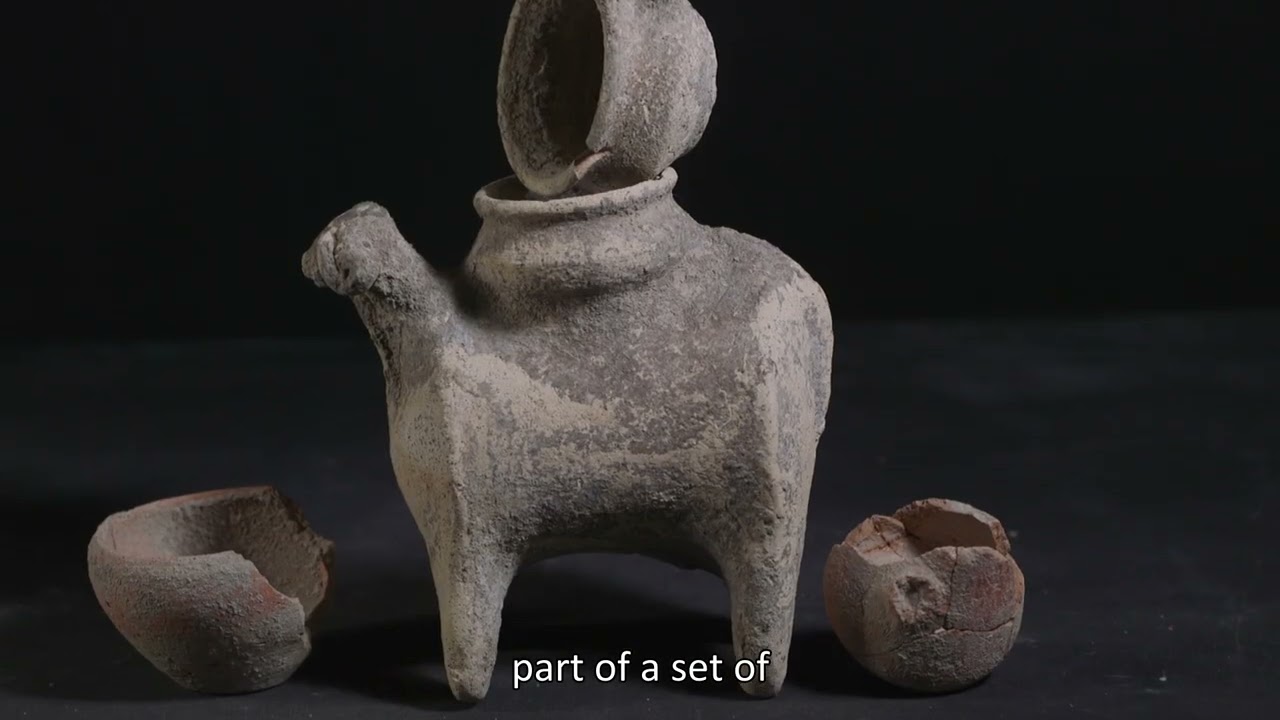
While the ancient wine press provides evidence of some of the region's oldest grape-juicing, researchers think the temple model and “tea set” indicate a Canaanite folk cult that operated outside Megiddo, per the statement. Perhaps this religious group was made up of lower-class farmers who were unable to enter Megiddo and its main temple.
“What makes it so fascinating is that maybe we can see how the common people were making offerings in their religion outside the city,” Golani tells the Times. “We are making an assumption, but it is very clear that this is a form of religion that we were previously unaware of.”
Editor's note, November 18, 2025: This story has been updated to more accurately describe the region and the location of the wine press. It is in northern Israel in the ancient region of Canaan.
/https://tf-cmsv2-smithsonianmag-media.s3.amazonaws.com/accounts/headshot/Sonja_headshot.png)