
3,400-Year-Old Grasshopper Artifact That May Have Been Stolen From King Tut’s Tomb Sells at Auction for More Than $450,000
While the artifact’s provenance is unclear, many experts think the archaeologist Howard Carter took the item for himself after excavating the pharaoh’s tomb in 1922
/https://tf-cmsv2-smithsonianmag-media.s3.amazonaws.com/accounts/headshot/ChristianThorsberg_Headshot.png)
/https://tf-cmsv2-smithsonianmag-media.s3.amazonaws.com/filer_public/92/db/92dbccdb-f832-47f0-b57b-e0ca7c79a321/462-1.jpg)
After weeks of heated debate over its controversial provenance, an artifact that may have been taken illegally from the tomb of Egypt’s King Tutankhamun sold for roughly $450,000 at auction in London.
The Guennol Grasshopper, carved from ivory and wood and measuring just 3.5 inches long, was fashioned and painted an estimated 3,400 years ago, around the time of Tutankhamun’s reign.
“Its black and blue inlaid eyes lend it lifelikeness while its checkerboard-patterned upper wings pivot outward to reveal a small interior cavity presumably used to store kohl or perfume, both essential accoutrements in New Kingdom elite life,” according to a statement from Apollo Art Auctions, which handled the sale.
/https://tf-cmsv2-smithsonianmag-media.s3.amazonaws.com/filer_public/23/8f/238f156d-09fb-45d3-8b41-9ec512711b7f/462-6.jpg)
However, some experts think that the archaeologist Howard Carter, who found the pharaoh’s tomb in 1922, stole the artifact after making his discovery. Since the auction was announced, the item’s provenance has generated buzz among historians.
The records suggest that Maurice Nahman, an Egyptian art dealer, purchased the grasshopper from Carter. Nahman then sold the artifact to Joseph Brummer, a New York art dealer, in 1936. According to Brummer’s inventory card, now archived at the Metropolitan Museum of Art in New York, the object was “supposed to come from the tomb of King Tutank-Hamen.”
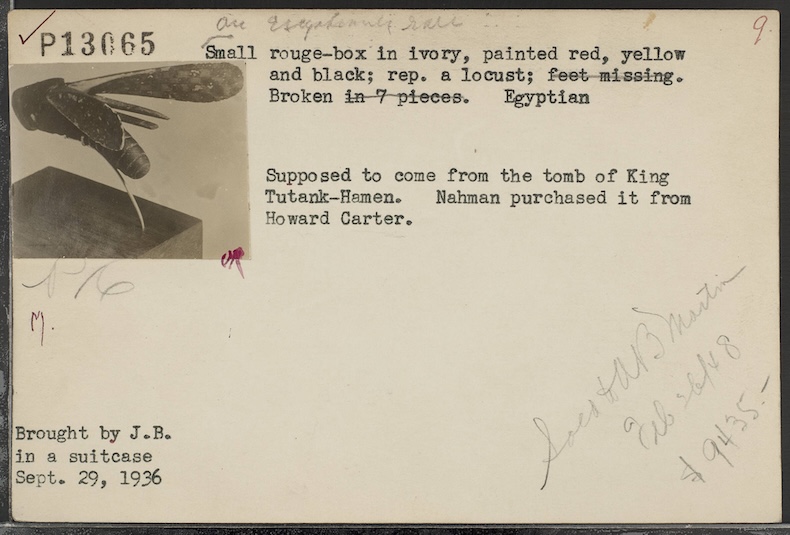
In 1948, the grasshopper was purchased by Alastair Bradley Martin, heir to a Pittsburgh steel fortune, for nearly $10,000 (more than $100,000 today). Artifacts in Martin’s collection were called “Guennol” items, as “gwennol” is Welsh for “martin,” the bird, reports Apollo magazine, which has no ties to the auction house. In 2007, the Merrin Gallery acquired the artifact. At some point after that, the heirs of Sheikh Saud al-Thani, a member of the Qatari royal family, bought the grasshopper for $1.2 million.
Quick facts: Other objects from the Guennol collection
- Items from the collection, which aren’t limited to Egyptian art, have appeared in several auctions in recent years.
- In 2007, a 5,000 year-old Iranian figurine known as the Guennol lioness sold for $57.2 million.
While in Martin’s collections, the grasshopper went on view at the Brooklyn Museum for various periods between 1948 and 2002, and it was displayed at the Met in 1969.
Meanwhile, rumors of Carter’s thefts began to swirl. After his death in 1939, artifacts linked to Tutankhamun were found among the archaeologist’s belongings. In recent years, unpublished letters and discoveries of lost treasures have provided more evidence for the looting.
/https://tf-cmsv2-smithsonianmag-media.s3.amazonaws.com/filer_public/a2/a5/a2a57ae2-8706-4596-896a-8f5a1491f9a7/462-20.jpg)
In a statement to Apollo magazine, the auction house claims that the connection to Tutankhamun’s tomb “is a recent scholarly hypothesis and not an established fact,” adding: “There is no excavation photograph of this item in the tomb, [and] Carter never listed it in the inventory.”
Christian Loeben, an Egyptologist at the Museum August Kestner in Germany, tells the New York Times’ Alex Marshall he is “quite convinced” the grasshopper came from Tutankhamun’s tomb. Its style is from “exactly the period” of the pharaoh’s reign, and its well-kept condition suggests that it was safely stored in a sealed chamber, he says, adding that the vessel should be returned to Egypt.
But on July 27, the auction went ahead as planned.
/https://tf-cmsv2-smithsonianmag-media.s3.amazonaws.com/filer_public/a1/ff/a1ff3808-b719-4b0b-ae77-e2321c056708/tutankhamun_tomb_photographs_2_008.jpg)

“In line with U.K. law, any restitution claim would require proof of illicit origin, illegal export and timely action, none of which have been presented during its 80+ years of public history,” Apollo Art Auctions tells Artnet’s Jo Lawson-Tancred in an emailed statement. “We chose to offer the piece for sale because of its historical and cultural importance. It deserves to be appreciated, and we hope it will enter a public collection where it can be responsibly cared for and accessible to all.”
Erin Thompson, a scholar of art crimes at John Jay College of Criminal Justice at the City University of New York, says the auction house’s smaller size is noteworthy. Larger auction houses like Christie’s and Sotheby’s “wouldn’t touch an antiquity connected so closely to a known pilferer,” she tells the Times.
/https://tf-cmsv2-smithsonianmag-media.s3.amazonaws.com/accounts/headshot/ChristianThorsberg_Headshot.png)