
/https://tf-cmsv2-smithsonianmag-media.s3.amazonaws.com/filer_public/b2/b4/b2b4bc3f-eb65-4aef-b58e-3f6e9ecb4258/16700079786_2a6be19034_o.jpg)
Yellowstone Is Among the World’s Best Places to See Wild Wolves. Here’s the Story of the Animal Called Both ‘Public Enemy’ and Cultural Icon
A century ago, resident wolves were eliminated from the park. In 1995, biologists brought them back, marking a historic reintroduction of a top carnivore
:focal(1421x1306:1422x1307)/https://tf-cmsv2-smithsonianmag-media.s3.amazonaws.com/filer_public/b2/b4/b2b4bc3f-eb65-4aef-b58e-3f6e9ecb4258/16700079786_2a6be19034_o.jpg)
Gray wolves know that the best way to survive in this world is together. They live in pack families, relying on each other to hunt hoofed mammals many times their size. A single wolf doesn’t want to be alone for long.
“So much of how the wolf appears rhetorically in America is in this ‘lone wolf,’” says writer Erica Berry, author of the 2023 book Wolfish: Wolf, Self and the Stories We Tell About Fear. “It’s like the wolf howling alone at the top of the mountain.”
But what humans share with wolves “is not this idea of our independence and solitude, but actually the ways that we collaborate,” she says. “Even a lone wolf comes from a pack and is looking for another pack.”
/https://tf-cmsv2-smithsonianmag-media.s3.amazonaws.com/filer_public/40/c3/40c3d24d-cd70-43a5-9a1b-5f83f5ab7bd1/53470570715_873e9028fb_o.jpg)
The wolf was once the world’s most widely distributed land mammal, and it roamed North America in abundance. Environmentalist James Holt, a member of the Nez Perce Tribe in Idaho, said his Indigenous community has long had a deep understanding of wolves: “We’ve seen and experienced wolves from before the last ice age,” Holt said to Boise State Public Radio’s Heath Druzin last year. Holt added that the oral histories about prehistoric wolves and other animals “had a huge impact on us.”
But like many sizable predators, wolves have been consistently persecuted by people throughout their history in the United States, and the first documented bounty was placed on them in 1630 in Massachusetts. Once settlers arrived and spread widely across the continent, they began to clash with the canids.
Wolves are generally good at avoiding people. In colonial America, “wolves had a ghostly presence,” writes historian Jon T. Coleman in his 2004 book Vicious: Wolves and Men in America. “Settlers heard howls, but they rarely spotted their serenaders.”
/https://tf-cmsv2-smithsonianmag-media.s3.amazonaws.com/filer_public/ff/21/ff2127de-79ce-48d5-b5e0-aeea7e558ee6/18040d.jpg)
However, by the 19th century, when settlers moved west, their expansion decreased the numbers of the wolf’s ungulate prey, and ranchers’ livestock became a target for the carnivores. Humans then ramped up attempts to eliminate them—through trapping, shooting and poisoning. Those efforts, some backed by the federal government, led to the near-eradication of the animal from the lower 48 states. Historical images frequently show people proudly standing alongside wolf pelts from the animals they’d killed.
And yet, the story of the wolf in America did not end there. If humans had the power to essentially wipe out wolves, then they also had the ability to help bring them back.
Perhaps no location is more central to the wolf’s decimation and return than Yellowstone National Park. Gray wolves lived in Yellowstone when it was established in 1872, and fossils show they inhabited the Mountain West region for thousands of years.
But just as wolves had been systematically removed outside of the park, people also deemed them a problem within it. In 1915, Yellowstone’s superintendent wrote that growing wolf populations had become “a decided menace” to their prey animals, and park managers made efforts to kill them.
“Wolves were public enemy number one,” Doug Smith, who worked as a biologist at Yellowstone for almost 30 years, said in a 2022 video.
/https://tf-cmsv2-smithsonianmag-media.s3.amazonaws.com/filer_public/3f/cc/3fcc8152-d4c6-455c-ad0b-3b5ed50a73dd/14768.jpg)
From 1914 to 1926, by the National Park Service’s count, at least 136 Yellowstone wolves were killed. They became wrapped up in a “targeted predator eradication program that happened on all public lands across the country,” says Dan Stahler, a Yellowstone senior wildlife biologist, adding that other animals, such as cougars and coyotes, were included.
Park management used poison to kill the carnivores, often strychnine, an alkaloid that causes convulsions, respiratory failure and extreme pain. They laced carcasses of livestock, elk and bison with the toxin so that wolves would ingest it while scavenging. “We’re talking crates and crates of this poisoning,” Stahler says. Because wolves are intelligent, they could learn to evade hunters and become trap savvy. But they couldn’t avoid the poison.
The park’s last resident wolves were killed in 1926. Despite “remnant sightings and observations of wolves in the couple of years following that,” says Stahler, in Yellowstone, “essentially there’s no longer a functional wolf population after 1926.”
One hundred years later, thanks to a high-profile reintroduction project that began in the 1990s, Yellowstone is now the best place in the country to see wild wolves. Today, the park spans more than 2.2 million acres and three states: Wyoming, where about 96 percent of the park is located, as well as Montana and Idaho. Visitors can see lakes, rivers, hot springs, active geysers, a supervolcano and a massive ecosystem bursting with wildlife, including bears, bald eagles and otters. And gray wolves are now one of Yellowstone’s biggest draws, with people embarking on hours-long tours just to get a glimpse of them.
It is illegal for hunters to kill wolves on Yellowstone grounds. The park offers a protected environment for the carnivores, Stahler says, making it a “wolf fortress.”
One of the big motivations for recovering wolves was to bring back a top carnivore to the landscape. In the early 20th century, with the absence of apex predators, the park’s ungulate population faced no natural top-down force. Elk numbers grew to high levels, putting pressure on the park’s vegetation, and staff aggressively managed the herds’ size.
/https://tf-cmsv2-smithsonianmag-media.s3.amazonaws.com/filer_public/c8/e9/c8e9c26c-786d-4acf-ae99-817bcc93d61b/35967460023_3341ddaa60_k.jpg)
Tens of thousands of elk were either culled by hunters and Yellowstone officials or moved to other parts of the country to support elk conservation. In the late 1960s, park leadership backed off this approach and decided to “let nature take its course,” as Stahler puts it. Once again, the elk population grew rapidly.
Gray wolves were listed under the Endangered Species Act of the 1970s, which set the stage for their recovery and return to the park and the Northern Rockies region. The U.S. Fish and Wildlife Service published a recovery plan for wolves in 1987. After years of attaining public feedback and support and working out the logistics of the proposal, in 1994, Secretary of the Interior Bruce Babbit approved gray wolf reintroduction to Yellowstone and the central Idaho wilderness.
In January 1995, 14 gray wolves flown in from western Canada were set to change the park’s landscape for good. Yellowstone management held them in pens for about ten weeks to acclimate them before releasing them into the park. After staff members cut the metal fencing keeping them in, they found freedom, pressing their paws into what would become their hallowed ground.
/https://tf-cmsv2-smithsonianmag-media.s3.amazonaws.com/filer_public/34/f3/34f391a4-31df-4f37-928d-439ba848ac98/15575.jpg)
/https://tf-cmsv2-smithsonianmag-media.s3.amazonaws.com/filer_public/fc/14/fc1402c7-7867-4743-8f11-64cafa9000e1/15118.jpg)
The following year, 17 more Canadian wolves were brought in and released.
“By the time wolves were coming back onto the landscape, they were experiencing one of the most abundant elk populations ever recorded,” Stahler says, with likely more than 25,000 of the herbivores in the northern herd, which is the largest and most studied of the elk herds that occupy Yellowstone seasonally. During the first decade after reintroduction, the wolves saw rapid population growth as they hunted the immense herds.
The animals typically “breed at high rates, and they disperse well across the landscape,” says Arthur Middleton, an ecologist and wildlife management scholar at the University of California, Berkeley. They formed packs and procreated, just as wildlife managers had hoped. Wolves are “one of the most resilient species of large carnivore that we have in the world,” he says, “which is partly why they’re here today.”

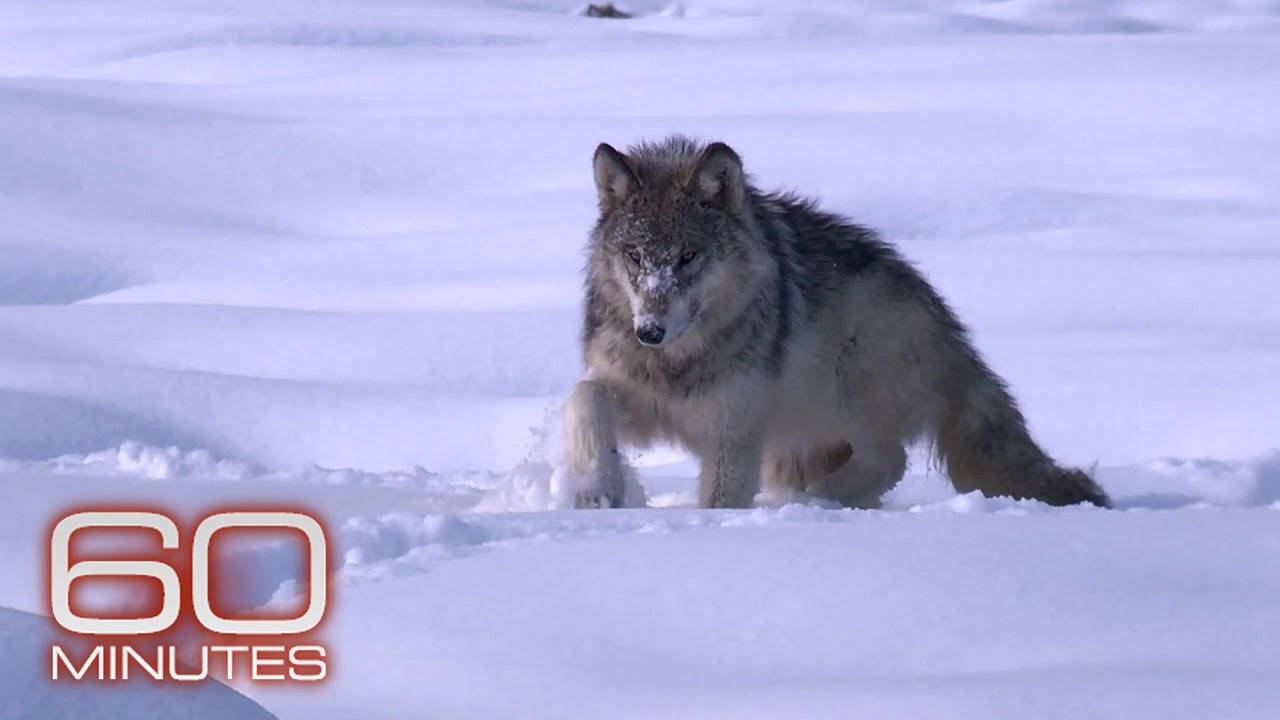
Over the past three decades, the park’s biologists have gotten to see the wolves’ legendary resilience up close: “They live day to day, like many wild animals,” Stahler says. “No matter the adversity, they persist. They might have an injured leg; they might have gotten kicked pretty badly from the last hunt. They’re out there the next day doing the same thing.”
Yellowstone provides an unprecedented opportunity to closely study a wolf population on a regular basis over time. The park likely has “the largest data set on wolves in the world,” Smith told Montana’s KBZK News in a 2022 report. Smith was hired in 1994 to help manage the Yellowstone wolf reintroduction, a post he held until his retirement in December 2022. Stahler, who joined the project alongside Smith in 1997, took over as manager in 2023.
To track the wolves, in the winter, park staff members fly helicopters to find and radio collar them. The collared animals become part of Yellowstone’s long-term studies of individual wolves as well as group behavioral documentation. Stahler says the park aims to keep about 25 percent of the wolf population collared.
/https://tf-cmsv2-smithsonianmag-media.s3.amazonaws.com/filer_public/ff/d1/ffd14305-d471-4687-bb88-8a7b2e50a67b/16055515297_c8c13c05b3_o.jpg)
/https://tf-cmsv2-smithsonianmag-media.s3.amazonaws.com/filer_public/ec/f7/ecf78065-72a1-4986-ab4b-4a567744d85a/53726569610_182e8bdb20_o.jpg)
Yellowstone is also exploring less invasive tracking techniques. Biologists have set out audio recorders as a first step toward developing tools that use howling and other vocalizations to count and track wolves, in combination with remote cameras.
The park has had about 100 wolves in ten packs on average, over the past dozen years, Stahler says. Last year, their official population count was around 80 wolves. Despite that number being slightly lower than typical, he notes, “we consider it a healthy, stable population.”
Genetic and behavioral studies have taught park biologists that the wolves tend to avoid breeding with close relatives. The wolf pack consists of an extended family, with the mother and father—the dominant female and male, called the “breeding pair”—producing pups yearly. As the young wolves grow, some stay with the pack for one to two years and serve in the cooperative family unit. About 75 percent of Yellowstone packs fit that framework, according to Stahler. However, 25 percent of the packs each year have more than one female giving birth to a litter.
/https://tf-cmsv2-smithsonianmag-media.s3.amazonaws.com/filer_public/c5/7a/c57a8633-d6a2-4c26-9ee3-ce5992f65ac0/16189.jpg)
Fun facts: A coat of many colors
- A wolf’s overcoat, also called guard hairs, ranges in color—including gray, black, white and brown—and is often blended. Gray wolves, no matter their guard hair color, have a gray undercoat, which gives the animal its name.
- Yellowstone researchers have discovered that the park’s black-coated wolves are more resistant to disease, while the gray-coated wolves have more reproductive success. Many packs will have opposite-color breeding pairs, maintaining genetic diversity in their offspring.
In the protected environment of the park, mortality among the carnivores is largely driven by natural dynamics: wolves killing each other. The canids are territorial and fiercely defend their land against neighboring packs to secure food and den sites to raise their offspring.
Disease can cause more death. In the late ’90s and early 2000s, Stahler witnessed population dips caused by disease outbreaks, specifically canine distemper, which cycles through populations of wild carnivores, not just wolves. But the packs were able to rebound.
Wolves can also be killed by their large prey during a hunt, especially bison, which now have a robust population in the park due to successful conservation and management measures.
“We watch them test bison a lot; they’re often unsuccessful,” says Stahler. The bison is North America’s largest land mammal, difficult and dangerous to kill. “I’ve personally witnessed a wolf getting kicked and killed by a bison during a hunt. We have to remember these animals literally have their face, their mouths, to run up to something five times their size and grab onto it and kill it.”
/https://tf-cmsv2-smithsonianmag-media.s3.amazonaws.com/filer_public/05/c8/05c82a63-4c73-41a3-a1a0-4b3ac2b49501/26375779068_eb49b13492_o.jpg)
Because of this, wolves typically scavenge the bovine carcasses or target weak and small members of the herd. Yellowstone research helps dispel the myth of wolves as a predator that can kill anything at will, the biologist says. “Wolves need vulnerable prey to be successful,” he explains. “They cannot kill any elk they want. They cannot kill any bison they want.”
When wolves attack adult elk, they’re successful only around 10 to 15 percent of the time, he adds. Wolves must exert a tremendous amount of energy and effort to feed themselves regularly.
Larger packs are often the most successful, because they can more effectively hunt big prey, and they have additional helpers to raise pups. Older and more experienced wolves contribute most to the success of the group, from hunting to defending territory.
“We’ve learned these really neat details about wolf social life because of our ability to watch this population so closely,” Stahler says.
Reintroducing an apex predator can send effects trickling down the food chain, which ecologists call a trophic cascade. But exactly how much of a role the reintroduced wolves have played in Yellowstone’s ecosystem has long been the subject of scientific study and debate.
The idea behind bringing wolves back was that they would eat large herbivores like elk, which would tamp down their populations. And by their mere presence, the wolves might scare elk, researchers thought, changing their behaviors. Then, with fewer elk grazing and browsing in the park, its plants, particularly willow and aspen trees, would flourish. While grasses are the elks’ main food, the herbivores will browse from trees when the grasses become packed under snow.
/https://tf-cmsv2-smithsonianmag-media.s3.amazonaws.com/filer_public/55/87/5587c2a6-00fb-4bc4-8552-1c3cab28d8e5/41576711525_98d312233b_k.jpg)
/https://tf-cmsv2-smithsonianmag-media.s3.amazonaws.com/filer_public/d4/11/d4110609-0706-416c-aa1c-418bcf334b46/26791820784_f7929fe427_o.jpg)
Wolves have certainly affected the ecosystem, but some earlier descriptions of their impact “jumped the gun a little,” Stahler says. “I think kids going to high school probably read a trophic cascade section in a biology textbook that focuses on Yellowstone that is probably not fully accurate, because science has continued to help us understand and tease that apart.”
Ecologist Elaine Brice recalls learning about the subject in high school, as she told Science in 2024. It was the idea that “predators had magical protective properties and could fix damaged environments,” she said. “You can’t just restore a predator and expect everything—plants, insects, rivers—to recover. It’s far more complex than that.”
Yellowstone has shown a growth of willow and aspen communities, along with less browsing pressure, Stahler says, though the recovery isn’t as robust as scientists once thought. Some of the early science around the vegetation growth assumed, “Well, it’s got to be due to wolves; that’s the only major change,’” the biologist says. But subsequent research has complicated that picture. Brice worked on a 2024 study with Stahler and other scientists that cast doubt on the idea that the fear of wolves drove elk away from their favorite browsing spots, leading them to eat significantly less from trees. It seems, Stahler says, that the change in vegetation isn’t because of shifting elk behavior—it’s because there are fewer elk.
“So, to the extent that wolves have caused a decline in elk abundance, yes, wolves have played a role in the trophic cascade story,” Stahler says. During the first ten years of wolf reintroduction, humans’ hunting, drought and severe winters likely collectively played a bigger role in the decline of elk in the northern herd than wolves did, he adds.
/https://tf-cmsv2-smithsonianmag-media.s3.amazonaws.com/filer_public/26/7c/267c30bf-f560-425f-b241-78a9fcb06007/15570.jpg)
Alongside that, cougar numbers were increasing because they naturally recolonized the park around the 1980s and into the ’90s, before wolves had arrived. Grizzly bears and black bears were also increasing in abundance, and they eat plenty of elk calves in the summer. Stahler calls this a “multicausal influence” on elk reduction.
Middleton points out that while the wolf has been made the face of the trophic cascade, “we do nature a disservice when we attribute so much to one creature, because it’s just not how nature works.”
In the past 10 to 15 years, human hunting has had less of an impact on the northern herd elk. But the park’s carnivores still eat elk, so it’s likely that wolves are playing a more important role in keeping elk numbers lower now, Stahler adds.
“We could spend the next 30 years studying rules and trophic cascades and learn new things and still come away, like, ‘Jeez, we still don’t understand exactly’ because of that complexity, and that’s OK,” he says.
Middleton emphasizes that the food chain isn’t the only element affected by wolves’ return. “As soon as you call wolf reintroduction an extraordinary success, you’ve got to realize that you’re not being inclusive of people who are severely impacted by that on the larger landscape,” he says.
When Middleton speaks to groups of ranchers who are set on repelling wolves, he says one of the most powerful realizations is that the animals are not going away. “You can kill them, you can do all these kinds of things, and they’re going to come back,” the ecologist says. It’s “the biology of this animal.”
Wolves need long-term healthy habitats and prey populations. Without these elements, they are likely to prey on livestock more, and they sometimes also kill domestic dogs working to guard and herd on ranches. “You can scare wolves away as much as you want, but they’re just going to try harder to thwart your deterrence,” Middleton says.
Nonlethal methods to deter wolves from livestock include making noise, shining lights or instituting electric fences. Protecting the most vulnerable livestock, the calves, could mean encouraging cattle to herd together for defense. But if all these methods fail, Middleton says, that’s when ranchers want assurance that they’ll be able to implement lethal tactics.
“Many advocates don’t like it, but it’s part of the toolset in essentially every place that wolves exist in the world,” he says. “And, in my view, it has to be. It’s just a question of how these all fit together.”
/https://tf-cmsv2-smithsonianmag-media.s3.amazonaws.com/filer_public/9e/62/9e62c32a-d61e-4793-a19e-ee1b91c512a1/49235201847_2b6c1c9040_o.jpg)
Now, he explains, conserving wolves is about “balancing wildlife protection with human livelihoods.”
“In the U.S., more wolves live outside of protected areas than within protected areas,” ecologist Avery Shawler, who worked with Middleton on a study tracking wolves’ prey-driven movements, said last year. “These wolves are going to overlap with humans and livestock.”
Stahler understands that living with wolves sometimes means they’ll be managed in a way that some people disagree with. Still, in his view, American society has made headway in forming partnerships and accommodating different outlooks on the issue, instead of attempting to annihilate the wolves, like in the past.
Compromise has been a big part of wolf recovery in the U.S. In Berry’s experience, she’s heard about coalitions that include the government, conservationists and ranchers to help people exist alongside wolves. “I get a little bit frustrated sometimes when the wolf is still only referred to as you’re either loving or hating them in media,” she says.
/https://tf-cmsv2-smithsonianmag-media.s3.amazonaws.com/filer_public/83/07/83077e92-45de-47e3-8b7c-24c23acada4f/smithmag-article-wolf-v3.jpg)
Wolves have been depicted as villains for hundreds of years, even in our fables and fairy tales, from “Little Red Riding Hood” to “The Three Little Pigs.” Advocates speculate whether some people direct a particular animosity toward wolves, more so than other animals.
“I don’t want to say they’re uniquely contentious,” Middleton says, adding that there are “large carnivores in a lot of places that attract a similar controversy.” Still, he does acknowledge that there seems to be “a special disdain that is held for them in parts of the Western U.S. and other places in the world.”
/https://tf-cmsv2-smithsonianmag-media.s3.amazonaws.com/filer_public/d0/09/d009d5f9-0457-4faf-8c84-aef868e663f3/15563.jpg)
“I live in Montana, and most anyone in the Mountain West will tell you, people have big feelings about wolves here,” NPR’s Berly McCoy said on the “Short Wave” science podcast last August. “Some years ago, I remember driving by this huge billboard with a picture of a majestic-looking wolf with a message like ‘protect the wolves,’ and someone had shot an arrow through its forehead.”
Even Yellowstone can’t safeguard every wolf. In 2017, a beloved wolf, known as the “White Lady” due to her rare, stark appearance, was shot by a poacher illegally inside the park. Staff had to euthanize her.
“So, wolf hatred’s that bad, you’re that intolerant and noncompromising, that you’re going to blow a wolf away inside the park?” Smith recalled in a documentary last year.
Berry was initially surprised by the fervency with which some people opposed the wolves’ presence in the West when she began researching the topic in 2014 while living in New England. “I didn’t understand that wolves could cause death threats or could invoke death threats toward reporters,” she says.
In 2021, science journalist Avery Hurt pondered why some people harbor such anti-wolf hostility. Hurt traced the sentiment back to the colonists who relied on their livestock. They felt their survival was threatened by the animals, so “the fight was personal,” she wrote. Some still feel like that.
“In so many ways, the story of the wolf is the story of what is at stake in America at any one moment,” says Berry. “The wolf represents a sense of polarity and ‘us versus them’ mentality.”
/https://tf-cmsv2-smithsonianmag-media.s3.amazonaws.com/filer_public/c2/d1/c2d17385-9c09-4a34-93ef-b2e5907dcd0f/15833.jpg)
Gray wolves are wanderers. As the biggest wild canids on the planet, with long legs that help them traverse great distances, they were made to be on the move. Some descendants of those reintroduced in Yellowstone and Idaho moved beyond their initial areas, stepping out into lands long bereft of wolves. Middleton notes that since the 1990s, wolves have gone from being scarce in the lower 48 to numbering in the thousands across several Western and Midwestern states.
One wolf crossed the Snake River from Idaho into Oregon in 1999, becoming the first in the state in about five decades. “In Yellowstone,” Berry says, “you had a case where they’re flown in, but in many other places they’ve just walked over.”
/https://tf-cmsv2-smithsonianmag-media.s3.amazonaws.com/filer_public/cb/65/cb652189-9c20-4491-a15c-132aa9a18e52/38401270711_3037330860_o.jpg)
/https://tf-cmsv2-smithsonianmag-media.s3.amazonaws.com/filer_public/1e/05/1e051c63-d32a-4b23-9cc9-f80f29b5b375/33007883433_07ef6e7c22_o.jpg)
A famous Oregon wolf, called OR7 and aptly nicknamed Journey, was born into a northeastern Oregon pack in 2009 and radio collared by the Oregon Department of Fish and Wildlife in 2011. He became California’s first documented wild wolf in nearly 90 years when he crossed into the state in 2012, “all in search of a mate,” according to the Department of Agriculture.
The wolf had roved about 1,200 miles. In California, “his average daily movement was approximately 15 air miles,” reported the state’s Department of Fish and Wildlife. “Since animals do not typically walk in straight lines, the actual distance traveled was likely much larger.”
In February, a wolf that had roamed for hundreds of miles was spotted in Los Angeles County for the first time in around a century. “It’s a milestone,” Axel Hunnicutt, lead wolf biologist with the California Department of Fish and Wildlife, told the New York Times.
“Wolves obviously have returned to California,” Hunnicutt said. “As of yesterday, they’ve returned to the most populous county in the U.S. as well.”
The canids move with their prey, too. In the Greater Yellowstone Ecosystem, they might follow elk herds, which make big seasonal migrations to higher ground in spring. Part of Middleton’s current work is trying to understand how to better safeguard those migrations and in turn, sustain the wolves.
As wolves trek around the West and find ways to survive, the pack animals will keep seeking each other.
“At the end of the day,” Middleton says, “as long as wolves aren’t being systematically hunted and poisoned and stamped out the way that our government did and others did 100-plus years ago, they’re going to continue to grow and expand. That’s just in the nature of wolves.”