Green Sea Turtles Are Making a Remarkable Comeback on the Remote Aldabra Atoll and Around the World. But Their Recovery Is Far From Complete
One year after the species was reclassified from “endangered” to “least concern,” green turtles in the western Indian Ocean exemplify that return—and the subtleties a global designation can miss

On an early January night after sunset, I’m walking with Elke Talma toward Settlement Beach, a 1.2-mile stretch of white sand on Aldabra atoll in the western Indian Ocean. We’re each here for a month on different projects: Talma is volunteering with the atoll’s marine research program, and I’m here to study its 180,000 giant tortoises for a book. As Talma leads us out along a path that parallels the beach, we detour around one of these sleeping giants, with its head flopped down on the short, cropped grass.
Aldabra, 400 miles off the eastern coast of Africa, is one of the very few places on Earth where giant tortoises might cross paths with their distant seafaring cousins, green sea turtles, which are the target of our search tonight. Green turtles nest on Aldabra year-round, but fewer are found this time of year.
Our red-beam flashlights—the only artificial light out here—sweep the smooth sand, pale in moonlight. The females, nesting mostly on the atoll’s outer rim, leave distinctive tracks: alternating left-right gouges in the sand up the beach, made by one flipper at a time, that look like tire tread marks from a monster truck.
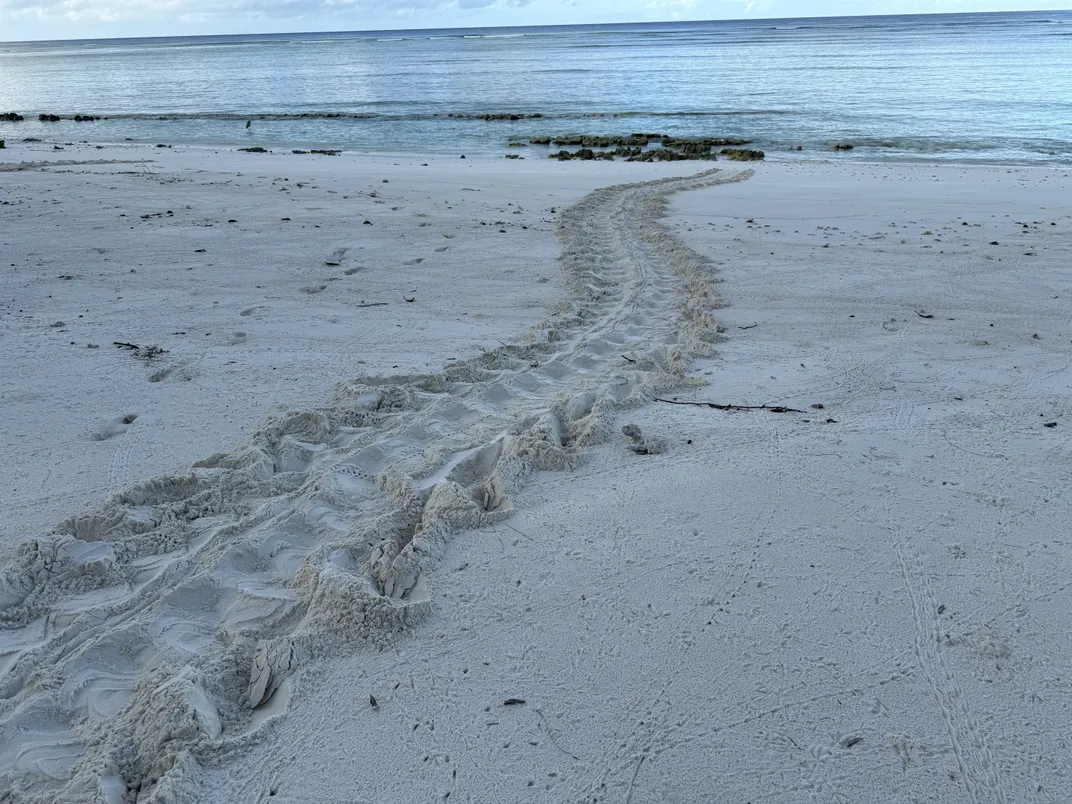
A single line of tracks leads up from the water, and Talma follows them into a stand of casuarina trees above the high-tide mark, where the dry sand is suitable for nesting. The green turtles have dug craters everywhere for their nests. From above, the beach would look like it’s been bombed.
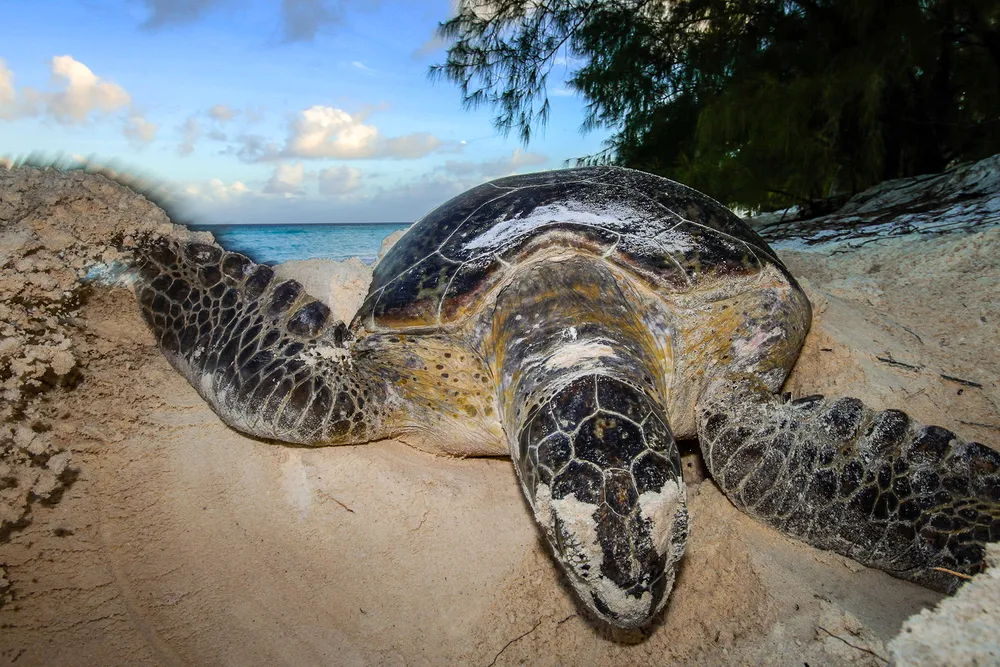
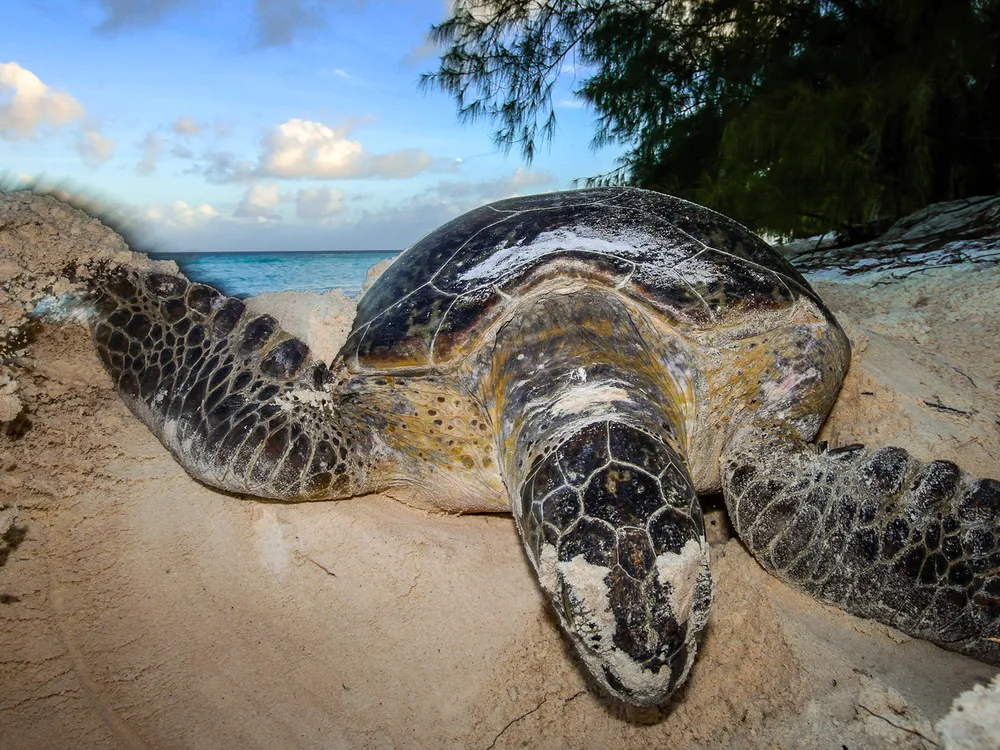
We hear the turtle before we see her. She makes soft scraping sounds as she moves across the dry sand in search of a good spot for her own nest. The turtle, as clumsy on land as she is elegant in the water, tosses some sand with her flippers, then lets out a low sigh. She moves farther into the trees, seemingly indecisive.
The sight of a nesting sea turtle on Aldabra is far more common now than it was 50 years ago. Here and around the world, green turtles were a valuable source of meat and leather, and their eggs were considered a delicacy. During the first two-thirds of the 20th century, large numbers of green turtles were slaughtered across the islands in the western Indian Ocean. On Aldabra, hunters ambushed females coming up to nest, chopping their heads off. At the end of the 19th century, as many as 12,000 green turtles were captured at the atoll per year.
By the 1960s, annual nests on Aldabra had hit a low point of 2,000 to 3,000. But a hunting ban in 1968 gave Aldabra’s turtles a key safeguard. Now, after decades of local and global efforts to reverse their decline, the atoll is the site of the longest-lasting continuous protection for nesting green turtles in the western Indian Ocean—and one of the most important regional hubs for the species, trailing only Europa Island.
A similar resurgence can be seen on many beaches around the world. In October 2025, green turtles were downlisted by the International Union for Conservation of Nature from endangered to a species of least concern. It reflected one of conservation’s most remarkable comebacks—and a global one, as green turtles inhabit all the world’s major oceans.
The IUCN estimated that green turtles’ worldwide numbers have increased by roughly 28 percent since the 1970s. A separate 2025 assessment found that 8 of their 11 regional populations are at low risk. Still, some green turtle populations are considered threatened and remain dependent on conservation efforts.
Key context: Turtle comeback
This year, the loggerhead sea turtle—another of the world’s seven sea turtle species—broke a record for nesting success. In Georgia, the reptiles laid 4,174 nests, the most since researchers began comprehensive surveying in 1989.
Today, the remote and protected Aldabra atoll exemplifies the green turtle’s recovery. Aldabra is part of Seychelles, a nation of islands that are spread across a patch of ocean roughly the size of Montana. Rising about 26 feet above sea level, the atoll is one of the world’s largest and most pristine raised coral atolls—a ring of islands surrounding a lagoon that could easily fit Manhattan inside. Most of its shoreline is protected by jagged limestone cliffs. But bits of sand are accessible: some 50 pocket beaches and the larger Settlement Beach on its western edge.
Fewer than three dozen people live on the atoll, all at the research station run by the Seychelles Islands Foundation. Those researchers have monitored green turtles along the ring of coral islands for more than half a century.
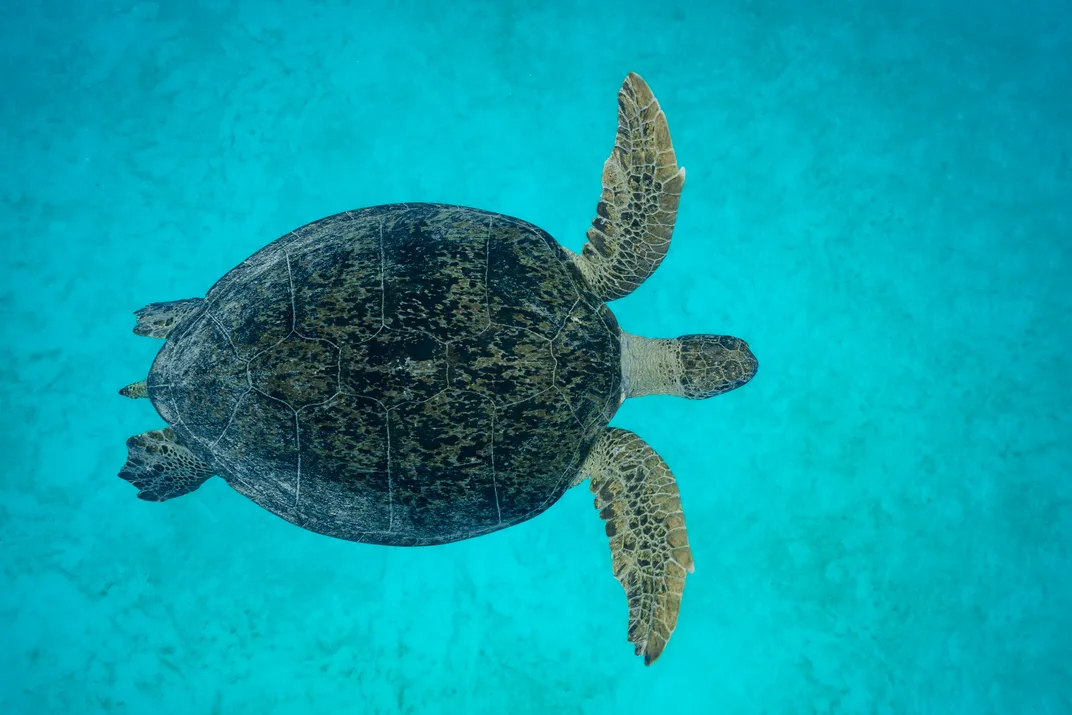
Green turtles are citizens of the sea. What happens at a nesting hub like Aldabra can echo throughout an ocean basin. Satellite tracking has mapped their voyages across more than 1,500 miles as they disperse from the atoll along distinct routes like the crooked spokes of a wheel to forage for seagrass in coastal shallows—as far north as Somalia, south to Mozambique and even to the southern tip of Madagascar.
Environmental economist Adam Pritchard analyzed Aldabra’s trove of nesting data for England’s University of Exeter in research published in 2022. “It’s a kind of Eden of conservation that allows you to see going from a period of heavy exploitation to almost none,” he says. Few places offer such a clean demonstration of what sustained protection can accomplish.
Turtle expert and conservationist Jeanne Mortimer watched that shift happen. When she first visited Aldabra in 1981 to assess the turtle population, she encountered a lonely beach. “I’d walk two kilometers and maybe find two or three tracks,” she says. “It was a lot of work for not many tracks.” Her work began the five decades of surveys, in which researchers monitored the population by counting the tracks left by nesting turtles—like those Talma and I saw.
About fifteen years later, Mortimer began noticing more breeding females returning to Settlement Beach. But it was a false signal. It was not an increase in the population, she says. Not yet. “They were [just] no longer having their heads cut off.” The turtles’ late age of sexual maturity, 25 to 35 years, meant it would take decades for a generation born under protection to return to the beach and reveal the impact of the hunting ban. But, in time, they did.
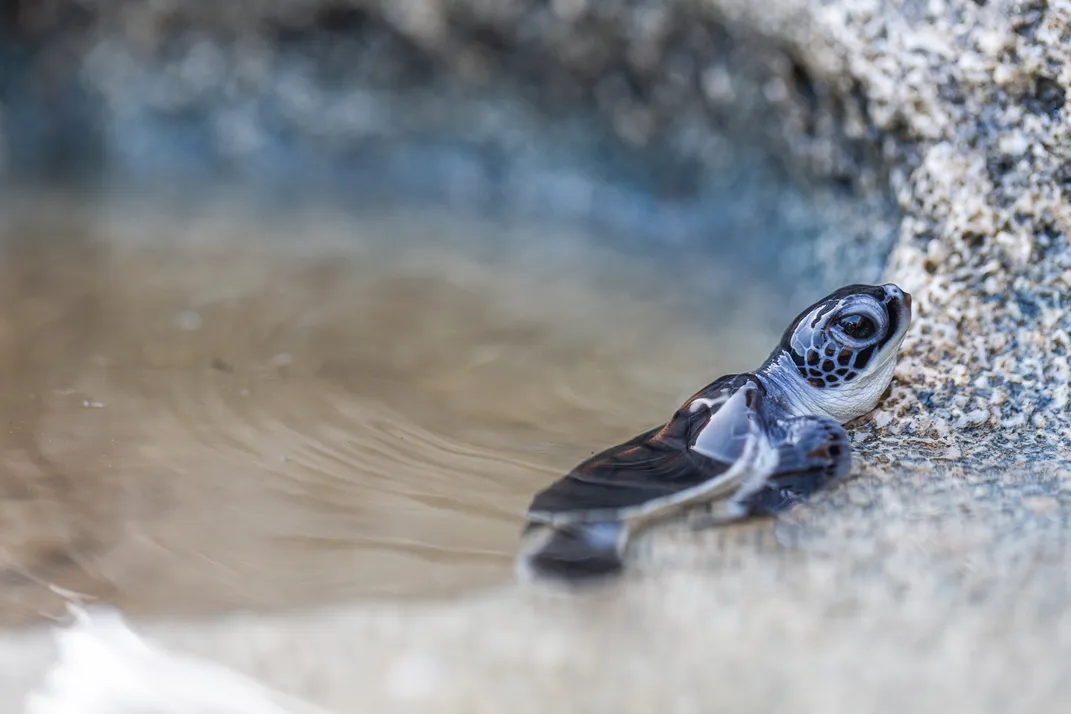
In 2019, research staff estimated more than 15,000 clutches of eggs across the atoll—a 173 percent increase since 1980. “Now, it’s ridiculously noticeable,” Mortimer says. On Settlement Beach alone, “you can find close to 100 turtles in one night at the peak season,” she adds. The increase in nesting females shows no signs of slowing. “It probably still isn’t quite at carrying capacity,” she adds.
Behind the global story, however, lies another truth—that green turtle recovery is uneven. Zoom down to the ocean basin level, and a small population in the south-central Pacific remains in serious trouble, facing pressure from bycatch, hunting and climate change. Other populations in the East Pacific, southwest Pacific and North Indian Oceans are vulnerable, with some declines in nest numbers.
“Is it a conservation success story? Yes,” says Pritchard. “But are we done? The answer is definitely no.”
Throughout the Seychelles islands, turtles and people have come to exist in something approaching inverse proportion—wherever there are more humans, there are fewer turtles. Mortimer is interested in where those turtles are, which could shed light on at-risk populations that are hidden by the overall growth trend. “It’s rosy, but it’s not as rosy as people might like to think,” she says. The health of the green turtle population varies across Seychelles. “You’ve got thousands in the far south. You’ve got hundreds in the Amirantes and tens in the Inner Islands.”
The Inner Islands include Mahé, home to the country’s capital and most of its human population. At one Inner Island site, no green turtle nests were recorded during the first decade of a 33-year data set, Mortimer says. Now seven may be found in a year. Even in these human-occupied areas, the recovery is real—a “tiny little curve,” Mortimer calls it—but green turtles in the Inner Islands remain “balancing on a knife edge.” Her worry is that the new global label of “least concern” makes the species’ recovery sound complete.
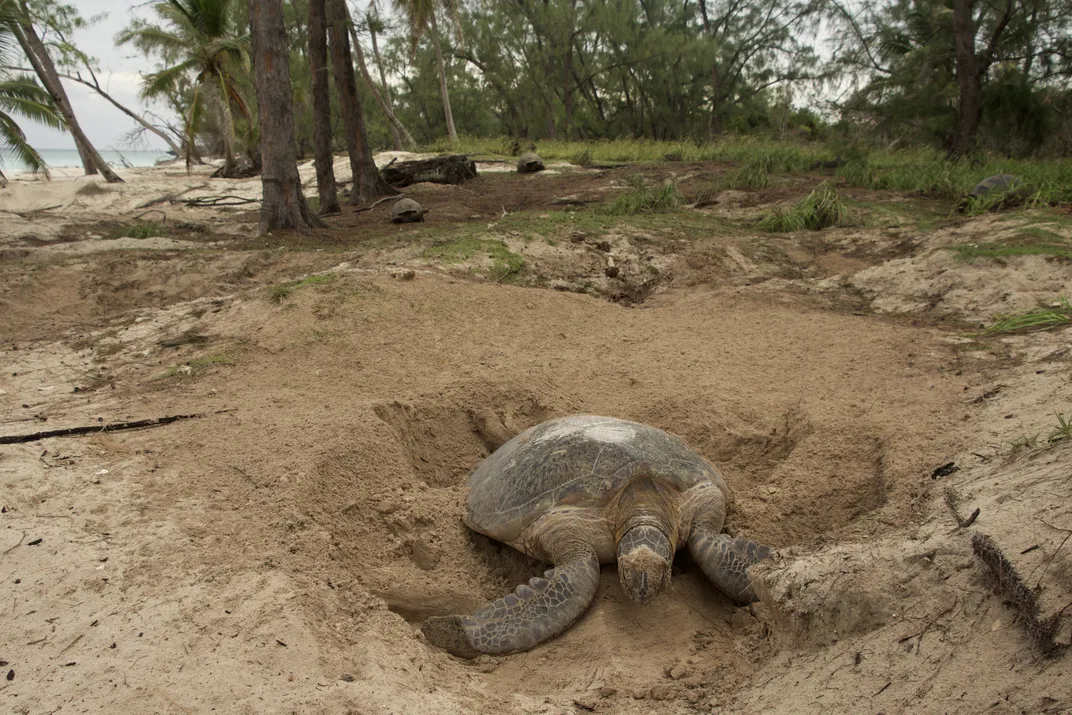
On Aldabra’s nearest neighbor, Assumption Island, green turtle recovery has been less documented, but the potential may well be even greater. With a sweeping three-mile beach and a deep approach that green turtles prefer, Assumption Island was historically an even better nesting site, notes Mortimer. “At the turn of the 1900s, it had more turtles than Aldabra,” she says.
Then, guano mining operations in the early 1900s destroyed much of its vegetation and most of its birds and brought up to 100 resident workers who hunted turtles relentlessly into the 1980s. Since the hunting stopped, Mortimer has witnessed a dramatic recovery.
Forty years ago, Mortimer wrote that evidence of green turtle recovery might lead to demands for renewed hunting. Now, on Assumption, the durability of the species’ return hinges on a different kind of test. A recent luxury resort development, with a string of villas near the beach, raises the specter of familiar threats: habitat loss from construction, lighting near nesting areas that can disorient hatchlings and the influx of tourism.
The new challenge will be finding a way for humans to coexist with the animals. “How do you control people in the areas where the turtles are most vulnerable?” Mortimer asks. “Because the places where you have the highest numbers of turtles, there aren’t any people. You would have a giant green turtle population there if you just leave them alone and let them breed.”