
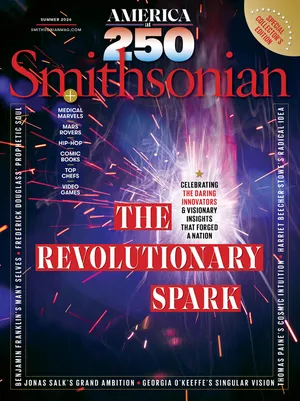
America at 250: The Revolutionary Spark
A Smithsonian magazine special report
In the Early 1900s, a Young Ecologist Shot a Wolf and Watched the Life Leave Its Eyes. That Changed His Position on Conservation
Aldo Leopold’s writing reconsidered the place of humans in the natural world and challenged people to be less conquerors of the land and more citizens of it
/https://tf-cmsv2-smithsonianmag-media.s3.amazonaws.com/filer_public/05/dd/05dde32f-3d0b-4faf-baac-5a8649056ea0/aldo_leopold.jpg)
One day in the early 20th century, in eastern Arizona, a forester—“full of trigger itch,” as he later wrote—leaned over a rimrock ledge, readied his rifle, and shot a wolf.
This was hardly unusual: Wolves and other carnivores were mammalia non grata, persecuted for their perceived crimes against livestock and deer. “In those days, we had never heard of passing up a chance to kill a wolf,” the forester, Aldo Leopold, would recall decades later. More surprising was what followed: remorse. Standing over the fading wolf, Leopold watched a “fierce green fire” die in her eyes. “There was something new to me in those eyes,” he wrote—an epiphany that would forever change his perspective on nature, and our own.
America has been graced with plenty of environmental prophets, yet Leopold’s work has arguably had the greatest influence on conservation. His fatal, fateful wolf encounter epitomizes his perspicacity: He gazed into the eyes of an expiring animal and intuited an ecological truth.
Born in 1887 to a nature-loving Iowa family, Leopold graduated in 1909 from the Yale School of Forestry and headed to the Southwest to serve in the U.S. Forest Service, an agency founded just four years earlier. Conservation was newly urgent: Decades of overgrazing by livestock had peeled away “an incalculable amount of very fine soil,” as Leopold wrote, and wanton hunting and trapping had laid waste to what he called “the richest fauna in the world.” Automobiles would soon run roughshod over the American countryside, injecting tourists into once-roadless landscapes. America was becoming aware of nature’s limits and developing institutions to protect it.
While 19th-century writers like Henry David Thoreau were content to observe and celebrate nature, Leopold was also a scientist who made substantial contributions to fields including forestry, wildlife management and the discipline we now know as ecology. He churned out journal articles, op-eds and letters with the indefatigability of a printing press. In a seminal 1921 paper for the Journal of Forestry, for instance, he championed the preservation of the Gila National Forest in its “semi-virgin state,” an idea that led to its designation as the country’s first wilderness area in 1924.
By far his best-loved work is A Sand County Almanac, a posthumously published essay collection that bent the trajectory of environmental thought—particularly through Leopold’s idea that humans are mere players on a “biotic team” encompassing wildlife, vegetation, soil, water and other natural elements. Today our interdependence with the natural world is almost a truism, but when Sand County was published in 1949—just a few decades after the near extinction of the bison, and at the dawn of the atomic revolution and the Interstate Highway System—it was radical to aver that Homo sapiens should transition from “conqueror of the land-community to plain member and citizen of it.”
Buddy Huffaker, executive director of the Leopold Foundation, compares what Leopold called his “land ethic” to the Copernican Revolution, which recast the Earth as a component within the solar system rather than the universe’s heart. “Leopold challenges us to reframe humans from being in the center of everything to being a part of everything,” Huffaker said in an interview. That mind-set would shape developments from 1970s environmental legislation to the rise of organic agriculture.
Did you know? The Gila Wilderness Area
- At nearly 560,000 square miles, the Gila Wilderness Area was created in June 1924.
- Visitors to the region can find evidence of volcanic activity, rock spires, steep cliffs, among other natural wonders
- The Mogollon people, ancestors of the Pueblo, lived in the region before the arrival of Europeans. Their 13th-century dwellings are still visible in the area.
Indeed, to revisit Sand County is to be struck by its prescience. Practically every significant strand of modern environmental thought is woven into its essays. Long before biologists proved that many parks were too small to sustain wide--ranging animals like grizzly bears, Leopold noticed that species “do not seem to thrive as detached islands of population.” And though he had long been a proponent of killing predators to bolster huntable game, he described his change of heart in his essay “Thinking Like a Mountain.” Without wolves, he realized, deer browsed “every edible bush and seedling” to nubbins, starving themselves in the process.
Biologists have since documented how the disappearance or addition of predators can shift an entire ecosystem. The effects have been measured in seagrass beds, rainforests and tide pools, catalyzed by animals as diverse as tiger sharks, jaguars and sea stars. But Leopold expressed this concept with matchless concision: “I now suspect that just as a deer herd lives in mortal fear of its wolves, so does a mountain live in mortal fear of its deer.” His views on wildfire also evolved over time. Like most foresters, he once considered it a scourge; later, he recognized it as a force of grassland rejuvenation. That Native people deliberately started fires to promote wildlife habitat did not escape his attention.
In 1935, Leopold, then a professor at the University of Wisconsin, purchased a Sauk County farm. When he broke the news to his wife, Estella, and their five children, “they imagined this house with geraniums and white flower boxes in the front,” recalled Susan Leopold Freeman, his granddaughter, in an interview. The reality was bleaker: The main farmhouse had burned down, leaving behind only exhausted soil, ravenous mosquitoes and a battered chicken coop. None of this daunted the Leopolds. They planted trees—white pines and jack pines, red oaks and red cedars, maples and tamaracks—alongside shrubs, grasses and wildflowers like violets and trillium. Around 50,000 pine seedlings went into the sandy earth.
Leopold suffered a fatal heart attack in 1948, at 61, while fighting a fire on a neighbor’s property. Restoration remained a family passion: In the 1990s, Freeman and her husband, Scott, purchased an 18-acre dairy farm along a damaged stream in western Washington and set about recontouring its channel and replanting its flood plain, to the delight of beavers, otters, cougars and salmon. Legions of volunteers aided the recovery, among them the couple’s children and grandchildren. “When you work on the land and plant trees, it touches something very deep inside people,” Freeman said.
Though Leopold lamented the effects of human industry, his writing rarely comes across as misanthropic. As Huffaker put it, “Leopold casts people as positive actors in the unfolding drama of the world.” People possess the capacity to harm, but also to protect, to cherish and to restore. An ethical relation to nature, Leopold wrote, must emerge from “love, respect and admiration for land.” And Leopold had love to spare—even, in the end, for the wolf he killed.
Subscribe to Smithsonian magazine now for just $19.99
This article is a selection from the Summer 2026 issue of Smithsonian magazine
An American Conservation Corps
These forward-thinking scientists and policymakers changed our approach to earth, water and air
/https://tf-cmsv2-smithsonianmag-media.s3.amazonaws.com/filer_public/eb/38/eb3827f4-57c3-4f70-a929-39f9a12252e9/conservation_corps-v1_1.jpg)
John Wesley Powell, Water (1870s-1890s): After surveying the Colorado River and its tributaries, Powell issued prescient warnings about Western water scarcity.
Bernhard Fernow, Forestry (1880s-1910s): The country’s only trained forester until 1891, Fernow drafted the laws that created the U.S. forest system. He also founded the first forestry degree program, at Cornell University.
George Washington Carver, Soil (1890s-1940s): The agricultural scientist studied and promoted crucial techniques for replenishing depleted soil, including crop rotation.
J.N. “Ding” Darling, Wildlife (1930s-1940s): The influential political cartoonist led efforts to reverse environmental damage and establish the National Wildlife Federation.
Rachel Carson, Environmental Health (1950s-1960s): Her book Silent Spring raised awareness of toxic pesticides and helped launch the modern environmental movement.
E.O. Wilson, Biodiversity (1960s-2010s): Ants were his first love, but Wilson expanded his lens to include larger ecosystems. He argued that preserving the diversity of species was crucial for life on Earth.
Ada Deer, Native Lands (1970s-2020s): The first woman to oversee the Bureau of Indian Affairs, she helped Native groups gain sovereignty, including the right to restore and manage their own lands.