
/https://tf-cmsv2-smithsonianmag-media.s3.amazonaws.com/filer_public/e2/71/e2710538-c2f3-4f51-b602-62117ad500e7/smithmag-brainonart-v2.jpg)
Does the Experience of Beauty Show Up in the Brain? With Electrodes and a Museum Collection of Artifacts, These Neuroscientists Aim to Find Out
Researchers are tracing the brain and body’s response to aesthetic expression in search of a scientific value to art
/https://tf-cmsv2-smithsonianmag-media.s3.amazonaws.com/accounts/headshot/DSC_4581-edit.png)
:focal(750x500:751x501)/https://tf-cmsv2-smithsonianmag-media.s3.amazonaws.com/filer_public/e2/71/e2710538-c2f3-4f51-b602-62117ad500e7/smithmag-brainonart-v2.jpg)
“You may open your eyes now,” the researcher says.
Beneath the tight fabric compressing my skull like a swimming cap, 32 electrodes are primed to catch the firing of neurons in my visual cortex, where information about what I’m seeing is processed in my brain. Two more electrodes taped to my clavicles track my heartbeat, and a pair on my left hand gauge my skin’s electrical conductance, or sweat. Wired up, I observe the gold tones and minute engraved lines on the object in front of me—a brass astrolabe used by Galileo himself—as Francesco Goretti hunts for the biological signature of beauty in my body.
Goretti is part of a research team at the new Laboratory of Neuroaesthetics, a collaboration that’s measuring how people react to the beauty of items in the historical and scientific collections at the Galileo Museum in Florence, Italy. The goal of their experiment, in which I participated as a volunteer, is to understand the biological and neural changes triggered by the aesthetic experience—how the body and brain respond to art.
In a secluded room hidden behind a panel in the museum’s entrance hall, I sit in front of a copy of Galileo’s astrolabe, used historically to tell time and observe the stars. Moments ago, with my eyes shut, I listened as Goretti offered a verbal description of the object. Now, as I size it up visually, he can monitor how prior knowledge affects my reaction.
/https://tf-cmsv2-smithsonianmag-media.s3.amazonaws.com/filer_public/dc/fd/dcfd276a-b582-4807-980a-bc626cd00bb1/dsc_0174_1.jpg)
The instrument is a masterpiece of intricate metalwork, glowing with the luster of brass. Its surface is a labyrinth of fine engravings, where delicate, spindly lines arc like a golden spiderweb. My eyes trace the elegant sweep of the alidade, a slender bar that bisects the central map of the celestial sphere, and the surrounding rings crowded with meticulously etched zodiac symbols and minute calligraphic numbers. Although an astrolabe might not seem like a piece of art, scientific instruments in the Renaissance were designed with a high “aesthetic load,” Goretti explains to me later. “At that time, science was expected to be beautiful.”
Did you know? A valuable astrolabe
An 18-inch-tall astrolabe created by brothers Qa’im Muhammad and Muhammad Muqim in 1612 fetched more than $2.75 million at a London auction in April.
For millennia, painters, sculptors, writers, musicians and thinkers have explored deep human experiences—love, beauty, desire and how we see the world—through art. Today, the field of neuroaesthetics studies these mysteries from a scientific perspective.
This emerging line of research “aims to understand the brain mechanisms that are engaged during aesthetic and allied experiences in the wildest sense,” as Semir Zeki, a neurobiologist at University College London who established the field in the 1990s, recently wrote. Among other things, it investigates whether our tastes are hardwired from birth or learned over time—and why people have such different opinions on what looks good.
I am asked to provide a numerical beauty rating for the astrolabe. For me, the contrast between its cold, mathematical precision and the warm, handcrafted artistry of the brass is what makes it appealing; I give it a top score. The scientific instruments track where my brain lights up as I make that decision.
“Neuroaesthetics,” Goretti says, “is a search to give a value, a quantity, to beauty—to locate it, perhaps, in the brain and in the heart.”
What happens when we encounter beauty?
In 2011, Zeki discovered that making a judgment about whether something is beautiful or ugly involves activation of the medial orbitofrontal cortex, a brain region located just above the eye sockets. This activity, he suggested, is correlated with the reported level of beauty: The more beautiful a person thinks a sight is, the more activity appears in that specific brain area.
Over the past decade, neuroscientists have come to understand that when we encounter something beautiful, our brains do more than just flip a single switch. Instead, the response is a complex interaction between our senses, emotions and personal histories, says Anjan Chatterjee, a neurologist at the University of Pennsylvania and the founder of the Penn Center for Neuroaesthetics.
Chatterjee has proposed an aesthetic triad framework in which three major systems across the brain work in parallel to interpret beauty: The sensory-motor system analyzes what we see, the emotion-valuation system decides how much we like it and our knowledge-and-meaning system connects the experience to our personal background.
This often feels like a “cocktail of emotions,” he says. But these reactions aren’t just in our heads; they show up in our bodies through physiological shifts, such as changes in heart rate or skin responses, which reflect how deeply we are being moved or calmed by what we are looking at.
Using various kinds of imaging, neuroaesthetics researchers can see patterns of activity in the brain’s reward, sensory and emotional networks. They can track the exact timing and strength of a brain’s response to music or an image. By measuring heart rate, breathing and sweat, as well as shifts in neurochemicals and hormones like dopamine, oxytocin and cortisol, they can determine the intensity of a person’s aesthetic engagement.
/https://tf-cmsv2-smithsonianmag-media.s3.amazonaws.com/filer_public/6b/ce/6bce14e9-f642-4755-9568-1983ae367d03/dsc_0207_1.jpg)
At the Galileo Museum, “the current focus is strictly on mapping the neural activity and biological markers during the experience itself,” Goretti says. Later, the project could expand into exploring wider questions, such as how museum collections affect viewers’ well-being.
Because the signals being measured, like brain waves and heart rhythms, are incredibly complex, however, the team needs a large number of participants before they can reach definitive conclusions. Goretti expects to begin pulling together the first major results after this summer.
“Data are an inexhaustible source of information, but it is not simple to interpret them,” he says.
In search of a universal experience
For some, the idea of using science to study art might feel like an intrusion into a deeply private world. There is a common belief that because art is subjective, it is impossible to measure with cold, hard data, Zeki writes. But some experts have suggested that people’s responses to art might be more alike than we think.
Philosophers Immanuel Kant and Arthur Schopenhauer argued that aesthetic experiences aren’t purely random or personal. Kant believed that when we find something to be beautiful, we feel that everyone should agree with our judgment, implying that our taste reflects a universal logic. Schopenhauer suggested that art allows us to momentarily escape our personal desires and tap into a deeper, shared human reality.
In pursuit of describing this elusive feeling, researchers can measure parts of aesthetic experiences: “We now have tools that can noninvasively get inside our heads and study how the brain and body respond to art and beauty,” says Susan Magsamen, the founder and director of Johns Hopkins’ International Arts + Mind Lab, Center for Applied Neuroaesthetics, and a co-author of Your Brain on Art. “But those are really correlates and signatures, not the experience itself.”
For example, an increase in heart rate or sweat typically signifies emotional arousal. However, while these sensors tell us how much someone is feeling, they struggle to identify what they are feeling. “I can understand that you are getting emotional,” Goretti says, “but it is much more difficult to understand the polarity—I can’t tell if you are feeling fear or if you are ecstatic.”
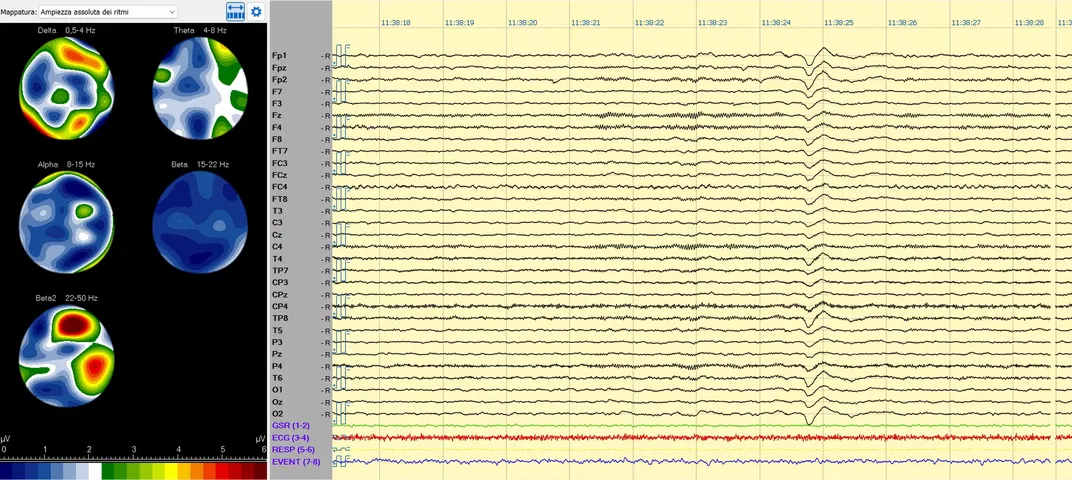
To make sense of their data, the Galileo Museum researchers analyze how different types of brain waves are distributed across the skull as a person decides whether an object is beautiful. They also use a technique called hyperscanning—which simultaneously records brain activity from two participants—to see if their neural signals begin to synchronize as they view the same item.
The researchers are also testing whether an artificial intelligence algorithm can learn to predict a person’s beauty rating for an object based solely on their biological signals. In this way, the team might reveal underlying patterns in the experience of beauty that may be too subtle for the human eye—or even the conscious mind—to detect.
Still, certain elements of the artistic experience remain beyond a sensor’s reach, Magsamen says. Because every aesthetic moment is shaped by a person’s history, culture, body and context, she argues, scientists should view quantification as a tool to deepen our understanding of art, rather than as a method to collapse the full richness of art and beauty into a single, neat number.
Neuroaesthetics, Chatterjee says, can also be a tool for self-discovery. Our reactions are filtered through our experiences, so noticing what moves us helps us understand our own values, he adds. “Ultimately, the question is, what is your experience of this art?” he says. “That is a way to think of art as a means for people to understand themselves.”
Art makes us human
In the quiet room at the Galileo Museum, the data continues to scroll across Goretti’s monitor. I am still staring at the astrolabe. My visual cortex is tracing the model of the universe, my memories are searching for stories of Galileo’s late-night observations and somewhere in my medial orbitofrontal cortex, a signal is being assigned to my perception of the dim light hitting the metal.
As I sit there, wired to the computer, I realize that the drive to quantify this moment goes deeper than mere scientific curiosity. As Magsamen puts it, to understand the aesthetic experience is to understand what makes us most human. The arts activate our brains’ pleasure, reward and fear circuits, she says, suggesting that our ability to create and appreciate art is a fundamental biological trait tied to our survival as a species. By engaging these circuits through art, early humans were able to build social cohesion, share complex cultural knowledge and imagine new solutions to environmental threats, Magsamen adds—and these traits offered our ancestors a significant evolutionary advantage over more solitary or less imaginative species.
“The arts are the language of humanity, our deepest and earliest form of complex communication and connection,” Magsamen says. “They still serve the same function today; they help us communicate and connect with one another, much as they did in our evolutionary past.”
Shielded from the noise and distractions of the museum’s public galleries, the silence in the lab is punctuated only by the click of Goretti’s mouse as he saves the session data. He leans toward the table and takes the astrolabe away. “You may close your eyes again,” Goretti says, as he reaches for the next masterpiece.
/https://tf-cmsv2-smithsonianmag-media.s3.amazonaws.com/accounts/headshot/DSC_4581-edit.png)