
/https://tf-cmsv2-smithsonianmag-media.s3.amazonaws.com/filer_public/65/1e/651e7a00-2459-4cd9-b0bf-73d22729a386/crf-smithsonian-250719-090.jpg)
Cascade Red Foxes Are Notoriously Reclusive. So How Did This Photographer Capture These Stunning Images of the Endangered Species?
Even the scientists who study the animals rarely see them except on camera. But Gretchen Kay Stuart spent a season documenting them up close
:focal(2025x1350:2026x1351)/https://tf-cmsv2-smithsonianmag-media.s3.amazonaws.com/filer_public/65/1e/651e7a00-2459-4cd9-b0bf-73d22729a386/crf-smithsonian-250719-090.jpg)
You never forget your first glimpse of a Cascade red fox.
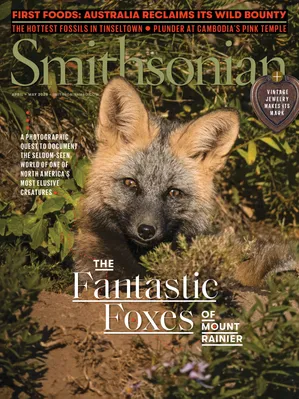
For the wildlife photographer Gretchen Kay Stuart, it happened in 2020, while she was driving up the slope of Washington State’s Mount Rainier. As soon as she spotted the bundle of fur on a snowbank, she says, “I knew she wasn’t a normal fox.” The animal’s coat was pale, tawny and extraordinarily bushy. “She looked so different and so beautiful. I instantly fell in love, and I photographed her. But I was like, ‘What is this fox?’”
An online fox hunt revealed very little information. The one short write-up she could find was on the website of the Cascades Carnivore Project, a nonprofit founded and directed by the wildlife biologist Jocelyn Akins. A photo made clear that the animal Stuart had seen was a Cascade red fox. Somewhat confusingly, these animals aren’t always red. Their name simply indicates that they’re a subspecies of the standard red fox that lives in the lowlands. Only about 50 Cascade red foxes have been identified, all of them on or around Mount Rainier or nearby Mount Adams. Even Akins, who had been working to protect them since 1999, had rarely spotted one in the wild. “Jocelyn told me, ‘We really only see them on our trail cameras, if we’re lucky,’” recalls Stuart, who took those words as a challenge. “She just laughed at me, like, ‘Ha ha! Good luck.’ She didn’t think I would find them. But I found another individual that summer, and the following year, I found another two. I became obsessed.”
/https://tf-cmsv2-smithsonianmag-media.s3.amazonaws.com/filer_public/e9/30/e930cab9-284c-4b44-a362-b2f9bcfddd24/crf-smithsonian-250718-002.jpg)
/https://tf-cmsv2-smithsonianmag-media.s3.amazonaws.com/filer_public/ae/75/ae7584e4-c1c6-4619-9901-f589e85bc39c/crf-smithsonian-251005-035.jpg)
/https://tf-cmsv2-smithsonianmag-media.s3.amazonaws.com/filer_public/88/af/88af80ed-19a0-4c6b-b5a3-09cdd2ed9ab0/crf-smithsonian-251004-030.jpg)
Conservationists usually don’t worry much about foxes. These adaptable animals, in the same family as dogs and wolves, live on every continent other than Antarctica. The ancestors of North America’s foxes are thought to have crossed the Bering Land Bridge from Asia, just as early humans likely did.
But during an ice age that ended 11,000 years ago, these foxes became isolated in separate populations. Some stayed in the lowlands and became the ancestors of ordinary red foxes that amble through suburban neighborhoods, sniffing around garbage cans. Others adapted to cold conditions, and as the climate warmed, they sought refuge at higher altitudes like the Cascade Mountains in what is now Washington State. “They’re just stuck in these high elevations without the ability to increase genetic diversity,” Stuart says. “They’re becoming inbred, really. They have a lot of threats that they face.”
Some of the most dire threats come from humans. Foxes spend three to four months raising their kits in dens, sheltered sites, sometimes close to human communities, where food is more plentiful. In June 2025, Stuart was excited to come across a Cascade red fox den at a ski resort, but she noticed right away that the location had many hazards. Indeed, the father ended up being hit by a car. Other members of the family died, apparently after ingesting rodenticide, which ski resorts often use to prevent deer mouse infestations. Akins says the Washington state government has been working with resorts to minimize such hazards, but they’re impossible to eliminate completely. “People want to ski,” Akins said. “That is a challenge for wildlife, as is a road, as is climate change.”
About a month after the dispiriting news about the ski resort den, Stuart got a call from Mount Rainier National Park. A volunteer had found another Cascade red fox den with three kits, one male and two female. Although Stuart is a photographer, not a scientist, researchers and park rangers knew that she had a special history with the famously elusive creatures. A few years earlier, she’d partnered with the Cascades Carnivore Project on a public awareness campaign, which helped persuade Washington State to list the Cascade red fox as endangered in 2022.
/https://tf-cmsv2-smithsonianmag-media.s3.amazonaws.com/filer_public/7d/33/7d33e3d5-1d4f-44b4-9323-56cdf92ddcc7/crf-smithsonian-250910-007.jpg)
Did you know? Following the Cascade red fox
- Traditional tales from local Native cultures about clever mountain foxes provide clues about where the Cascade red fox lived before Europeans arrived.
- The mountains where the Cascade red foxes reside have a higher annual snowfall than any other place in the United States, including Alaska, which makes it harder to track the species. Camera traps help, however.
/https://tf-cmsv2-smithsonianmag-media.s3.amazonaws.com/filer_public/ed/ee/edee6e78-1c69-4408-aeff-dd93a6ddcbab/crf-smithsonian-250830-103.jpg)
/https://tf-cmsv2-smithsonianmag-media.s3.amazonaws.com/filer_public/9d/c9/9dc99dad-f009-40df-a971-bebc71b8bbbe/crf-smithsonian-251004-085.jpg)
/https://tf-cmsv2-smithsonianmag-media.s3.amazonaws.com/filer_public/c0/bf/c0bfcbce-daeb-431d-92d0-896fe58173cd/first_weasel_carcass_she_saw_them_playing_with_-_crf-smithsonian-250801-094.jpg)
When Stuart arrived at the new den, she realized she knew the mother. She’d even given the female fox a name: Shadow. Akins, the wildlife biologist, says, “I always thought of foxes as not being identifiable as individuals. With a tiger or a leopard, you can identify it by its spots or stripes. But Gretchen was looking at subtler things. She was able to say, for instance, ‘That one has a notch in its ear.’ Then we could look at the camera traps and say, ‘That red fox we saw yesterday is the same one, or it’s different.’ We could get a better sense of how many there are across the population.”
The new den site was a sloping piece of land around several big trees. Its main access points were drainage tunnels under a trail, but the foxes built their own tunnels, which allowed them to pop up all over the place. But during Stuart’s first hour at the site, she watched tourists thronging around the fox family. At one point, the mother tried to bring a meal to her kits and was so spooked by the crowds that she ran off without making the delivery. When Stuart reported this to park officials, they swiftly barricaded the area and assigned volunteers to take turns guarding access points from 5 a.m. to 9 p.m.
For the next few months, Stuart was the only person granted access to the den site. She spent long hours sitting behind a blind, taking photos and jotting down copious notes, documenting how Cascade foxes raise their kits in a den. “When I’m living out of my van up on the mountain, my sleep schedule adjusts to sunrise and sunset,” Stuart says. “I was so anxious to be with the foxes that I didn’t want to waste time heating up coffee. So I would just have cold coffee. I ate a lot of snacky stuff—bananas, oranges, apples, granola bars, bread with hummus. And I would just sit and watch and wait.”
Male foxes are involved in raising and feeding their kits, and Stuart soon realized she knew the father, too. She’d seen him a year earlier out in the back country and named him Crag, because he was so good at scaling the mountains. “He’s got a bigger white portion on his tail, and he’s got longer legs than a lot of the others,” she says.
/https://tf-cmsv2-smithsonianmag-media.s3.amazonaws.com/filer_public/0a/ba/0aba69b0-b406-4827-bff1-2a446031c8c8/crf-smithsonian-251003-025.jpg)
/https://tf-cmsv2-smithsonianmag-media.s3.amazonaws.com/filer_public/16/ea/16eadb64-da29-4993-8fc5-96694c309ae2/crf-smithsonian-250830-010.jpg)
/https://tf-cmsv2-smithsonianmag-media.s3.amazonaws.com/filer_public/31/72/31723d6f-af11-464b-98c8-633317fe1844/crf-smithsonian-250809-000.jpg)
/https://tf-cmsv2-smithsonianmag-media.s3.amazonaws.com/filer_public/2c/68/2c687c22-3fde-46e0-a84d-d9bac0780529/crf-smithsonian-250808-073.jpg)
Stuart watched Crag make meal deliveries to his offspring. “He brought the kits a long-tailed weasel—and that was pretty surprising, because long-tailed weasels are vicious. But this dad was a fierce hunter.” The kits didn’t eat the weasel. “They just played tug of war with it. The funny thing was, the dad was insisting that the kits play with this weasel. They would play with it for a while, and then they’d drop it and start playing with each other. He would go and pick it up and bring it back to them and make them keep playing with it.”
Why was the father fox so enthusiastic about this morbid version of Pop Goes the Weasel? Parents who encourage their kits to play with dead animals are generally teaching them to hunt, though a weasel seemed like an unusual choice, because foxes generally don’t eat them. “Maybe a weasel was the dad’s favorite childhood toy!” Stuart speculates. “I wish I could read their minds.”
/https://tf-cmsv2-smithsonianmag-media.s3.amazonaws.com/filer_public/86/2c/862ccf95-f2bd-43bb-a3f4-76b1d74a3708/crf-smithsonian-250902-028.jpg)
/https://tf-cmsv2-smithsonianmag-media.s3.amazonaws.com/filer_public/fd/f6/fdf65a23-4f4e-4cc5-83f1-65368fa33d15/crf-smithsonian-250601-111-2.jpg)
Subscribe to Smithsonian magazine now for just $19.99
This article is a selection from the April/May 2026 issue of Smithsonian magazine
/https://tf-cmsv2-smithsonianmag-media.s3.amazonaws.com/filer_public/9b/3d/9b3d977b-b4f5-41fb-904c-7e8efc166d0e/crf-smithsonian-250716-080.jpg)
/https://tf-cmsv2-smithsonianmag-media.s3.amazonaws.com/filer_public/27/15/2715c7cb-36ce-46aa-913e-6a3d67c63165/crf-smithsonian-251002-026.jpg)
The mother and father took turns bringing food, but every now and then, Stuart got to see the whole family of five together. “One time, the mom was with the kits, and all of a sudden she ran up the slope and scrunched down really quickly. I looked, and there was the dad. She was being really submissive, kind of rolling around, and he was just sitting there. The kits got all excited and ran over to him.”
Stuart hopes she’ll be able to observe another den at the same site next year. Akins says Stuart’s work is a testament to how a photographer can integrate into a research project. “There’s only so much we can do,” she says of her science team. “We don’t spend hours and days at dens. We’re covering a bigger geographic scope, endlessly collecting scat and setting cameras across the landscape, trying to find out how many Cascade red foxes there are and what their genetic diversity is. I tromp through the woods at top speed checking camera stations, and Gretchen’s like, ‘God, you walk so fast.’ She has complete patience. And she always has her big lens.”