
America at 250: The Revolutionary Spark
A Smithsonian magazine special report
With a Few Tweaks, the Country’s Favorite Sports Went From Pastimes to Part of the Fabric of Our Culture
Can you imagine a football game where there was never a passing play? The forward pass is just one of the innovations that made these contests into events
/https://tf-cmsv2-smithsonianmag-media.s3.amazonaws.com/filer_public/9b/7b/9b7b4c2b-c72d-4ab0-b96c-9e257ad16337/gettyimages-76286721.jpg)
The Forward Pass: In its earliest days, football was brutal, even deadly, with offense and defense smashing and scrabbling for a yard or two at a time. The Chicago Tribune reported that 19 athletes died playing the sport in 1905 alone, the last year before college football’s rules committee legalized the forward pass to prevent total barbarism. Notre Dame’s subsequent success with the passing game set football toward the more open, creative, full-field sport played today—still brutal, but more elegant, and much more popular.
Baseball’s Farm System: In the early 1920s, manager Branch Rickey realized that his cash-poor St. Louis Cardinals were “at a disadvantage in obtaining players of merit from the minors,” then a sprawling and ad hoc enterprise. Rickey’s Cardinals took over a minor-league team in Houston in 1924, and from there gradually built a system through which young players could improve over years, learning the finer points of a difficult sport while staying under the control of one team. It was a sound investment that made history. Soon every other team followed suit. A quarter-century afterward, Rickey signed Jackie Robinson to the Dodgers, integrating baseball. The latter milestone in sports history helped redefine American culture.
Night Baseball: In 1930, the Negro League’s Kansas City Monarchs started traveling with six floodlights on flatbed trucks, and their resulting night games gave fans with day jobs the chance to see live baseball. Crowds flocked, and big-league clubs came around to playing under the lights. From the White House, President Franklin Roosevelt threw the “first switch” to illuminate Crosley Field before the Cincinnati Reds played (and won) MLB’s first night game, in 1935; the Ohio crowd of 20,422 was nearly ten times the team’s average daytime draw. Attendance skyrocketed, and 11 of MLB’s 16 teams had electrified by America’s entry into World War II. The lights helped usher in the era of live sports as a premier television product.
The Shot Clock: Basketball before the 1950s was a dry game of keep-away—until the shot clock made its NBA debut in the 1954-55 season. Syracuse Nationals owner Danny Biasone devised the concept with Nats general manager Leo Ferris. In the liveliest games, Biasone said, “I noticed each team took about 60 shots. That meant 120 shots per game. So I took 48 minutes...and divided that by 120 shots.” That left teams with 24 seconds per possession—enough to imbue each trip down the floor with urgency.
Did you know? The Major League Baseball pitch-clock
- In 2023, Major League Baseball introduced a new innovation with the goal of shortening game times: a pitch clock.
- In its first year, the average length of a nine-inning game dropped 24 minutes, the shortest since 1985.
- Despite initial fears that the clock would increase injuries to pitchers, analyses found that no statistically significant increase occurred and the number of "Tommy John" surgeries has actually decreased.
Subscribe to Smithsonian magazine now for just $19.99
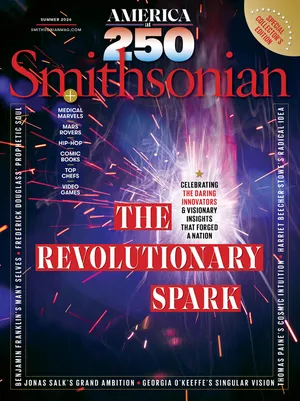
This article is a selection from the Summer 2026 issue of Smithsonian magazine