
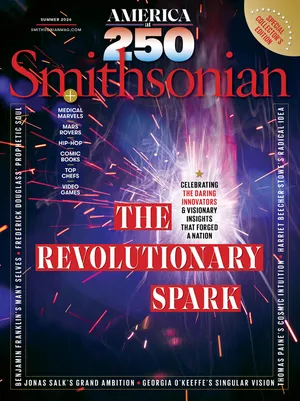
America at 250: The Revolutionary Spark
A Smithsonian magazine special report
When the Fear of Polio Gripped the World, Jonas Salk’s Determination Led to a Liberating Medical Breakthrough
The son of the doctor, himself now a physician and researcher, recalls his vaccination in the kitchen as painless. Now, he recounts the impact of the work his father led
/https://tf-cmsv2-smithsonianmag-media.s3.amazonaws.com/filer_public/a9/a2/a9a2af7e-39e3-43f1-82d8-829ba51d2f8c/jonas_salk_3.jpg)
In 1952, around 58,000 American children contracted polio. More than 21,000 were paralyzed and 3,000 died. The disease would start like a cold, and then, all of a sudden, children couldn’t breathe or couldn’t move their arms and legs. Because polio epidemics happened sporadically, parents never knew when the next one would take place. Where would it happen? Would their own children be stricken? Parents lived with enormous fear.
My father, Jonas Salk, shared that fear. One summer, my parents refused to take us to an amusement park, in an effort to avoid exposure to polio. But my father was different from other parents in one significant way: He was working on a vaccine that could keep a polio epidemic from ever happening again.
My brothers and I received our first injections of the experimental vaccine in 1953, when I was 9. My father and his team at the University of Pittsburgh had successfully completed animal studies the summer before, and they’d begun small preliminary studies with children who had already had polio and were undergoing rehabilitation. Now they were on the cusp of rolling out larger experiments in Pittsburgh schools. I imagine my mother saying to my father: “Okay, Jonas, it’s time to get our own kids immunized.”
My father brought some vaccine home and sterilized the syringes and needles by boiling them on the stove. Then he lined us up. My brother Darrell was 6, and my brother Jonathan was just shy of 3. Like any kids, we absolutely hated getting injections. Remarkably, though, when my father inserted the needle this time, I didn’t feel it. I’ve never forgotten that moment, standing in the kitchen, seeing the sunlight coming in through the window and realizing that my fears had been unnecessary.
/https://tf-cmsv2-smithsonianmag-media.s3.amazonaws.com/filer_public/cc/2f/cc2f9147-5f91-48ed-93a9-0aa9078ec656/jonas_salk_2.jpg)
My father began praying, early in life, that he could do something to help humanity. In 1934, during his first year at the City College of New York, he decided to study medicine. He didn’t want to be a practicing physician, although he was very good with patients. He wanted to conduct research that could have a large-scale effect.
In his microbiology class at New York University College of Medicine, my father’s professor described vaccines that had been developed in the 1920s for two bacterial diseases, diphtheria and tetanus. These bacteria secrete toxins that produce severe damage in the body. However, the toxins can be chemically modified so they are no longer dangerous but will still provoke an immune response when injected. After vaccination with the altered toxins, exposure to those bacteria would not cause disease. In contrast, the professor told the students it wasn’t possible to protect the body against viral diseases, such as influenza or polio, using an inactivated (killed) virus. He said that viruses had to replicate in the body and cause an actual infection to produce a protective immune response. That lecture set my father on a course to challenge this longstanding dogma.
While my father was still in medical school, he started working with one of his professors, Thomas Francis Jr., on methods to inactivate influenza viruses. He later continued this work at Francis’ new lab at the University of Michigan. The team developed the first successful influenza vaccine, using chemically inactivated influenza viruses. It was introduced first to the military, then to the general public in 1946.
In 1947, my father started his own lab at the University of Pittsburgh, gathering a strong team to work toward a polio vaccine. A pall had been cast over such programs in the 1930s, when two attempts to create a polio vaccine failed to produce immunity. One of the experimental vaccines actually caused polio in a small number of subjects. My father’s team knew they had to take a more systematic approach. They used a new method, developed by scientists at Harvard, of growing polioviruses in the laboratory, in cultures of monkey cells bathed in a nutrient medium. The team could then study these lab-grown polioviruses and determine the exact combinations of heat and formaldehyde solution required to kill them reliably. It was important not to alter the virus’s structure so much that the immune response to the vaccine would no longer match the original virus. If that happened, the vaccine would fail to protect against the disease.
Two members of the team, Elsie Ward and Julius Youngner, came up with a clever way to quickly establish whether live polioviruses were still present in test samples, using a pH indicator dye. Animal cells growing in test tubes would naturally turn the medium more acidic over time as they released waste products. As the medium became more acidic, its color would change from red to yellow. However, if live poliovirus was present in the cultures, the virus would kill the cells and the medium would remain red. This at-a-glance method allowed the team to significantly speed up vaccine production and testing.
Did you know? What happened next
- The 1.8 million children who took part in the nationwide field trial received certificates and special pins for being “Polio Pioneers.”
- Salk spent the rest of his career pursuing big-picture questions about the future of humanity, while working on vaccines for other viruses, like HIV.
/https://tf-cmsv2-smithsonianmag-media.s3.amazonaws.com/filer_public/57/4d/574d12ee-c51d-4e8e-99fe-b1f4b84ef4a1/untitled-1.jpg)
The first small-scale human trials, at the D.T. Watson Home for Crippled Children, showed that the vaccine was safe and that it produced antibody responses in the children’s blood. Further studies in the Pittsburgh area confirmed these findings. In April 1954, shortly before the summer polio season, a massive field trial began with 1.8 million children across the United States. One branch of the study was double-blind. Half of the children received the vaccine while the other half received a placebo injection, and neither the doctors nor the families knew which group the children were in. In another branch of the study, second graders got the vaccine with parental approval, while first and third graders at the same schools remained unvaccinated and served as “observed controls.”
Thomas Francis, my father’s earlier mentor, was responsible for evaluating the data. On April 12, 1955, he announced the results: The new vaccine was “safe, effective and potent” against all three strains of polio. Doctors watched the press conference on closed-circuit TV. Church bells rang out. Workplaces observed moments of silence or celebration. It was an extraordinary event in our nation’s history. All the terror that had accumulated for decades lifted in a single stroke. Within seven years, enough children were inoculated that the incidence of polio in the U.S. dropped by 97 percent.
That evening, Edward R. Murrow interviewed my father on his television program “See It Now” and asked who owned the patent for the vaccine. My father responded, “Well, the people, I would say. There is no patent. Could you patent the sun?”
The American people could take great pride in the vaccine, because the research and testing program had been supported by the March of Dimes, the fundraising arm of the National Foundation for Infantile Paralysis—an organization founded in 1938 by President Franklin D. Roosevelt, who himself had contracted polio in 1921. A hundred million Americans across the country had contributed to the effort. The achievement belonged to everyone.
Subscribe to Smithsonian magazine now for just $19.99
This article is a selection from the Summer 2026 issue of Smithsonian magazine