
America at 250: The Revolutionary Spark
A Smithsonian magazine special report
A Moment of Divine Inspiration Helped Melvil Dewey Bring Obsessive Order to the Infinitely Disorganized Stacks in the Library
The Massachusetts student let his mind wander during a Sunday sermon and created the decimal-based system that greatly simplified the search for any book you were looking for.
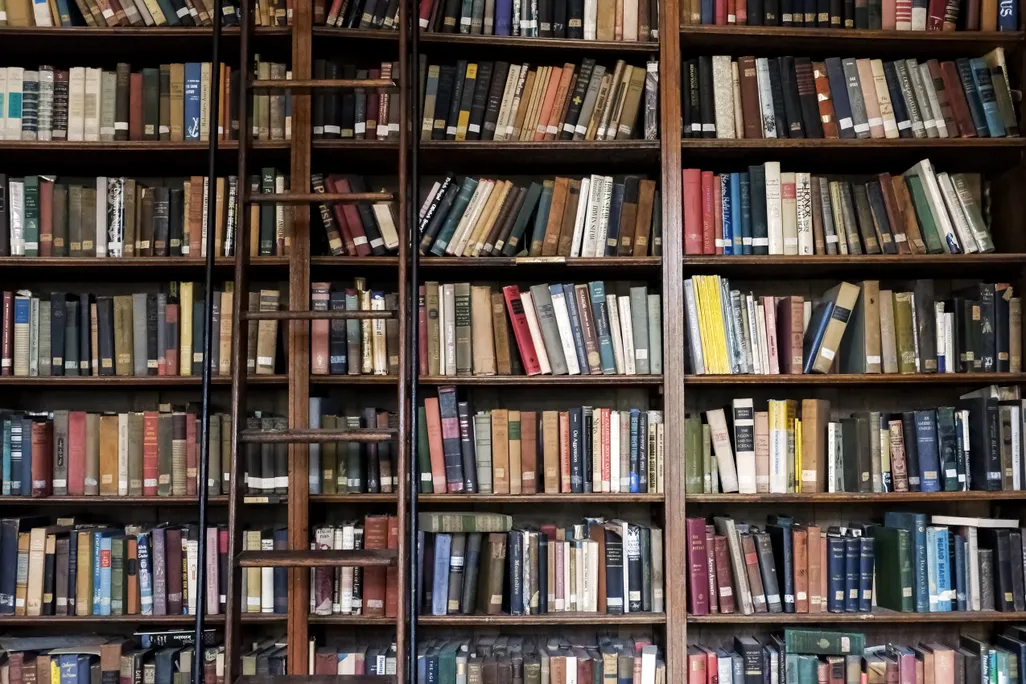
Melvil Dewey was a cash-strapped Amherst College student in the early 1870s, working at the school library to pay his bills. An intense young scholar, Dewey felt at home among the books. There was only one problem: They were so disorganized that finding a given volume could prove impossible.
One spring Sunday in 1873, he made a breakthrough. He was sitting in the college chapel, listening to a long sermon from the college’s president. His mind wandered, and “the solution flashed over me so that I jumped in my seat and came very near shouting ‘Eureka!’” The idea was beautifully simple: “Use decimals to number a classification of all human knowledge in print.”
Thus was born the classification system that now bears Dewey’s name. His plan sought to tame the chaos created by an ever-growing number of books, and taught the world how to manage the exponential growth of knowledge that has defined the modern age.
Born and raised in a devout Baptist family, he internalized his era’s ethos of religious reform. Though he soon strayed from the church, he never abandoned the conviction that the world could be made a better, more ordered place.
The Amherst library was his guinea pig. Like other libraries around the world, it used a makeshift system of classification, lumping books by general subject or even by size. As collections grew with astonishing speed after the invention of steam-powered printing presses, reformers sought to organize the flow. Dewey found their ideas wanting. After meeting the Boston Athenaeum’s head librarian, Dewey returned to Amherst and lamented in his diary: “He puts the books on the horse under ‘horse’ & not under ‘zoology.’”
/https://tf-cmsv2-smithsonianmag-media.s3.amazonaws.com/filer_public/a4/28/a428a91a-2dd9-4748-b5cc-94dfe1c66057/julaugsum2026_i08_liberty_copy.jpg)
“For months I dreamed night and day that there must be somewhere a satisfactory solution,” he later wrote. Then came that fateful mid-sermon revelation.
Dewey’s system closely mimicked the metric system, with everything built around the number ten. There would be ten major areas of knowledge, from basic General Works (000-099) to Geography and History (900-999). Each could be broken down into ten potential topical subdivisions, with infinite further subdivisions. Here, then, was a system that could categorize everything from aardvarks (599.31) to zydeco (781.62410763).
As Dewey wrote in a formal proposal published in 1873: “The sub-classes may be increased in any part of the library without limit; each additional decimal place increasing the minuteness of classification tenfold.” This begat problems: Some areas of study grew faster than others, generating ever-finer distinctions and unwieldy strings of numbers. Others barely changed at all.
Dewey doesn’t seem to have anticipated these flaws. He continued to hone his classifications at Amherst and in 1883 became chief librarian at Columbia University, where he organized the collection under his scheme. Other U.S. libraries copied the system, as did many overseas. In 1900, a prominent British librarian concluded that the Dewey Decimal System was “by far the most widely used and influential of all the classification systems. ... Its decimal numbers have attained an international significance.”
Fun fact: Melvil Dewey's doomed quest for a phonetic English
-
Dewey was obsessed with simplifying and increasing efficiency—including in spelling.
-
Dewey became a zealous spelling reformer, introducing a phonetic approach to English orthography that did away with unnecessary consonants, non-intuitive diphthongs and other bugbears of the language.
-
To take one example: the man born as Melville Dewey began to write his name as “Melvil Dui.” (The Dewey/Dui approach to spelling did not catch on.)
Dewey established the world’s first library school at Columbia in 1887 and encouraged women to join the profession. But women librarians alleged that he’d made unwanted sexual advances. He died in 1931, but not before the allegations caught up to him. And in 2019, the American Library Association stripped his name from its highest award, citing his sexual harassment as well as his prejudice against “Jewish people, African Americans or other minorities.”
These revelations, and the coming obsolescence of brick-and-mortar libraries, diminish Dewey’s stature. Yet his legacy as an apostle of the information economy remains. Confronting the prospect of a near-infinite expansion of knowledge, his system anticipated a place for everything—and put everything in its place.
Subscribe to Smithsonian magazine now for just $19.99
This article is a selection from the Summer 2026 issue of Smithsonian magazine