
How the Boogie Board Became One of Summer’s Most Popular Toys
Fifty-five years ago, surfer Tom Morey cut a piece of polyethylene foam with a carving knife and created a wave-riding board with a low barrier of entry
/https://tf-cmsv2-smithsonianmag-media.s3.amazonaws.com/accounts/headshot/IMG_7600-edit-v2.png)
/https://tf-cmsv2-smithsonianmag-media.s3.amazonaws.com/filer_public/18/d3/18d3c412-f69c-4872-96af-a79726f67a09/gettyimages-641186814.jpg)
Forms of surfing and wave riding have existed for centuries, dating back to 12th-century Polynesian cultures. But it wasn’t until the early 1970s that a modern bodyboard, or what some might know as a “Boogie Board,” was invented.
Mastermind Tom Morey loved to surf. Born in Detroit in 1935, he moved to Laguna Beach, California, in 1944. By the 1950s, he became a jazz musician, and in 1957, he earned a degree in mathematics from the University of Southern California. In the 1960s, while working at Douglas Aircraft, he hosted first-of-their-kind competitions in noseriding—a style of wave riding where the surfer stands at the nose or the tip of the board. While he wasn’t a competitive person, he loved bringing people together to witness great wave riding.
By the 1970s, Morey had relocated from Ventura, California, to Hawaii. He was always looking for new ways to ride the waves aside from a typical stand-up surfboard. One day, Morey found a piece of polyethylene foam in his garage and, using his knowledge of aerodynamics, cut it with an electric carving knife to shape it into something that could float. He sealed the board using a Honolulu newspaper, which is how he remembered the date of his invention: July 7, 1971.
“I could actually feel the wave through the board. … On a surfboard, you’re not feeling the nuance of the wave, but with my creation, I could feel everything,” the inventor, who died in 2021, once told Surfer Today. “I was thinking, ‘It turns, it’s durable, it can be made cheaply, it’s lightweight, it’s [safe].’”
Patti Serrano, who worked closely with Morey, told the California Surf Museum, “It was Tom’s goal that every family have three Boogies in their garage.” Fifty-five years later, the Boogie Board has become a household name, opening the door to the sport of wave riding to people of all ages and abilities and expanding the definition of surfing.
/https://tf-cmsv2-smithsonianmag-media.s3.amazonaws.com/filer_public/33/b1/33b161cf-7ea8-454e-9ee3-640074978c53/gettyimages-1240626694.jpg)
Early adopters
Unlike a typical surfboard, a bodyboard is smaller, lighter, more flexible and intended for riders to use while kneeling or lying on their stomachs rather than standing. This ease of use allowed for more people to get out on the water. Including pregnant women—Tom’s wife, Marchia, rode the original Boogie Board while their son Sol Morey was still in utero, becoming the second rider to ever test the invention.
Sol, who is still involved in the business today, says that it was always his dad’s intention to make the world of surfing more accessible.
“At Boogie Fests, with our Universal Waveriding Alliance group that we had come up with, it was really about the families getting the kids and pushing them into the sport, so that they could get past the fear factor, that they might be able to be the new generation to help this sport keep going,” Sol says.
He says his dad was a “tinkerer” who coined the term “garagemanship” because of his passion for do-it-yourself construction and entrepreneurship. He saw a gap in the surfing market and potential for his new board, so he signed a deal with Gordon & Smith Surfboards in 1971 and started mass-producing the Morey Boogie in Oceanside, California.
At first, Morey called his board the SNAKE, which stood for “side, navel, arm, knee, elbow.” These body parts are key to riding the board. However, women in the Gordon & Smith surf shop where the board was slated to be sold did not like the creepy name, and it was abandoned before production.
Morey decided to call it the “Morey Boogie” as a nod to his musicianship. He played with jazz greats like Dizzy Gillespie, Conte Candoli, Leroy Vinnegar and Bud Shank. While the name “Boogie” referenced the style of jazz music popular before World War II, it was also fitting for the rising disco age of the 1970s.
Some of the earliest models of the Boogie Board came as a build-it-yourself kit, to encourage users to be involved with the product every step of the way. The $25 mail-order kit came with instructions on how to skin the board and attach the necessary components. At this point, Tom and Marchia Morey put all the boards together in their kitchen in Carlsbad, California. To advertise these products, he asked Patti Serrano, longtime friend and business partner, to drive up and down the West Coast and knock on people’s doors.
Business takes off
By the late 1970s, the Morey Boogie business started to grow. His team of eight people (in addition to his kids) moved production into a factory in Carlsbad.
“Tom had no clue how to manage money,” Serrano says. “People think he must be a multimillionaire. Quite the opposite. He wanted to buy factories so he could produce his little inventions.” While the design of the board itself was not patentable, Morey patented a few design components and trademarked the name “Morey Boogie.” But it was never about the money for him; he wanted to provide an exhilarating experience to people.
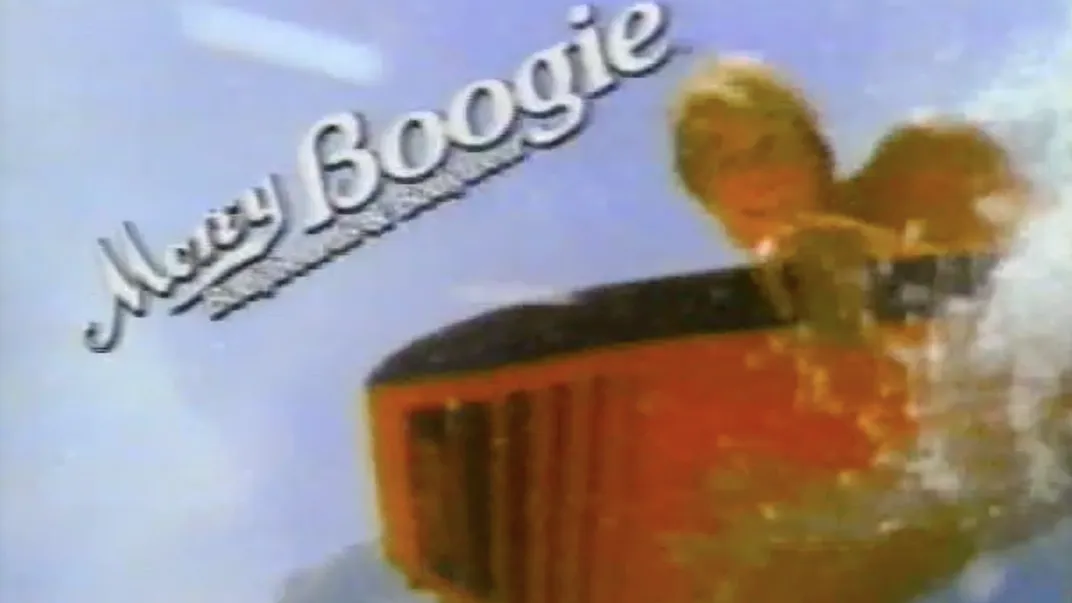
From knocking on doors to national commercials, the distribution of the Boogie Board skyrocketed. Morey Boogie was producing roughly 80,000 boards a year to keep up with demand. The jingles helped make the product memorable, as people still use the catchphrase “put your body on a Boogie” today. According to a 1986 commercial jingle for the Morey Boogie, “you can bend ’em, you can bounce ’em, you can roll ’em, too.”

The future of bodyboarding
The global bodyboard market is estimated to reach $623.6 million by 2035, up from $296.3 million in 2024. Sales increased during the Covid-19 pandemic as people searched for outdoor recreation, and they have been steadily climbing ever since as interest in water sports grows. It is hard to estimate the exact number of bodyboard sales each year since there are so many different types, brands and alternative versions now exist. The global market is now split, catering to casual riders on one end and elite competitors on the other, and today’s Morey Bodyboards has a high-end line that offers limited-batch runs, such as its 55th anniversary Mach 7, which was capped at 555 units.
“In Hawaii, I see an original board that is 40 years old over there next to me in the water. Somebody’s using it, and I ask the person, this tourist, ‘Hey, where’d you get that board?’” Sol says. “‘Oh, it was in the condo.’ What condo doesn’t have a Boogie Board?”
Sol says his dad always cared about the environment, and he cared deeply about getting as many young people as possible out onto the water.
“There are many academies that have now started to get municipal funding to teach Boogie Boarding, and that brings kids that would otherwise not know their shoreline into the ocean,” Sol says. “They become the new oceanography future, taking care of your environment, which is really where I think this is all going.”
Fun fact: Idaho is a leader in urban surfing
- Boise Whitewater Park is attracting surfers to the landlocked state, and the innovative public works project is inspiring others around the country.
The legacy of Tom Morey
Jim Kempton, executive director of the California Surf Museum and former editor of Surfer magazine, says that Morey had a “particular genius about him.” The museum has an archival collection of some of Morey’s earliest boards and flippers, along with original kit instructions and information about his life.
“What Tom Morey did with the invention of the Boogie Board was to introduce a wave-riding vehicle that anyone, regardless of their abilities, regardless of their gender, regardless of their strength, could use,” Kempton says. “It was also less expensive than a surfboard. He ended up introducing more people to the act of riding a wave than any other single person or any other single invention in the history of waves.”
The Boogie Board was not the first type of bodyboard; that distinction belongs to the paipo, a wooden board named after the Hawaiian term for “headfirst.” However, while the name “Morey Boogie” is trademarked, “boogie board” has become a universal term for nearly any type of bodyboard. In 1979, toy company Kransco bought the rights to the Morey Boogie, and in 1994, Mattel bought Kransco and distributed the Boogie Boards. Three years later, Mattel sold its sports division to Wham-O, a toy company founded in 1948. Wham-O now owns the registered trademark for both the Boogie and Boogie Board names.
/https://tf-cmsv2-smithsonianmag-media.s3.amazonaws.com/filer_public/8e/ae/8eae95f9-1b2b-4c31-b96f-fb6d2ff30998/et2015-06508.jpg)
The Morey company now calls its higher-end boards “Morey Bodyboards.” However, Tom called them “Boogie Boards” throughout his entire life because he thought that a “bodyboard” sounded like something that would carry people to the morgue, according to Serrano. People close to him continue to honor that name.
“There are few things in life that can’t seem to ever be actually improved,” Kempton says. “There’s a lot more competition [on the market] today because Moorey [bodyboards] are sort of on the high end of that type of watercraft, but they still do extremely well. They are the Kleenex, the Coca-Cola of the sport, not only because of their brand, but because of how they perform.”
The Smithsonian’s National Museum of American History houses one of the earliest Morey Boogie Boards in its collections. Though it is not currently on display, California’s Surfing Heritage & Culture Center donated the board in 2015. “It’s one of the ones that he had personally given to the heritage center, and then they gifted it to us,” says Jane Rogers, a curator of the sports collection at the museum, which houses numerous surfing-related artifacts.
Tom Morey died on October 14, 2021, at the age of 86—50 years after he made the first Morey Boogie. It was eight days after receiving acknowledgement from the city of Oceanside for his extraordinary contributions to waveriding worldwide. He was supposed to be honored at the Silver Surfer Awards in November of that year.
“He was very beloved by everybody,” Serrano says. “He clearly left a mark in the surfing world. I’m so grateful I’ve lived through it all.”
/https://tf-cmsv2-smithsonianmag-media.s3.amazonaws.com/accounts/headshot/IMG_7600-edit-v2.png)