
America at 250: The Revolutionary Spark
A Smithsonian magazine special report
Because of a Mathematician From Rural Virginia’s Work on Global Positioning, You Have No Excuse for Getting Lost
Gladys West had an “insatiable thirst for knowledge.” She used computers, radars and satellites to make calculations that led to the GPS technology that allows us to pinpoint any spot on the globe
/https://tf-cmsv2-smithsonianmag-media.s3.amazonaws.com/filer_public/f0/af/f0af7b63-24b5-4a63-9e41-b0da0373bf2d/gladys_mae_west.jpg)
When mathematician Gladys Mae West died this year at 95, she was celebrated for her work on global positioning satellite mapping. “We didn’t know exactly where it was going, because we worked for the military, where everything is secret,” West once recalled. As a child in segregated rural Virginia, West attended what she described as “the stereotypical little one-room schoolhouse, with rusty, decrepit furniture, sometimes leaky ceilings, and always hand-me-down books.”
She won a scholarship to Virginia State College, propelling her toward 42 years of mapping for the U.S. Navy. In the 1960s, she helped train a computer to do five billion calculations to measure the movement of Pluto. In the ’70s, she began using radar and satellite data to calculate the Earth’s curvature, accounting for ice levels, ocean currents, gravity and tides. Her work helped scientists create the precise model used by GPS to pinpoint any location on the planet. After her retirement in 1998, West went on to earn a PhD in public administration.
“I still had an insatiable thirst for knowledge,” she wrote in her memoir, It Began With a Dream. “I always had this sense that there was more to accomplish.”
Subscribe to Smithsonian magazine now for just $19.99
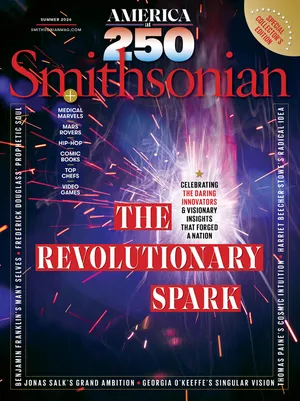
This article is a selection from the Summer 2026 issue of Smithsonian magazine