
Could This Dutch Invention Help Tackle Plastic Pollution in America’s Waterways?
The Netherlands has had success with the Bubble Barrier, which pumps air bubbles from the bottom of a canal or river to direct plastic to the surface. Now, Lansing, Michigan, is looking to be the first to install the technology stateside
/https://tf-cmsv2-smithsonianmag-media.s3.amazonaws.com/filer_public/5a/2d/5a2d2d01-d4ad-4e91-b743-52bae6648a07/boat_crossing_bubble_barrier_-_credits_the_great_bubble_barrier.jpg)
Amsterdam’s Westerdok looks like many other outlets to the city’s historic canals. But look past the familiar boats and birds, and there is a distinct pattern in the water not found elsewhere in the city: a diagonal line of whiter water.
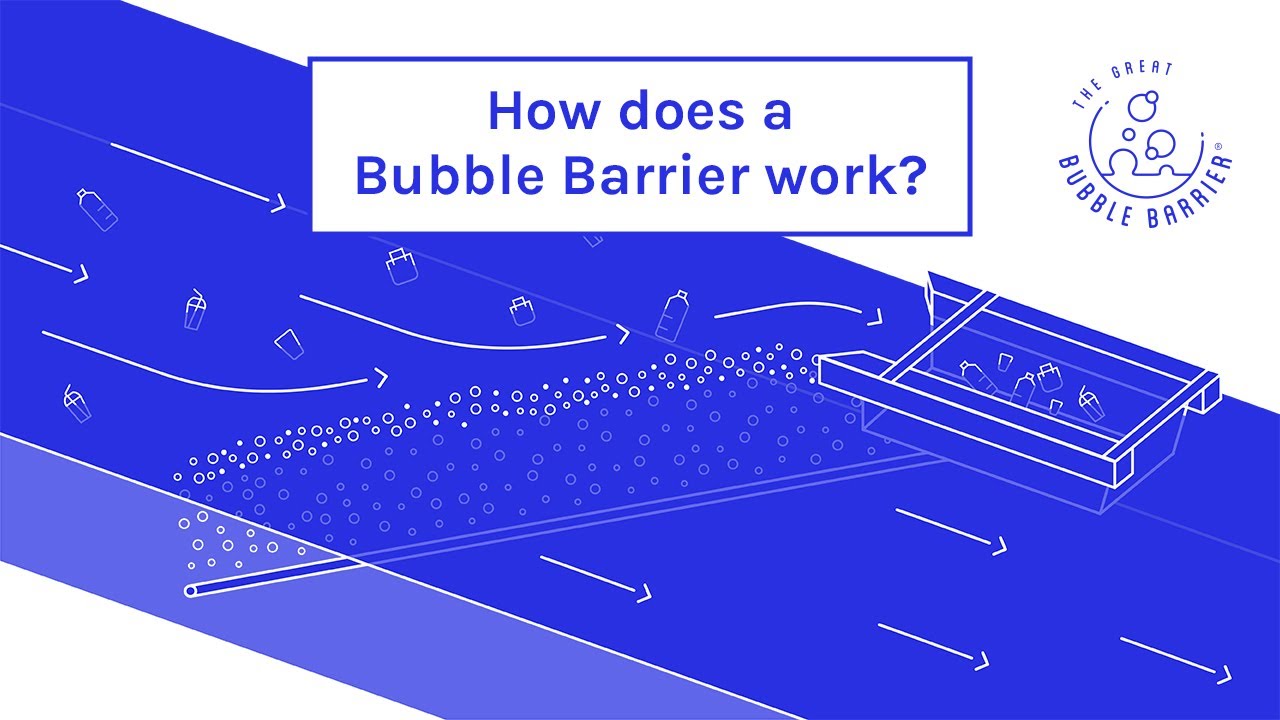
That’s because an innovative “curtain,” known technically as a Bubble Barrier, lies below the surface. On the bottom of the waterway is a perforated tube which pumps air out, directing plastic to the surface. The natural flow of water then carries plastic litter to the Bubble Barrier’s catchment system, an aluminum trap on one side of the waterway, to prevent it from making its way to the North Sea.
“Anything you can think of that people have in the city, we’ve seen here,” Philip Ehrhorn, co-founder and chief technological officer of the Great Bubble Barrier, the company behind the technology, told me as we surveyed the barrier on a warm day in September. The current catch—laminated restaurant menus, food wrappers, even a selfie stick—demonstrated that well.
/https://tf-cmsv2-smithsonianmag-media.s3.amazonaws.com/filer_public/80/72/80723cdd-e97a-4660-b411-0a2db1c10061/bubble_barrier_amsterdam_-credits_the_great_bubble_barrier_1.jpg)
The Bubble Barrier at Westerdok was the company’s first, installed in 2019, but the technology has since been installed in other waterways in the Netherlands. And now, for the first time, it looks like the United States may also be getting a Bubble Barrier, in the Grand River in Lansing, Michigan.
How a Bubble Barrier works
The Bubble Barrier in Amsterdam relies on bubbles of air to create a barrier of sorts to stop the spread of particles like plastic. Other companies have employed similar curtains to contain oil spills, guide fish migration and even mitigate underwater noise. But using this type of barrier for plastic is particularly useful.
According to Jordy Wolfand, a civil engineer at the University of Portland, it effectively functions as a boom. “It’s not like a typical boom that would stop a lot of flow or catch a lot of fine sediments,” she says. But the Bubble Barrier sends plastic debris upward and then catches it.

OceanTherm, a company based in Norway, develops bubble curtains to reduce impacts from hurricanes and tropical cyclones. These weather events obtain their energy from a warm ocean surface; the rising bubbles circulate cold water to the surface, cooling it down. So far, the company has deployed a pilot in Norway. Weighing in on the Great Bubble Barrier’s work, OceanTherm’s chief technology officer Olav Hollingsaeter says, “It’s a very good thing to stop plastic in the rivers from getting out to the sea.” The fact that it’s minimally invasive makes it especially apt for busy channels, like the one at Westerdok. “There are other solutions, like building physical barriers and collecting plastic and garbage that way, but the bubble curtains are the best way to do it if there is ship traffic,” he adds.
Amsterdam’s Bubble Barrier collects about 175 pounds of inorganic dry debris, per month, ranging from one millimeter to one meter in size. According to the company, the technology catches 86 percent of floating plastic debris, as validated by pilot and lab data.
Its success has inspired the installation of others across the country. In 2022, the municipality of Katwijk implemented the first community-initiated Bubble Barrier: a nearly 400-foot-long Bubble Barrier in the Oude Rijn waterway. Two years later, the company placed a new Bubble Barrier in the seaport city of Harlingen to prevent plastic pollution from flowing into the Wadden Sea.
/https://tf-cmsv2-smithsonianmag-media.s3.amazonaws.com/filer_public/7a/24/7a245ead-b366-40cc-a81c-779d419b4e70/bubble_barrier_-_katwijk_1_credit_the_great_bubble_barrier_zeevonk_media_1.jpg)
“A lot of people want to do something about plastic trash because they’re frustrated that you can’t do much,” says Ehrhorn. “This is a very tangible solution that speaks to people.”
To a group in Lansing, Michigan, it spoke loud and clear. Like those in the Netherlands, many residents of the Great Lakes State have an appreciation for waterways and a desire to protect them.
“We’re a city of two rivers,” says Brett Kaschinske, the City of Lansing’s director of parks and recreation. The Red Cedar River runs for 51 miles, through the Michigan State University campus, and the Grand River—the longest in the state—flows to Lake Michigan. A Bubble Barrier could help prevent plastic from ending up in the freshwater system or the lake itself. Of the Great Lakes, which collect an estimated 22 million pounds of plastic debris each year, Lake Michigan accounts for nearly half. “The Bubble Barrier was very intriguing to us because we spend a lot of time just making sure our waterways are clean,” says Kaschinske.
Will the technology work in Lansing?
Building a Bubble Barrier is more than just dropping a tube in a body of water. Each new project starts with a study, which “entails conducting a technical and practical feasibility analysis of the location, a permit scan, an initial design, an estimate of cost, several operational scenarios, communication possibilities and an action plan,” explains Carla Wessels, communications director for the Great Bubble Barrier.
“Everyone in the plastic cleanup industry says: one waterway is [only] one waterway,” explains Ehrhorn. “Lansing is different than Amsterdam canals.”
Even if the technology is suitable for a selected waterway, the next challenge is getting locals’ long-term commitment to it. “Thinking about the community buy-in and the maintenance of the system is what’s going to create a long-lasting, sustainable solution,” says Wolfand, who is not involved with the company or its projects. It requires stakeholder engagement and coordination at all levels.
/https://tf-cmsv2-smithsonianmag-media.s3.amazonaws.com/filer_public/2c/62/2c621abd-e6ac-4f56-93bf-cd729151c573/bubble_barrier_harlingen_from_above_-_credit_the_great_bubble_barrier_and_zeevonk.jpg)
In Lansing, a team has formed to do just this: the Great Bubble Barrier develops the technology, the consulting firm LimnoTech functions as project manager, the City of Lansing has agreed to own and operate it, and supermarket chain Meijer is sponsoring and funding much of the project. The Michigan Department of Environment, Great Lakes and Energy is also on board to help with permitting and funding independent researchers to study the ecological, hydrological and social conditions in the Grand River.
“The challenge is often the collaboration between the authorities,” says Ehrhorn. “It comes down to communication, getting everyone on board, hearing their stakes, their interests, their concerns, the risks that they’re seeing, but also their opportunities and making sure we play into what they want to get out of it.”
This interdisciplinary approach is critical when evaluating how the Bubble Barrier will fit into a local ecosystem, both above and below water. Many use the Grand River for recreational activities like fishing or boating, so an underwater solution like a Bubble Barrier is particularly apt. Researchers at Michigan State University are also engaging with the community to get their feedback to learn about their connections to Michigan rivers and their attitudes about microplastic pollution. Environmental studies professor Lissy Goralnik sees this as a necessary step for large-scale municipal infrastructure projects to be embraced and championed over the long term.
Mike Stout, founder of the Michigan Waterway Stewards, says he believes it’s a “wonderful concept” and is very excited about its potential. “It will improve fishery and wildlife habitat and enhance the appearance of communities downstream,” he adds. “The positive impact will also benefit ecotourism, encouraging more people to recreate on and along our waterways.”
Quick fact: This plant-based plastic removes microplastics from the environment as it biodegrades
- Eighteen-year-old Arya Satheesh invented Eco Purge, a plastic that biodegrades two weeks after it's disposed of and releases enzymes into the environment that break down microplastics in the soil and water. She won the European category of the 2026 Earth Prize, the largest environmental competition in the world for young students.
Other scientists are looking into the ecological and hydrological effects of the Bubble Barrier. “We’re mainly trying to understand how this technology works in Michigan, and also what kind of impact it can have,” explains Phanikumar Mantha, a civil and environmental engineer at Michigan State University. Alan Steinman, a botanist and expert on water resources at Grand Valley State University, has conducted studies looking at how the system affects various organisms in the water. One of the main concerns was that the Bubble Barrier would prevent migration of juvenile fish and plankton. However, preliminary studies in the river show the barrier would not likely impede them.
Some questions can’t be answered until the barrier is implemented, says Mantha. He is especially curious how the technology will fare in the free-flowing Grand River, with a depth that varies depending on the time of the year. But he will have to wait a bit to see. One of the final hurdles is making sure the team has all the permits and funds to implement—and maintain—the barrier.
Kaschinske and other team members are optimistic that the project will go through; it’s just a question of when. “We would not go down those steps of engineering design if we thought this was so pie in the sky that it won’t happen,” he says.
Drawing attention to plastic pollution
Once a Bubble Barrier is installed, some entity must pick up the plastic it collects. In Amsterdam, the local water authorities empty the catchment system three times a week. For the Lansing project, the city has also agreed to own and operate it, seeing it as an extension of its trash collection service. “We need to empty trash cans, and this is just a trash can for what’s collected on the river,” says Kaschinske.
But he and others stress that the Bubble Barrier is not the only thing that will stop plastic.
“Sometimes, people rely on these solutions a little too much,” says Wolfand, explaining that it could lead to people thinking they can litter or not have to think about plastic “because it’s going to be cleaned up.”
/https://tf-cmsv2-smithsonianmag-media.s3.amazonaws.com/filer_public/1f/80/1f801b52-c8d0-4f8f-af51-f33eabab1095/exit_to_het_ij__-_credits_the_great_bubble_barrier.jpg)
While catching plastic is the barrier’s main goal, it’s also an educational tool. The Bubble Barrier can start conversations about the importance of clean water, the harms of plastic and why the technology can help the Grand River waterway, says Kaschinske.
The area is already familiar with innovative solutions to plastic pickup: Grand Valley State University remotely operates BeBots to clean up local beaches.
“You’re capturing such a trivial amount of the total waste that’s there, but when people see a semi-autonomous robot rolling across the beach, people get interested, particularly the 8-year-olds,” says Steinman. “It’s a great way to educate people about the trash on our beaches and how problematic microplastics are in the Great Lakes.”
Back in Amsterdam, Ehrhron echoes Kaschinske’s sentiment. “Once a Bubble Barrier starts showing what’s flowing through the Grand River, or whatever waterway, people will see what’s previously been unseen,” he says. “Sure, collecting trash is one of the main priorities, but the motivation to act and learn goes above it.”