
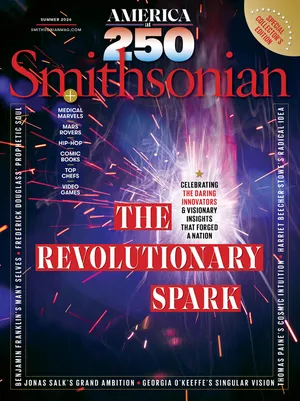
America at 250: The Revolutionary Spark
A Smithsonian magazine special report
Woodrow Wilson’s Legacy Is Loaded With Good and Bad, but His Work to Even the Economic Playing Field Is Often Overlooked
He won the Nobel Peace Prize for his efforts in ending WWI and strove to improve the plight of American workers. Today, his blind spots shroud most of his accomplishments
/https://tf-cmsv2-smithsonianmag-media.s3.amazonaws.com/filer_public/02/db/02db216f-f471-44ac-b1fd-d942db3591e5/woodrow-v1.jpg)
Imagine American democracy as a mountain lake, its waters held back by an earthen dam of legal, constitutional and cultural restraints. Periodically, the dam’s sluiceways become clogged by entrenched interests, concentrated wealth or fear of the unfamiliar. At such moments, we welcome an Andrew Jackson or a Theodore Roosevelt, those improbable champions of the working man, to clear the spillways of our democratic experiment, strengthening the dam and the lake it makes possible.
Woodrow Wilson’s March 1913 inauguration heralded just such a repair job. That spring, he became the first president in more than a century to address Congress in person. The next day, he returned. Operating out of the President’s Room in the Capitol, he successfully lobbied members to enact the most significant tariff reductions since the Civil War. This was the opening move in Wilson’s campaign to level the economic playing field by strengthening competition against the forces of monopoly.
A minister’s son reared in the South during and after the Civil War, Wilson may have had dyslexia, and his temperament was judged too remote for mass appeal. (He remains the only American president to earn a PhD.) Deploying persuasive talents honed as an academic instructor and administrator, his first-term legislative record reflects the progressive agenda at flood tide. Wilson created the Federal Reserve to reclaim for Washington the fiscal initiative that had been assumed by Wall Street. Consumers as well as small businesses benefited from his establishment of the Federal Trade Commission. Labor unions gained new protections via the Clayton Antitrust Act.
Under Wilson’s leadership, the federal government worked to curtail child labor in factories and introduced an eight-hour workday for railroad employees. Twice, the president vetoed immigration bills because they included literacy tests that he thought unjustly targeted disadvantaged populations. In 1916, he appointed Louis Brandeis as the first Jewish justice on the Supreme Court. Admirers hailed Wilson for his eloquence and commitment to reform. Harry Truman called him “the greatest of the greats.” In 1958, Herbert Hoover wrote a sympathetic memoir-biography about Wilson the visionary, who drafted his Fourteen Points hoping to end the First World War and prevent future conflict through a League of Nations.
Seven decades on, the mention of Wilson’s name evokes a very different consensus. Few historical figures better illustrate what British historian E.P. Thompson labeled “the enormous condescension of posterity,” with its inherent bias toward “now” over a less enlightened “then.” Scorned on the right as a statist conducting a dress rehearsal for the New Deal and Great Society, Wilson is disparaged by the left for his segregation of the federal workforce and wartime abuses against civil liberties. His diplomatic performance at the Paris Peace Conference is widely panned. His stubborn refusal to compromise with Senate critics of the resulting Versailles Treaty is blamed for the United States’ failure to join the League.
On the eve of his first inauguration, Wilson had mused, “It would be an irony of fate if my administration had to deal chiefly with foreign affairs.” The remark was sadly prophetic. For while U.S. foreign policy ever since has been weighed for its adherence to Wilsonian priorities, and Wilson’s own efforts to promote human rights and international cooperation earned him the Nobel Peace Prize in 1919, his name is commonly linked with home-front intolerance and suppression of dissent. A near-fatal stroke effectively ended his presidency 17 months before he officially left office in March 1921. During this period, Wilson’s second wife, Edith, functioned in a role somewhere between doorkeeper and deputy president.
Today, the sole Democrat to occupy the White House between Grover Cleveland and Franklin Roosevelt has been airbrushed out of his party’s history. Other institutions have followed suit: Weeks after George Floyd’s death at the hands of white police officers in May 2020, Princeton University, citing the “racist thinking and policies” of its onetime reformist president, struck Wilson’s name from its school of public affairs.
Ironically, before recent reckonings, the last time anyone had toppled a Wilson statue was in 1941 in Prague, as ordered by the city’s Nazi occupiers. Even now, America’s 28th president is more highly regarded in Poland and the former Czechoslovakia—nations whose establishment he championed at Versailles—than among his own compatriots. And yet. That we are still debating the Wilsonian legacy a century after his life ended at his house on S Street NW in Washington, D.C. testifies to the scale of the man’s ambition and the relevance of his ideas. He may be out of fashion, but now as then, Woodrow Wilson matters.
Fun fact: How Woodrow Wilson turned the White House into a (small) sheep arm
-
After the U.S. entered World War I, Wilson brought in sheep to graze on the White House lawn.
-
Wilson thereby saved landscaping labor, which could be redirected toward war efforts.
-
The sheeps’ wool went to auction, and the proceeds benefited the Red Cross.
Reaping the Fruits of Organized Labor
How workers mobilized—before the protections of 1938’s Fair Labor Standards Act
by Jacqui Shine
The Eight-Hour Workday: Labor action for shorter workdays is nearly as old as the Republic: Philadelphia carpenters struck (unsuccessfully) for a ten-hour day in 1791. In 1835, Philadelphians won a ten-hour day in North America’s first general strike, and Bay Area tradesmen wrested an eight-hour day from hostile mill owners after a workplace lockout in 1900. Theodore Roosevelt included an eight-hour day in his 1912 presidential platform, automaker Henry Ford instituted it in 1914 and President Woodrow Wilson signed it into law for federal railroad workers in 1916.
Minimum Wage: Seamstresses, shop clerks and suffragists began organizing for higher wages in the late 19th century, and 1912’s Bread and Roses strike compelled Massachusetts to pass the nation’s first minimum-wage law. Within a decade, similar laws guaranteed higher pay to women in 13 other states. But in 1923, the Supreme Court ruled against those and comparable laws protecting women and children. After clashes in boardrooms and courtrooms, at bargaining tables and in the streets, the campaign triumphed in 1938.
Workers’ Compensation: Sweatshops, mines, railroads and factories were notoriously dangerous at the turn of the 20th century. Matchstick makers breathing phosphorous vapor developed oral necrosis; the “sand hogs” who built the Brooklyn Bridge died of the bends. By 1900, workplace accidents killed 35,000 people a year. Liability laws required employees seeking compensation to sue for negligence, a tough, costly process. States shifted to an insurance model: In one 1911 example, after a mining accident that killed 259 workers in Cherry, Illinois, State Senator James Henson—once a union bricklayer—introduced a bill creating the state’s workers’ compensation law for on-the-job injuries. Such laws soon received the support of the American Federation of Labor. By 1920, 42 states had them.
Subscribe to Smithsonian magazine now for just $19.99
This article is a selection from the Summer 2026 issue of Smithsonian magazine