
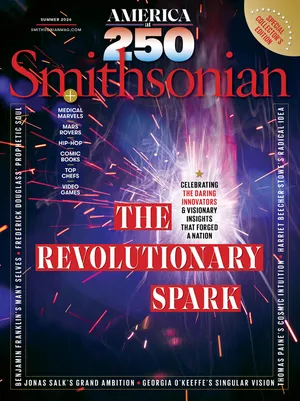
America at 250: The Revolutionary Spark
A Smithsonian magazine special report
When a Photographer Turned His Focus on Social Injustice, It Helped Usher in the First Child Labor Laws
Lewis Hine didn’t consider his job as taking pictures; it was “detective work.” Sometimes gaining access with ruse and subterfuge, he captured stark images that touched hearts and changed minds
/https://tf-cmsv2-smithsonianmag-media.s3.amazonaws.com/filer_public/d5/c2/d5c25672-de83-407c-98d0-66d9a91630e4/julaugsum2026_i16_liberty_copy.jpg)
When Lewis Hine began traveling the country in 1908 to document the working lives of children, around two million Americans younger than 15 were full-time laborers. A reformer and an investigative photographer for the National Child Labor Committee (NCLC), Hine, who trained as a sociologist, used his Graflex camera for what he called “detective work”: He’d materialize outside a factory or mine or cannery (sometimes in the guise of a Bible salesman) and wangle his way in. Other times, management denied him entry, even threatening him with physical violence.
Hine found the assignments trying and infuriating. “There is work that profits children, and there is work that brings profit only to employers,” Hine said in 1908. “The object of employing children is not to train them, but to get high profits from their work.” He considered photography the most direct and vivid means of evoking the public's horror at this exploitation. As he put it, “If I could tell the story in words, I wouldn’t need to lug around a camera.” Hine compiled the caption details himself, sometimes scribbling secret notes with a hand in his pocket, in case an overseer happened to be observing.
These photos, taken from 1909 to 1911, display Hine’s arrestingly direct style, which moved hearts and changed minds: In 1916, the NCLC celebrated the signing of the first federal child labor law. Four years later, in 1920, the population of American child laborers was estimated to have nearly halved compared with 1910.
Did you know? Inside the National Child Labor Committee
-
Established in 1904 and chartered by Congress in 1907, the committee was dedicated to exposing the conditions and ending the practice of child labor.
-
Early advocates included progressives Jane Addams and Florence Kelley, as well as Owen Reed Lovejoy, known as the “children’s statesman."
-
Lewis Hine was hired in 1908 and spent more than two years documenting the appalling conditions facing young children in U.S. factories, mines and other sites of exploitative work.
-
Besides the first child labor law, signed in 1916, the NCLC helped win major legislation for all workers by contributing to the passage of the 1938 Fair Labor Standards Act.
/https://tf-cmsv2-smithsonianmag-media.s3.amazonaws.com/filer_public/af/e1/afe13d86-bf49-4600-a47e-7269277f1d62/julaugsum2026_i18_liberty_copy.jpg)
/https://tf-cmsv2-smithsonianmag-media.s3.amazonaws.com/filer_public/ed/3e/ed3ea536-e17d-404c-ab58-e38ae7a286d7/julaugsum2026_i17_liberty_copy.jpg)
/https://tf-cmsv2-smithsonianmag-media.s3.amazonaws.com/filer_public/56/21/5621d364-0168-4a79-a0ad-1bb4effc9bb1/service-pnp-nclc-01400-01458v.jpg)
/https://tf-cmsv2-smithsonianmag-media.s3.amazonaws.com/filer_public/c6/c3/c6c3e178-b0e3-43c9-a12b-72de161d949e/service-pnp-nclc-03900-03912v.jpg)
/https://tf-cmsv2-smithsonianmag-media.s3.amazonaws.com/filer_public/de/80/de809aeb-4310-46e8-9a67-ae43b196f7f6/cotton_boy.jpg)
/https://tf-cmsv2-smithsonianmag-media.s3.amazonaws.com/filer_public/7d/5a/7d5aca26-5627-4036-b8f1-cec4f1f84ed0/service-pnp-nclc-03800-03843v.jpg)
/https://tf-cmsv2-smithsonianmag-media.s3.amazonaws.com/filer_public/2b/93/2b935668-3fe8-49ed-88cc-73f2ac9a48f7/service-pnp-nclc-00900-00909v.jpg)
/https://tf-cmsv2-smithsonianmag-media.s3.amazonaws.com/filer_public/d6/28/d628a4cc-b931-4f66-b25e-941e656c85c9/service-pnp-nclc-00800-00814v-1.jpg)
/https://tf-cmsv2-smithsonianmag-media.s3.amazonaws.com/filer_public/98/a4/98a45a92-63eb-4c19-bb96-95fc8ebca841/service-pnp-nclc-01400-01475v.jpg)
Subscribe to Smithsonian magazine now for just $19.99
This article is a selection from the Summer 2026 issue of Smithsonian magazine