
/https://tf-cmsv2-smithsonianmag-media.s3.amazonaws.com/filer_public/fe/a4/fea4733a-0d55-495d-8871-35601a376f66/gettyimages-2186736524.jpg)
This Box of 300 Love Letters Showed Up Out of the Blue. Who Was the Whimsical World War II Soldier Who Wrote Them?
Nobody knows who dropped Speedy Weber’s correspondence at a USO office in 2022. Researchers have finally tracked down two living relatives who remember him
/https://tf-cmsv2-smithsonianmag-media.s3.amazonaws.com/accounts/headshot/Ellen_Wexler.png)
:focal(1500x1000:1501x1001)/https://tf-cmsv2-smithsonianmag-media.s3.amazonaws.com/filer_public/fe/a4/fea4733a-0d55-495d-8871-35601a376f66/gettyimages-2186736524.jpg)
Louis Weber was learning how to get by in the military: How to wake in the dark morning hours and work kitchen duty until sunset. How to get the 1.5-inch-long haircut required to look the part. How to stay so busy that he wouldn’t have time to miss the life he’d left behind.
“I don’t feel as blue as I did yesterday,” he wrote to his wife, Frances, on June 17, 1942. “They don’t give me a minute to think about anything but Army life, and in a way that’s the best thing for me, because if I stopped to think about home I’d go nuts.”
Better known as “Speedy,” the 23-year-old from New York had been married for only about a year. He’d been in the Army for just a few weeks. But America’s role in World War II was just beginning, and the young soldier would spend the years that followed on the other side of the Atlantic. He passed the time by scribbling hundreds of letters to Frances, who waited at home in the Bronx.
In 2022, a cardboard box packed with more than 300 of Speedy’s letters arrived at a United Service Organizations (USO) office in New York. Nobody knew who’d donated them or what became of the couple after the war ended. The collection eventually made its way to the organization’s headquarters in Virginia, where it piqued the interest of archivist and historian Michael Case.
Now, after an extensive search, an amateur sleuth has helped track down Speedy’s nephew. He was able to fill in some of the gaps, providing more details about Speedy and Frances’ life together.
/https://tf-cmsv2-smithsonianmag-media.s3.amazonaws.com/filer_public/94/0d/940dfb2b-7f54-4ad0-8162-d1b5b15d54bc/gettyimages-2186736369.jpg)
These breakthroughs arrived after several years of fruitless searching. Case had been hoping to identify living relatives ever since the letters landed on his desk. “We get a lot of donations,” he tells Smithsonian magazine, “but usually it’ll be a photo or two, or a postcard, or a pin, or a button.” The missives were unlike anything the USO had received.
Reading through the box of letters, “I really felt like I started to know Speedy Weber,” Case says. “It’s an everyday guy—not a general, no one famous—just doing his job and loving and being emotional and screwing up occasionally.” Case wanted to know more about him.
Speedy probably never got past high school, but he wrote in an evocative style that Case describes as “everyday elegant.” “He just had this sense of drama,” the archivist explains. He “uses a lot of plain language but really nails the emotion of the time he’s in.” Case loves the titles he scrawled on the tops of his letters—“somewhere in England,” “somewhere in France,” “somewhere in Luxembourg”—and his signature sign-off: “You are always in my heart.”
The pace of Speedy’s correspondence wasn’t unusual. “Of course, there were folks who communicated more and those who sent few letters, but mail was the main communication channel for those on the front line,” Lynn Heidelbaugh, a curator at the Smithsonian’s National Postal Museum, tells Smithsonian. During World War II, the government encouraged military personnel to write, often providing free stationary and waiving postage fees. According to a 1944 survey, service members sent some form of mail—including long letters, short postcards and single-page V-Mail—about six times per week.
/https://tf-cmsv2-smithsonianmag-media.s3.amazonaws.com/filer_public/cc/06/cc0606eb-e5e8-41a8-842c-d31e30c1c266/gettyimages-2287835789.jpg)
But most of those letters didn’t show up in a mysterious box at the USO eight decades later. In 2024, the organization contacted the Washington Post, which determined that Speedy and Frances had lived near each other in New York in 1940. According to the census, both sets of their parents were immigrants who were recorded as speaking “Hebrew.” But when the article came out, no new leads appeared.
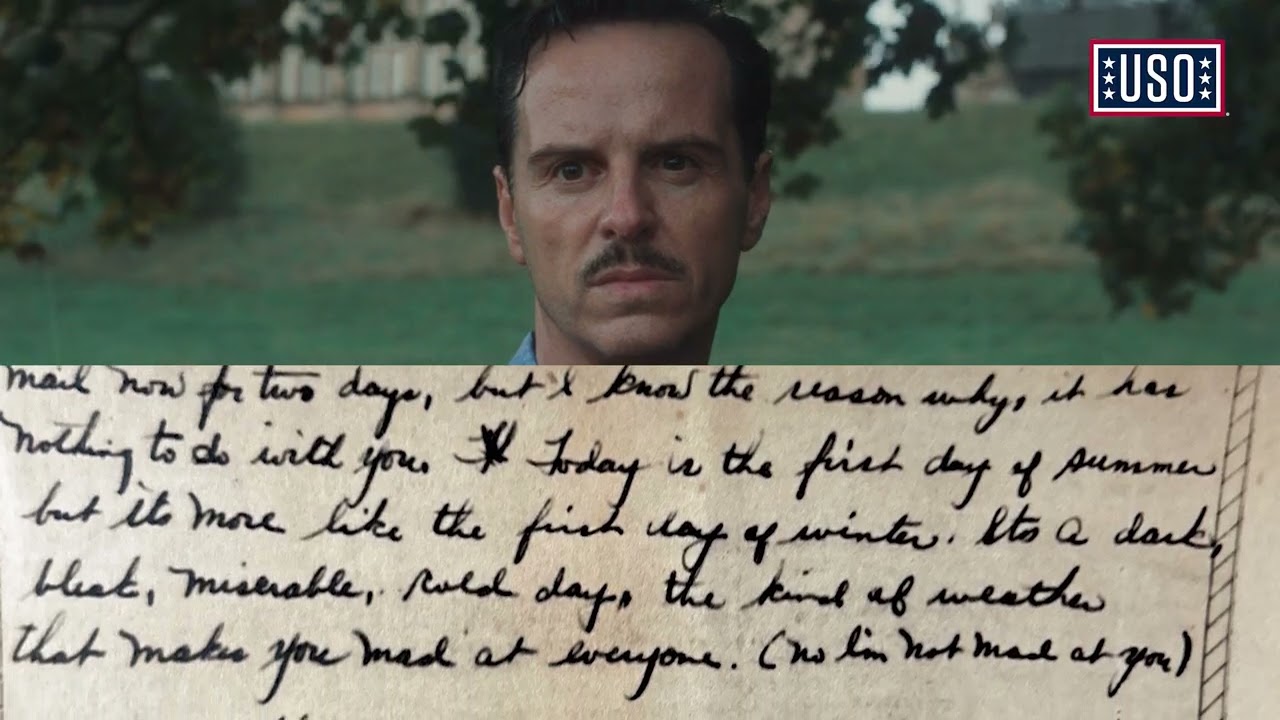
Earlier this year, the USO announced that it had digitized a selection of the letters. The organization even enlisted actor Andrew Scott, who starred in the recent World War II drama Pressure, to read excerpts from a letter that Speedy sent soon after D-Day. “It’s a dark, bleak, miserable, cold day,” he wrote, “the kind of weather that makes you mad at everyone. (No, I’m not mad at you.)”
Quick facts: The weather on D-Day
- Scott read from this particular letter because it tied in with the plot of Pressure.
- In the film, he plays James Martin Stagg, a meteorologist who convinced General Dwight D. Eisenhower to delay the invasion of Normandy to June 6, when the weather conditions would work in the Allies’ favor.
Staffers hoped that the publicity might produce a lead. “We’re putting the letters back out there as people are talking about this movie,” Jennifer Passey, vice president of communications at the USO, told the Washington Post in May. “We would love for anyone who may know more about Speedy or his wife, Frances, to reach out to us.”
Again, nobody connected to the couple came forward. But the case caught the attention of Matthew Brown, an amateur genealogist based in California. After spending hours scouring Ancestry.com, he found a potential relative—Arthur Serota—and sent the name to Joe Heim, a Washington Post reporter following the story. Heim tracked down Serota, who lives in Los Angeles, and asked what he knew about the mystery.
Serota knew nothing about the letters, but he knew a lot about Speedy. He explained that Speedy, one of his mother’s siblings, had been his favorite uncle. Now 84, Serota was born in 1942, the year that Speedy shipped out. By the time the soldier returned from the war, his nephew was a young boy. Speedy’s homecoming is one of Serota’s earliest memories.
“He was generous and just had this natural warmth that emanated from him,” Serota tells the Washington Post. He describes Frances as “classy,” explaining that she was “clearly the brightest of all the aunts and uncles.” He thinks that his mother and aunts may have been a bit jealous of her.
Serota then contacted another relative: Karen Weber Figilis, one of the couple’s nieces. She remembers her aunt and uncle drinking cocktails and listening to Frank Sinatra at family gatherings. Frances wore pencil skirts and spoke in a gravelly voice. “I can see her just as if it was yesterday,” she tells the Washington Post.
/https://tf-cmsv2-smithsonianmag-media.s3.amazonaws.com/filer_public/95/2a/952a9cc4-a2ba-4d8c-ae2e-c7c7a0e4a418/louis_speey_weber_20260608_104427_gmail.jpg)
Figilis, however, was in possession of more than just memories; she also had two black-and-white photographs. One shows Speedy and Frances smiling in a group shot, while the other features Speedy alone in a white jacket. “Up to this point, I had no idea what he looked like,” Case says to Smithsonian. “It was just great to put a face to the name.”
But Speedy’s relatives also had gaps in their understanding. Although Serota can summon his uncle’s warm presence and picture the contours of his face, he’d never heard any war stories. Speedy didn’t talk about his time in the Army.
The letters provide a remarkably comprehensive record. They came to Frances from Sicily, England, France, Belgium, Germany, Czechoslovakia and North Africa. Disregarding any correspondence that may have been lost, Speedy wrote an average of roughly 100 letters each year—one every three or four days.
Even in the early letters, before Speedy shipped overseas, he found clever, playful ways to express his affection. “In your letter, you asked me if there was anything I want that I can’t get out here,” he wrote on October 15, 1942. “Well, there most certainly is. I want you. So if you wrap yourself into a package and mark it fragile, I’m pretty sure it will come down to me in good order.” He called Frances by a variety of affectionate pet names, including “Dearest,” “Legs,” “Darling,” “Knucklehead,” “Shape,” “the girl I care for most” and “Meatball.”
As the years passed, Speedy still wrote with a winsome charm. Just before Valentine’s Day in 1944, he started plotting the trips they’d take after the war. “Our second honeymoon is going to be even more nicer than the original one,” he promised, adding that they would go to “some resort and have the grandest time of our lives.” But then, in just a few lines, his tone shifted to brooding angst (“Until this is over, we will both exist, not live”) and wistful reminiscence (“Darling, do you remember the times we spent on the roof? Well, those were my happiest days. What were yours?”).

Speedy likely arrived in France soon after D-Day, and he described what he witnessed while crossing the English Channel. “It was quite thrilling and exciting to be able to be there when the curtain went up on the biggest show in the world,” he wrote on June 14, 1944. He continued:
When I was on my way across the channel, I felt just as safe as if I were in your arms, because as far as the eye could see, there was nothing but ships of every description. When I looked up into the sky, I had a hard time seeing the sun because of the planes we had up there. It was a sight I’ll never forget.
In another letter, he described the role of the military chaplain. When a soldier “has a lot on his mind, he can always go to the chaplain for sympathy. He can cry his heart out to him, telling him all his troubles,” Speedy wrote. “What I’m worried about is, who does the chaplain tell his troubles to? If you know, please enlighten me as soon as possible.”
Occasionally he got into trouble. In early 1945, Speedy explained that he’d been demoted from private first class to private. “I suppose you want to know why I was reduced,” he wrote. “So do I. I must admit that a reason was given, but I think, and so does everyone else, that the reason is pretty flimsy.” Nevertheless, Frances need not worry about him “going any lower than private,” he added, “because there is no smaller grade than private.”
Sometimes Speedy reflected on the passage of time. On October 8, 1944, he explained that his sister had sent a photo of his mother with two of his nephews—including one named Arthur. “If my sister hadn’t said that Arthur was trying to get out of the picture, I would never know it was my nephew,” he wrote. Serota thinks that he was probably the nephew in question.
/https://tf-cmsv2-smithsonianmag-media.s3.amazonaws.com/filer_public/08/2c/082cff50-b1b3-4dbc-bcd4-adb0530369c0/louis_speedy_weber__20260608_104334_gmail_copy.jpeg)
Speedy was particularly concerned about his mother’s appearance in the photo. “I’ll be perfectly frank with you,” he wrote. “I didn’t like the way she looked. She looks so old and worried. I never realized that two years could make a person look so different.” He was only 26, but he said he felt older—and looked older. “Now that I’ve seen all those changes,” he added, “I’m beginning to wonder how you look.”
After the war, the couple returned to a semblance of normal life. Speedy worked as a truck driver, while Frances served as a manager at the U.S. Post Office. They never had children, but they spent the rest of their lives together, eventually moving to Florida. Speedy and Frances died at 78 and 87, respectively, and they’re buried together at a Jewish cemetery.
But their story isn’t finished—even with the help of Serota and Figilis. For one thing, Frances’ perspective remains largely mysterious. The collection contains only two of her letters, though Speedy’s correspondence suggests that she wrote regularly. In general, Heidelbaugh says, “more letters sent by military service members tend to survive because people who received this mail at home could more easily keep them than military personnel were able to while on the move.” Another mystery is that Frances seems to have left some of her husband’s letters unopened.
The biggest open question is who sent the box to the USO. Case theorizes that someone might have found it while cleaning out a home, perhaps following the death of the owner. Maybe they took the letters to the closest USO office because they noticed some of them had been written on USO letterhead.
Unlike formal reports or newspaper clippings, personal letters can reveal how World War II felt for the everyday people living through it. “I think it’s hard for people today to imagine,” Case says. “You signed up until the war was over.” Speedy’s correspondence provides insight into how the stress of such a long separation showed up in day-to-day frustrations.
Did Speedy consider what a future audience might think of his account? Case thinks he was “just a regular guy who just wrote what he saw”—a man who just so happened to have a front-row seat to some of the biggest turning points in World War II.
/https://tf-cmsv2-smithsonianmag-media.s3.amazonaws.com/accounts/headshot/Ellen_Wexler.png)