
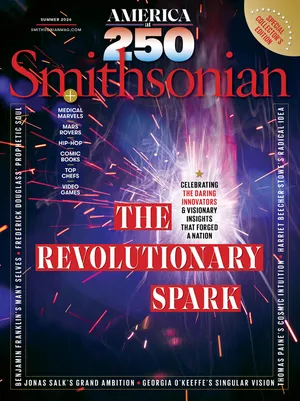
America at 250: The Revolutionary Spark
A Smithsonian magazine special report
At a Pivotal Moment of the Civil War, Frederick Douglass Delivered a Speech That Reframed What Was at Stake if Slavery Stood
In “The Mission of the War,” America’s incomparable orator helped turn public sentiment in favor of the Union and Abraham Lincoln, beginning the process of “national regeneration”
/https://tf-cmsv2-smithsonianmag-media.s3.amazonaws.com/filer_public/e9/ff/e9ffde77-443d-4cc6-ad13-1ce1afd50c8a/final_douglass_06.jpg)
In the cold early months of the election year 1864, the abolitionist Frederick Douglass wrote a speech called “The Mission of the War” and took it on the road, delivering it dozens of times in towns and churches to which he’d been invited across the Northern states. The speech was one of Douglass’ rhetorical masterpieces in a 50-year career as perhaps America’s pre-eminent orator. In this pivotal moment of the Civil War, Douglass crafted a work that served several purposes. A partisan election campaign address on behalf of Abraham Lincoln and a war propaganda speech to boost Northern morale, it was also a bid to redefine the conflict. The speech forcefully called for an “abolition war” that would transform the country forever, insisting that moral ends transcended policy imperatives. And finally, it offered a Bible-inspired, apocalyptic vision of history as sometimes requiring violent rendings and regenerations. For Douglass, all was at stake in 1864: whether the American experiment would survive and—even more crucial—whether and how slavery would truly be destroyed and a new country forged from its ashes.
Douglass performed his “Mission” speech in the vein of Jeremiah, the Hebrew prophet he most closely emulated. Douglass heeded God’s admonition to Jeremiah: “I have this day set thee over the nations and over the kingdoms, to root out and to pull down ... to build, and to plant.” According to Douglass, the Civil War was a “potent teacher,” its “lessons” written in “characters of blood.” For the former slave, the struggle was a holy war, a fight against “naked barbarism” on behalf of a “nobler and grander” cause than the world had ever seen. Raining down poignant metaphors and flowing refrains, Douglass personified “slavery” 14 times in one paragraph, and warned against a “slaveholding peace” and against complacency in the coming election. “Let but the little finger of slavery get back into this Union,” he declared, “and in one year you shall see its whole body again upon our backs.”
The speech appealed to his listeners’ moral hearts. It also marked a new political role for Douglass. No longer casting himself as a reformer or the mere voice of conscience, he was now a radical patriot arguing for revolution. “The most hopeful fact of the hour,” Douglass announced, “is that we are now in a salutary school—the school of affliction. If sharp and signal retribution, long-protracted, wide-sweeping and overwhelming, can teach a great nation respect for the long-despised claims of justice, surely we shall be taught now and for all time to come.” This was history presented as bloody, bitter instruction—an unfolding tragedy, in which catharsis, Douglass said, offered real hope.
That winter and summer, neither side was assured victory, and the loss of life had reached a scale no one had foreseen. Lincoln stood for re-election to the presidency in what was the first-ever general election conducted by a republic during a civil war. He would be opposed by the Democrat George B. McClellan, the former commanding general whom Lincoln had fired in great controversy after the Battle of Antietam in 1862. Since his Emancipation Proclamation of January 1, 1863, Lincoln and the Republicans had been stamped by Democrats as the dangerous party of Black freedom and equality. Democrats ran the most racist campaign on record to that time. They called Lincoln “Abraham Africanus I” and even invented the word “miscegenation” to argue that electing Republicans would, somehow, codify forced interracial marriage.
That August, Lincoln invited Douglass to the White House. The president needed the most important African American leader on his side at a moment of dire crisis, when he believed he might lose the election. He asked the radical abolitionist if he should back away from the emancipation policy in response to Northern public opinion, to which Douglass, as Lincoln expected, delivered an emphatic “No!” Astonishingly, Lincoln also asked Douglass to organize an effort to funnel as many slaves as possible out of the upper South before Election Day in November, in case McClellan and the Democrats won, thwarting emancipation forever.
Douglass returned to his home in Rochester, New York, and began to recruit agents for the border state liberation scheme. But he was, in effect, saved by events. On September 2, just days after the Democratic National Convention in Chicago nominated McClellan, news spread across the country that Atlanta had fallen to General William Tecumseh Sherman after a long siege. Confederates’ rising hopes plummeted, and many war-weary Northerners suddenly saw victory on the horizon. With morale boosted, Lincoln was re-elected with 55 percent of the popular vote, and the policy of emancipation was reaffirmed even by Union troops, who, in a massive and unprecedented “soldier vote,” cast 76 percent of their ballots for the Republican. The school of affliction, though, was hardly over. The war still had to be prosecuted to its haunting end, and the long and turbulent aftermath of Reconstruction lay ahead.
In his extraordinary speech, which undoubtedly helped turn public sentiment, Douglass had announced that the “mission of this war is national regeneration.” The address ended with a peroration that prefigured Martin Luther King Jr.’s in his “I Have a Dream” speech 99 years later. If remaking the United States on the doctrine of equality before the law could be “accomplished,” Douglass proclaimed, “our glory as a nation will be complete, our peace will flow like a river, and our foundations will be the everlasting rocks.”
Did you know? Frederick Douglass' sons fought for the Union
-
After Douglass campaigned for Black enlistment in the Union Army, helping recruit Black troops, two of his sons, Lewis Henry and Charles Remond, served in Massachusetts’ 54th Infantry Regiment.
-
Lewis became a sergeant major and was wounded in the Second Battle of Fort Wagner, less than six months before Douglass debuted his “Mission of the War” speech.
-
The widely publicized bravery of the 54th Massachusetts Infantry Regiment served Douglass and others as a powerful proof of the courage and resourcefulness of Black soldiers, and Douglass drew on this credibility as he argued for the fuller integration of non-white enlistees.
-
A third son, Frederick Jr., helped his father recruit Black soldiers.
Feats That Fostered Freedom for All
Bold, inventive abolitionists changed minds and saved families by organizing
by Taryn White
/https://tf-cmsv2-smithsonianmag-media.s3.amazonaws.com/filer_public/8b/35/8b359b9d-e6fa-4d13-aedc-3ce926ed529e/featsthatfosteredfreedom-v2.jpg)
William Still
Born in 1821, Still inherited abolitionism from his parents. In 1844, he moved to Philadelphia and eventually began working at the Pennsylvania Anti-Slavery Society. As chairman of the Vigilance Committee, he assisted hundreds of freedom seekers—raising funds, coordinating journeys—and helped finance several of Harriet Tubman’s missions to the South. He recorded stories from nearly 1,000 of those he’d aided, helping families find loved ones. (Still found his own long-lost brother when the latter visited the society after buying his own freedom.) He shared his records in 1872’s The Underground Railroad, still a vital resource for historians.
Mary Ann Shadd Cary
A pioneering figure in education, law and civil rights, Cary was born in Wilmington, Delaware, in 1823 and founded multiple schools to advance Black education. After the passage of the Fugitive Slave Act of 1850, Cary moved to Canada. She was the first Black woman in North America to edit and publish a newspaper, the Provincial Freeman. She returned to the United States. after the start of the Civil War to recruit Black soldiers for the Union Army. In 1869, she enrolled in Howard University and later became one of the first Black women in the U.S. to earn a law degree.
Angelina Grimké Weld
Born in 1805, Weld grew up in Charleston, South Carolina; her parents were enslavers, and she witnessed the brutality of slavery up close. She moved to Philadelphia in 1829 and published “An Appeal to Christian Women of the South” in 1836, urging her readers to oppose slavery. Less than two years later, she became the first woman to speak before a legislative body in the U.S., presenting 20,000 antislavery petitions at the Massachusetts State House in Boston. In her powerful address, Weld drew on her family history: “I stand before you as a repentant slaveholder. ... I owe it to the suffering slave, and to the deluded master, to my country and the world, to do all that I can to overturn a system of complicated crimes.”
Subscribe to Smithsonian magazine now for just $19.99
This article is a selection from the Summer 2026 issue of Smithsonian magazine