

Were Ancient Egyptians Really Just Like Us? Revelations About Egypt From an Archaeologist, an Art Historian and an Egyptologist
The Pyramids of Giza and the Great Sphinx might be Egypt’s superstars, but look beyond them and you’ll find intriguing myths, a warm modern-day culture and a very human side to ancient history—and maybe even a dog named Spot
:focal(1235x823:1236x824)/https://tf-cmsv2-smithsonianmag-media.s3.amazonaws.com/filer_public/48/a8/48a8cb8c-6e66-4c4e-8090-ce77bc9294c9/egp_komombo_temple_detail_ist_850936574.jpg)
Did you know that the ancient Egyptians used pet names like “Fluffy” and “Spot”? Or that in Egypt, falafel is made with fava beans instead of chickpeas? The golden treasures buried with King Tutankhamun are legendary—but have you heard about the personal keepsakes found inside his tomb?
People rightly expect to be astonished when they visit Egypt: after all, the sky-scraping Great Pyramid of Khufu is the lone survivor of the Seven Wonders of the Ancient World. But beyond the showstoppers lie touching stories, rich traditions that have endured centuries, and quite a few surprises that remind us that there is so much to discover in Egypt. We asked an Egyptologist, an archaeologist, and an expert in Egyptian art to weigh in on what they love most about Egypt. Their answers just might move it to the top of your travel list (If it’s not already there!).
Meet the Experts
- Art historian Annie Shanley earned a PhD in Egyptian art and has participated in digs in ancient Thebes. She now lectures on and researches the provenance and ethics of collecting antiquities and is based at the Michael C. Carlos Museum in Atlanta, renowned for its ancient art.
- Egyptologist Nicholas Brown splits his time between Los Angeles and Egypt, where he has worked on archaeological sites in Aswan and Luxor. He specializes in royal funerary culture, and has researched Egyptian and Nubian art for Boston’s Museum of Fine Arts.
- Janet Duncan Jones is a Pennsylvania-based archaeologist, professor emeritus, and glassblower who has excavated ancient sites across the Mediterranean and Middle East, with a special focus on early craftspeople and preindustrial technology.
All three serve as Smithsonian Journeys Experts, accompanying trips to Ancient Egypt and the Nile.
What sparked your interest in Egypt?
Nick: When I was around six years old, my grandmother gave me my first book on ancient Egypt, about Tutankhamun’s tomb. I was instantly hooked and obsessed with mummies, pyramids, and golden treasure. When I was 20, I took my first trip to Egypt and fell in love with the culture, the food, the place, and the people. That first trip to Egypt solidified my desire to study Egyptian archaeology and pursue it as a career.
Janet: I was obsessed with archaeology as a kid—Mesopotamia, Egypt, Greece, Rome—but the siren song of ancient Egypt was irresistible. I read everything I could get my hands on. I was lucky enough to be able to turn my lifelong interest into an academic career and to have the chance to introduce others to the places that fascinate me.
Are there modern-day Egyptian traditions that can be traced back to ancient Egypt?
Nick: Yes! There are many traditions that seem to come down to us today from ancient Egypt. Seeing boat drivers on the Nile sailing in feluccas is certainly one of them. Even parts of modern-day language are descended from ancient Egypt, including the modern Coptic language. Many craft traditions, like pottery and alabaster carving have their roots in ancient Egyptian culture too.
Janet: Both cultures are strongly united by a common religion and common traditions. I love that modern Egyptians will visit the tombs of family and bring picnics on special occasions—it makes me think of the Festival of the Valley [that was held annually in ancient Thebes]. Whether or not the modern tradition is related to the ancient, it’s a lovely practice.
Also, tourism itself in Egypt dates back to ancient times: the ancient Greek historian, Herodotus, writes about his visit to Egypt in the fifth century BC (although some of what he says his hilariously wrong).
What site are you most excited to introduce to travelers?
Annie: I love introducing people to Ramesses II's temples at Abu Simbel and Hatshepsut's Mortuary Temple at Deir el-Bahari. The architecture and art at both temples are spectacular and unmatched, but the landscape and locations turn visits to those sites into an immersive experience.
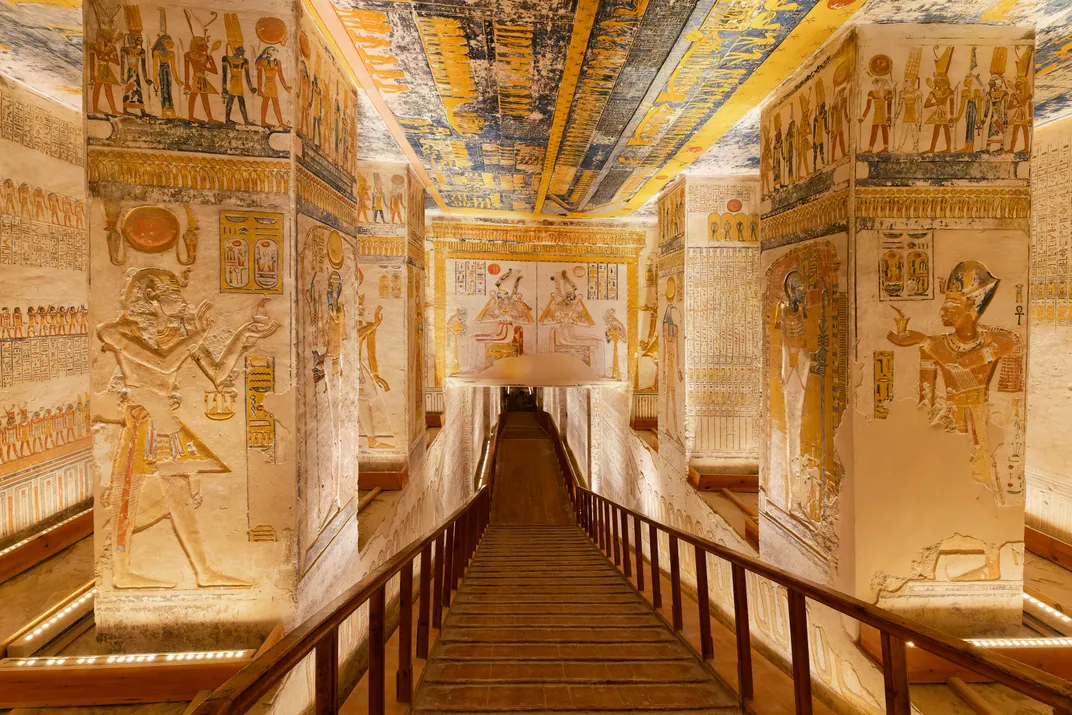
Nick: One of my favorites is the Valley of the Kings, where you can see the tombs of some of Egypt’s most powerful, influential pharaohs—including that of Tutankhamun. Many of the tombs maintain their bright colors from over 3,000 years ago, and I love to see people’s reactions when I tell them the colors and paint are original (they oftentimes don’t believe me!).
Janet: It goes without saying that bringing travelers to the GEM [Grand Egyptian Museum], to the pyramids, and to New Kingdom temples is exciting, but seeing them amazed at unexpected wonders like the Unfinished Obelisk, the reliefs in the Mastaba of Ti in Saqqara, or the tomb paintings in Sennedjem’s tomb in Deir el Medina always grabs me.
/https://tf-cmsv2-smithsonianmag-media.s3.amazonaws.com/filer_public/e1/eb/e1ebef11-6cad-4478-b8f9-c17684945cf3/egp_horus_raw_ss1254284.jpg)
What do hieroglyphs tell us about how ancient Egyptians saw the world?
Janet: When hieroglyphics were deciphered, the ancient Egyptians were revealed to be both highly religious but also a very down-to-earth, practical people—far less mystical and far more bureaucratic than had been imagined. Documents included funerary prayers and rituals, but also lists of offerings, inventories, audits, military records, honorifics, etc. Far more accountancy than philosophy.
Which Egyptian god or goddess do you find particularly intriguing?
Annie: I absolutely love the god Seth. He's very distinctive looking with a long snout and squared-off, erect ears. I think he's adorable. I love him because I believe he's misunderstood. He symbolizes chaos, yes, but chaos was necessary in the ancient Egyptian world view. Scholars in the early 20th century characterized him as the evil devil of the Egyptian pantheon, and that bad label has stuck with him ever since.
Janet: I love the fact that the scariest, deadliest creatures were worshipped as protector gods and goddesses. For example, the hippo goddess, Taweret, protected children and pregnant women; the cobra goddess, Wadjet, was the patron divinity of Lower Egypt; and Sobek, the crocodile god, who was the god of the military.
Nick: I love Anubis. He’s not only a jackal (I love dogs!) but without him we would not have mummies in ancient Egypt, since he’s the god of embalming.
Is there evidence that ancient Egyptians had pets?
Annie: The ancient Egyptians not only had pets but often treated them as beloved members of the family. Dogs and cats were given names like Spot, Fluffy, and Brownie. We find pets included in tomb decoration ensuring that they could be reunited with their owner in the afterlife, and pets could also be mummified and placed in the family tomb.
Nick: Some tombs depict the tomb owner with their faithful cat or dog (or even pet baboon!) underneath their chairs. Prince Thutmose of the 18th dynasty even loved his pet cat so much that when she died, his father Amenhotep III had her mummified and buried in a limestone sarcophagus. (The cat’s name was Ta Miu, which means she-cat in ancient Egyptian.)
Janet: Cats appear in domestic scenes and were highly revered in ancient Egypt. One of the most important Egyptian gods was the cat goddess, Bastet. I’m a dog person and some of my favorite Middle Kingdom funerary reliefs have portraits of the owner’s dogs and give their names, for example “his tail steers him like a lion” or “the lively one” or “breath of life for Sonebi.”
/https://tf-cmsv2-smithsonianmag-media.s3.amazonaws.com/filer_public/fe/14/fe1497cb-88c0-465f-bcbd-727cf527b220/egp_traditional_food_ist-1490731458.jpg)
What food or dish do you look forward to getting when you travel to Egypt?
Annie: I have to eat koshari at least once on each trip. Koshari is a hearty mixture of pasta, rice, and lentils topped with chickpeas, tomato sauce, and fried onions. Don't forget to top it with garlic vinegar! Domiati is an Egyptian white cheese that I'll put on just about everything. For a sweet treat, local coffee shops make amazing sahlab which is a milky pudding drink with chopped nuts.
Janet: I love ful mudammas, the traditional fava bean breakfast porridge offered at several of the places we stay with Smithsonian Journeys. It is accompanied by a variety of spices and garnishes that put pep in my step in the morning. I also love that Egyptian falafel is made with fava beans rather than the chickpeas that most of us are used to. I like it better.
Nick: There are so many delicious dishes to try! Some of my personal favorites include Egyptian falafel and a dish called macarona bilshemal, spiced ground beef with a bechamel sauce and penne, almost like a baked lasagna.
What recent archaeological discoveries are you most excited about?
Nick: It’s difficult to pick just one! I am partial to new discoveries in the Valley of the Kings, where my research focus lies, but the excavations of towns and settlements I also find so interesting. What was life really like for the everyday, common Egyptians who lived in the time of the pharaohs? When you dive in deep to the evidence, you start to realize that people over 3,000 years ago acted in the same ways and felt the same emotions as we do today.
Janet: The excavations at Wadi al-Jarf, an Old Kingdom harbor on the Red Sea used to bring copper from Sinai, have produced the oldest papyri ever discovered. Hundreds of fragments of 4,500-year-old logbooks kept by the Merer, an official inspector, include records of materials being sent to the Great Pyramid building site. To me, the harbor and the papyri provide compelling evidence of the way in which Khufu’s pyramid building project was a nationwide effort involving ancient Egyptians up and down the Nile Valley.
What is your favorite item in the King Tutankhamun collection?
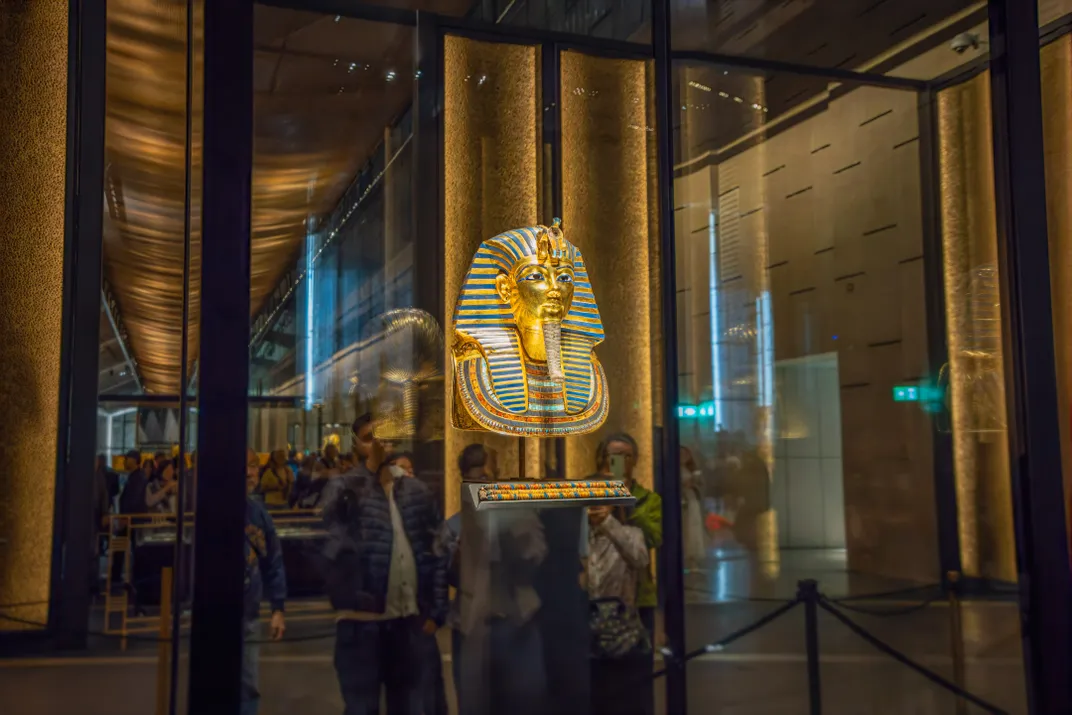
Nick: It’s difficult to pick just one. I’m fascinated by the gold funerary mask, as it tells so much about craftsmanship in ancient Egypt, resources and trade in the ancient world, and of course the religious beliefs of the ancient Egyptians. A very touching piece is a braided lock of Queen Tiye’s hair that was found inside the tomb in a little coffin labeled with her name. She was most likely King Tutankhamun’s grandmother, so it has a personal touch to it—that the king kept a memento of his beloved grandmother as a keepsake when she passed away.
Annie: I love the wooden "mannequin" of Tutankhamun that was found in his tomb. The facial features are beautifully rendered with the serene elegance that characterizes art of that period. We're not 100% what it was used for, which makes it even more interesting to me.
Janet: That wonderful blue glass headrest! I hope it was purely symbolic!!
What wildlife lives along the Nile?
Janet: Well, the scary stuff like cobras, hippos, and crocodiles are now confined to the Nile Valley south of the Aswan Dam. I find myself most captivated by the birdlife—Egyptian geese and vultures, and the wonderful little pied kingfishers often seen on the docks at Luxor.
Annie: The Nile is spectacular for bird watching, and you can even see some of the same birds that would have been familiar to the ancient Egyptians. My favorite is the hoopoe bird. They are adorable little birds with a crest on their head that can unfurl. Very recognizable today and in art from ancient Egypt.
/https://tf-cmsv2-smithsonianmag-media.s3.amazonaws.com/filer_public/46/4b/464b07d2-1257-46c0-9167-124fc6ea2d21/egp_ramadan_lanterns_khan_el_khalili_ist-1392299263.jpg)
What traditions or everyday rituals define modern-day life in Egypt?
Janet: Egypt is a wonderful place to experience Ramadan. Egypt is primarily Muslim and the month of fasting draws Egyptians together. They hang bright Ramadan lanterns and use a special vividly colored patterned cloth for tents, table coverings, and decoration. Most Egyptians fast and the urban landscapes are quietly transformed with restaurants and shops closed during the day and lively communal meals at sunset and before dawn.
What are Americans’ biggest misconceptions about Egypt?
Janet: That it’s a dangerous, scary place. Not true! Cairo, like any large city, can feel overwhelming but Smithsonian Journeys makes it accessible and easy. And the Nile Valley is a beautiful, peaceful place where people still live an agricultural lifestyle not that different from the past.
Annie: Many of my guests are pleasantly surprised at the hospitality and friendliness of the Egyptian people. They are warm, caring, and work hard to make visitors feel like they are at home.
Nick: Egypt is safe. Egyptians are lovely. The country is beautiful and there is so much to see and do that one trip will not be enough for most travelers. If you have a chance to visit this wonderful place, take it!
Learn more about traveling to Egypt with Smithsonian Journeys.