

At the Smithsonian’s Almaty Artisan Retreat, Kazakhstani and Native American Artists Connect through Stories, Copper, and Clay
For five days in April, artists from opposite sides of the globe met to reflect on their creative practices, learn from each other, and imagine the future of their craft.
:focal(750x500:751x501)/https://tf-cmsv2-smithsonianmag-media.s3.amazonaws.com/filer_public/d3/07/d3072a00-e18d-483b-9481-06b6e426b2b6/almaty-retreat-altar.jpg)
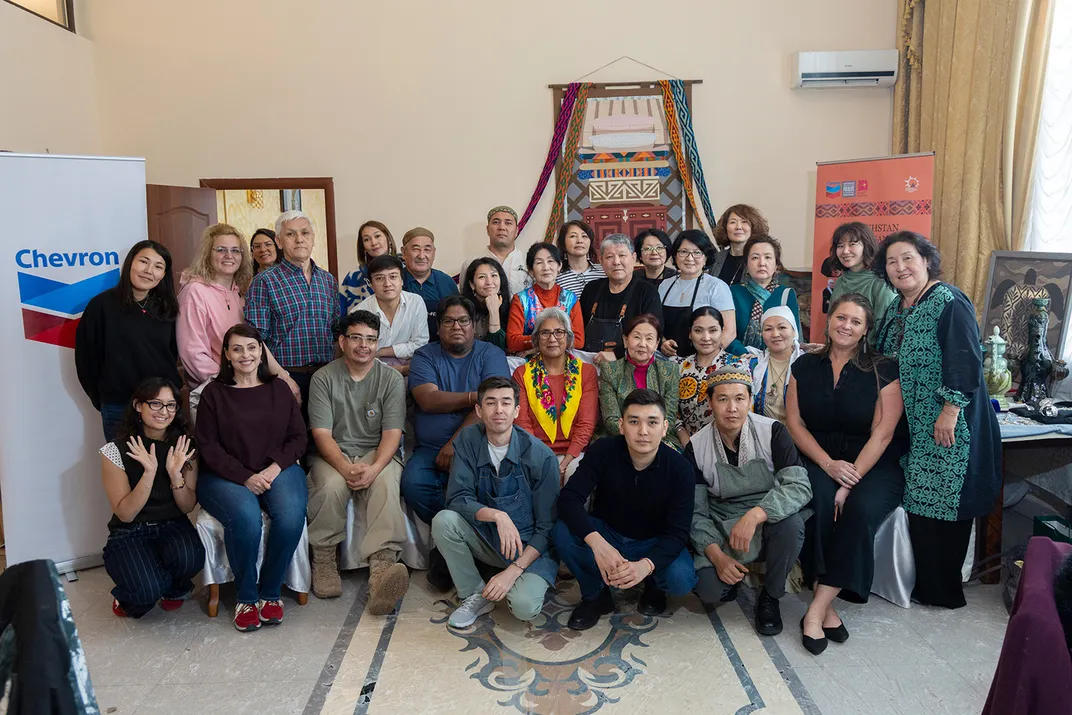
For artists, opportunities to gather and reflect are treasured, few, and far between. It’s not often we are able to carve out dedicated time to connect with other artists and give ourselves space to really think about our past, present, and future as creators and stewards of our culture. But when there is the opportunity to do so, like at the recent Almaty Artisan Retreat, the combination of a unique setting, an inspiring community, and some art supplies gave the nineteen participating artists just that needed space.
The artisan retreat was the latest gathering hosted by the Smithsonian Center for Folklife and Cultural Heritage in partnership with the Union of Artisans of Kazakhstan. Through the Kazakhstan Artisan Initiative, we have been working together on workshops, festival programs, and learning exchanges between artists from Kazakhstan and the American Southwest. Across continents and practices of pottery, jewelry making, weaving, and other traditional arts, the artists build understanding and share techniques. The five-day retreat in April was another chance to bring artisans together, some of whom already knew each other, and some who were sure to be fast friends and colleagues.
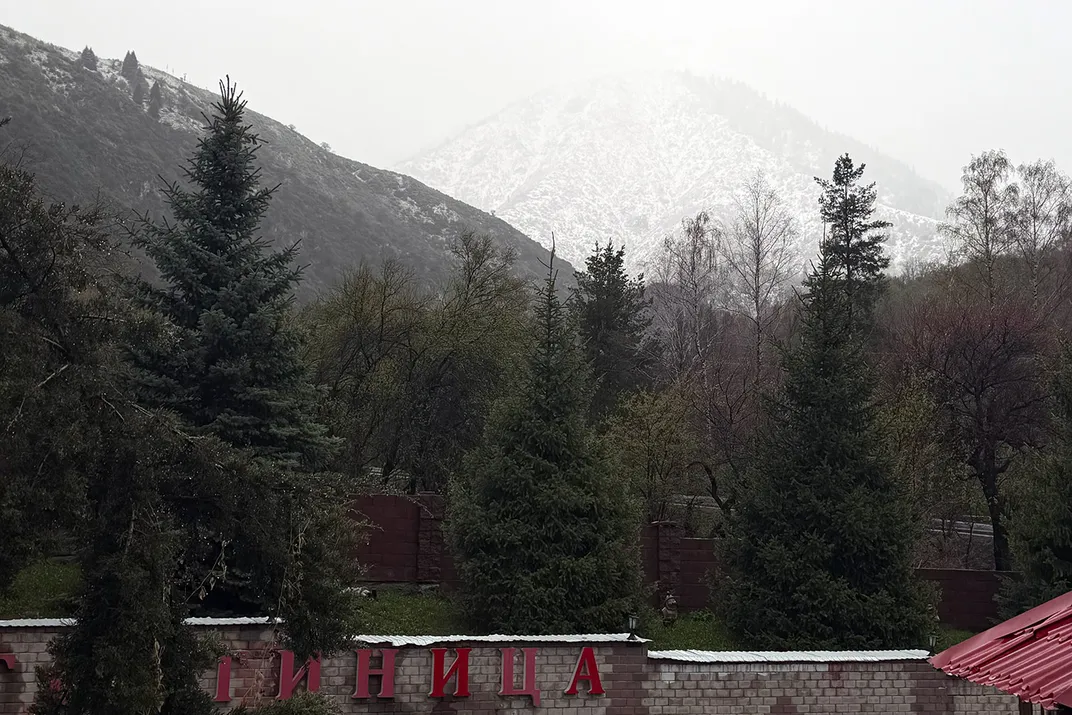
Walking through the gates of the retreat center nestled at the base of the snowcapped Trans-Ili Alatau Mountains just outside Almaty, Kazakhstan, we were met with some playful lawn ornaments like a giant chess board and a family of life-size deer—an interesting juxtaposition to the calming foggy and chilly day.
The large room where we would be spending the next three days featured floor-to-ceiling windows framed with thick gold curtains and walls holding works by some of the participating artists, hung up to give the space a more welcoming and personal feel. Because artists speak through a vocabulary of color, shape, form, and symbols, we asked each participant to take ten minutes and draw their earliest memory of craft at the tables scattered with paper, colored pencils, and markers. Surveying the room, everyone was deep in thought, hands busy with sketching symbols, scenes, landscapes, tools, textiles, even horseshoes and yurts.
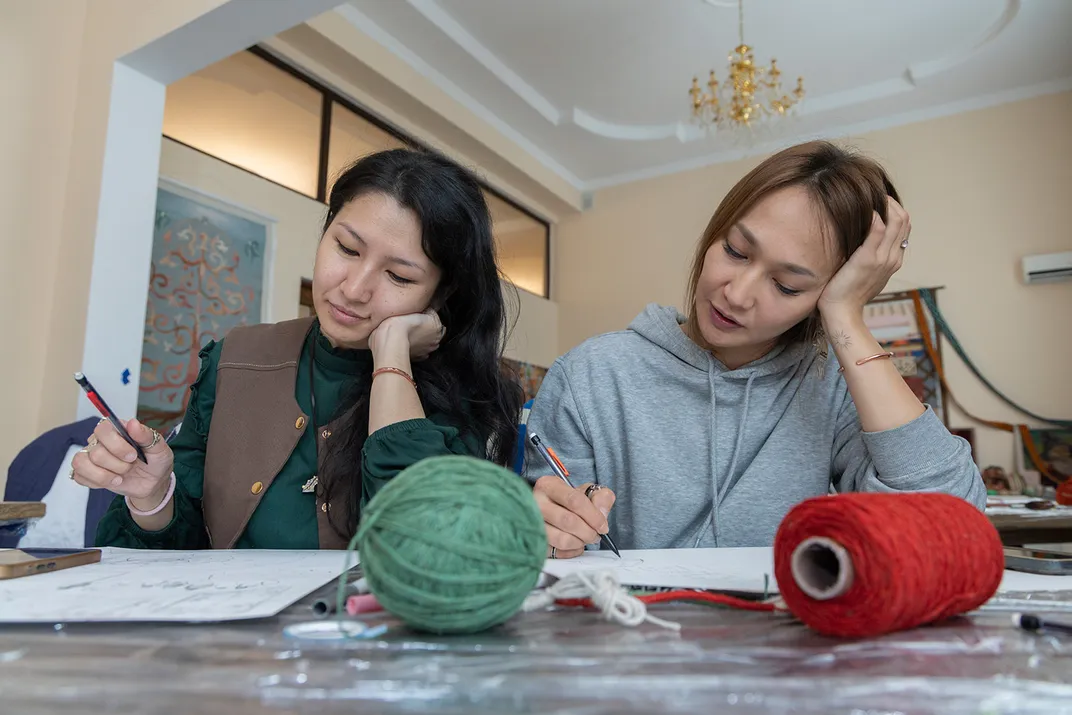
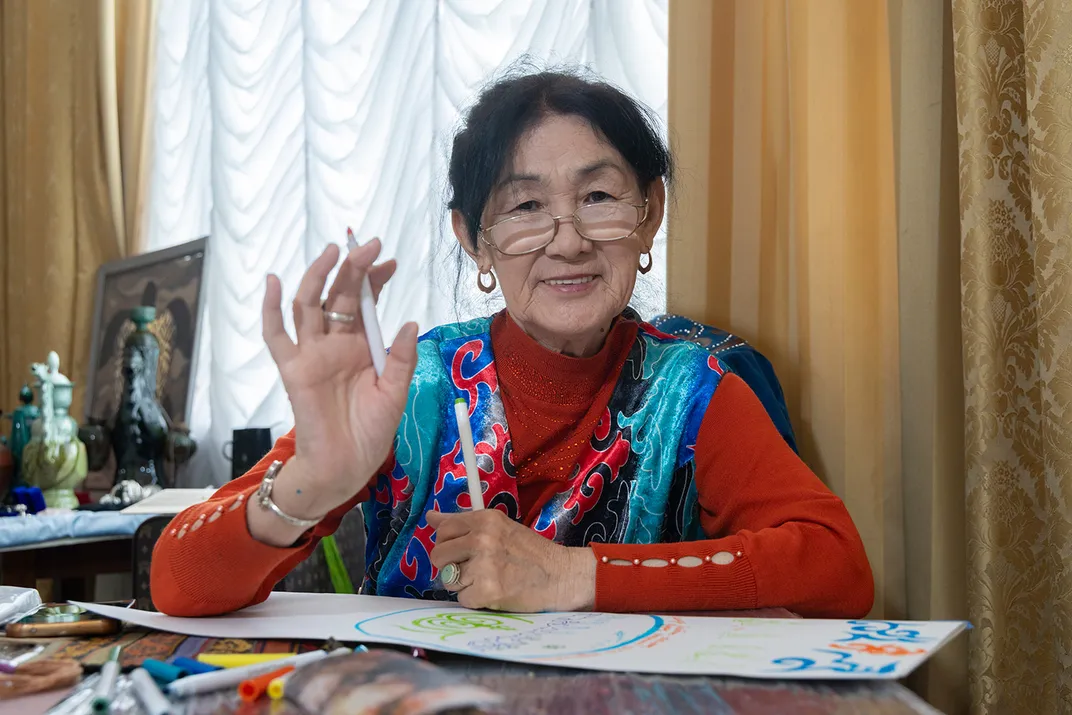
Each artist shared something significant in their lives, a special memory that they have carried with them and treasure, laying the groundwork for retreat days full of personal and professional reflection and connecting with each other. For Tohono O’odham ceramic artisan Kathleen Vance, craft chose her before she ever chose craft, when a small ceramic pot fell on her head when she was five years old. For Almaty-based textile artisan Kalamkas Sarsengaliyeva, learning sewing and traditional embroidery techniques from her grandmother set her on her own creative path.
While no one had been asked about their first memory of craft before, it was clear that each experience or memory was directly connected to their work today. Jeweler Oralbek Bekkalyy’s silver and copper bracelets reflect the form and texture of the horseshoes he drew. Daniyar Babashov’s ceramic bowls and pitchers feature the same drawing of a yurt that he associated with his first memories of craft in his family’s yurt.
“For the first time someone asked me about how I started, about me,” Babashov reflected later. “I’ve won all these awards, and no one has ever asked questions like that. I got to go back through all my memories.”
Then something unexpected happened: it snowed. We took a break to catch snowflakes on our tongues and take photos as the trees turned white.
Connecting with each other over first memories was a steppingstone for deeper reflection that would follow in the coming days. Inspired by the Smithsonian Folklife and Oral History Interviewing Guide, our team created opportunities each day for artists to reflect on and write out their personal artistic histories. The guide provided the basis for a new Craft Documentation Tool we piloted during the retreat. The artists interviewed each other—from basic questions like “how long have you been a practicing artist?” to more technical questions about their work and future-facing discussions on “what do you see for the future of your craft?”—and recorded their responses on our digital platform.
Craft artists carry a wealth of knowledge in their heads and hands, passed down through generations but often without anything written down. In addition to their technical knowledge, from tools to materials and techniques, stories about an artist’s background and history are also important to document and share with their community and clients. If we are not recording our own stories and craft history, we are losing so much wisdom and tradition.
While it is always fun to hear artists’ stories, we are also looking forward to taking what we learned from piloting the Craft Documentation Tool at the retreat and incorporating it into future projects and sharing the content and methodology with the artists so that they can continue to document and share their own stories.
It wouldn’t be an artisan retreat without hands-on workshops, letting participants do what they do best. We were so pleased to have three artisans from Tucson, Arizona, to participate in the retreat and lead workshops—one on silversmithing and jewelry led by Shane Bluehawk Beeshligaii, and one on pottery led by Kathleen Vance and Harrison Preston. Preston also led a brief demonstration on weaving.
To say everyone was excited to learn from these incredible craftspeople would be an understatement. For other silversmiths and ceramicists, it was a chance to connect and learn from each other, share techniques, and “talk shop.” For those who don’t specialize in those mediums, it was an opportunity to learn a new craft and apply the techniques and lessons to their own work in different ways. One artist noted, “I’ve always been interested in jewelry. During the bracelet-making workshop I got acquainted with the types of tools and was able to make a piece from start to finish. Although mine was not so beautiful, I liked it.”
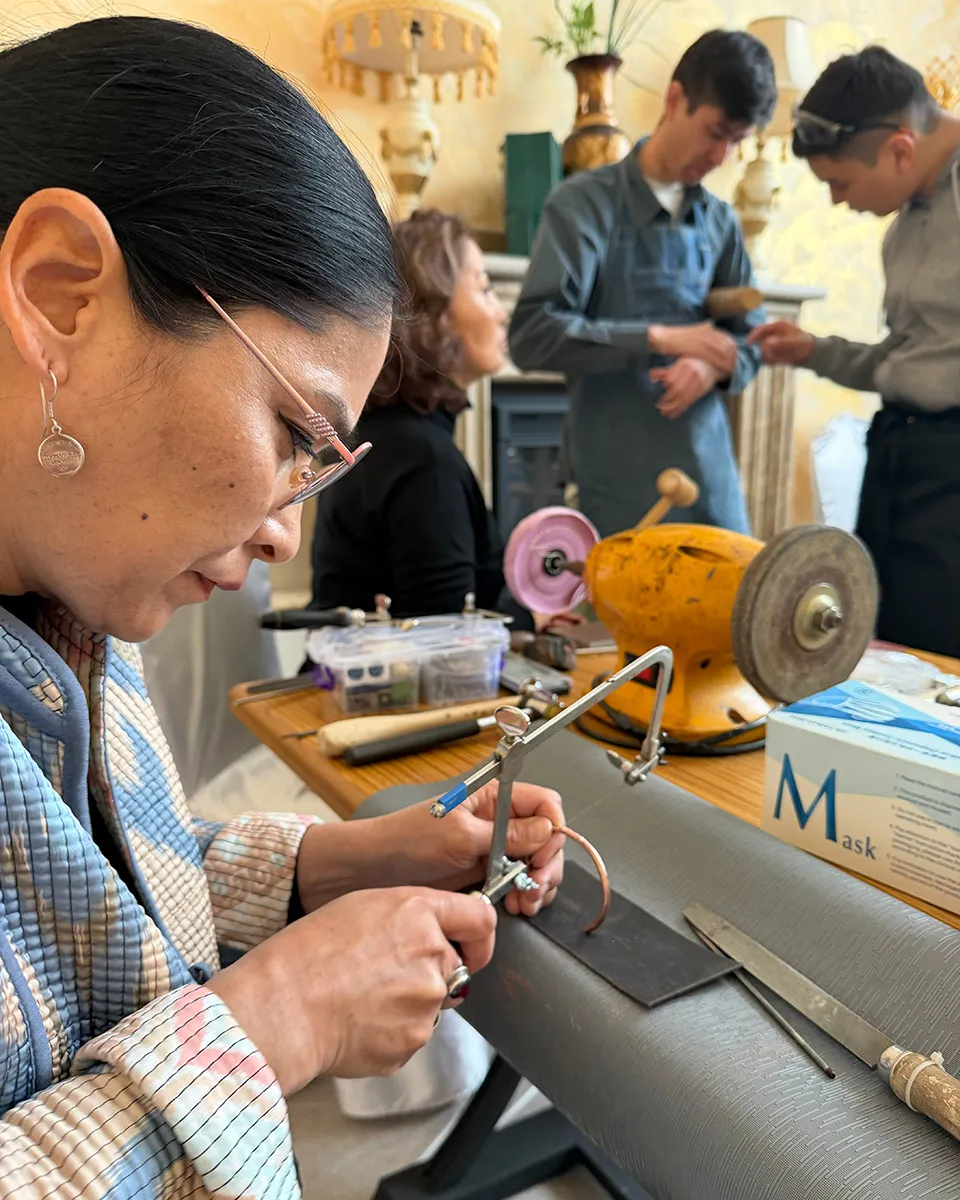
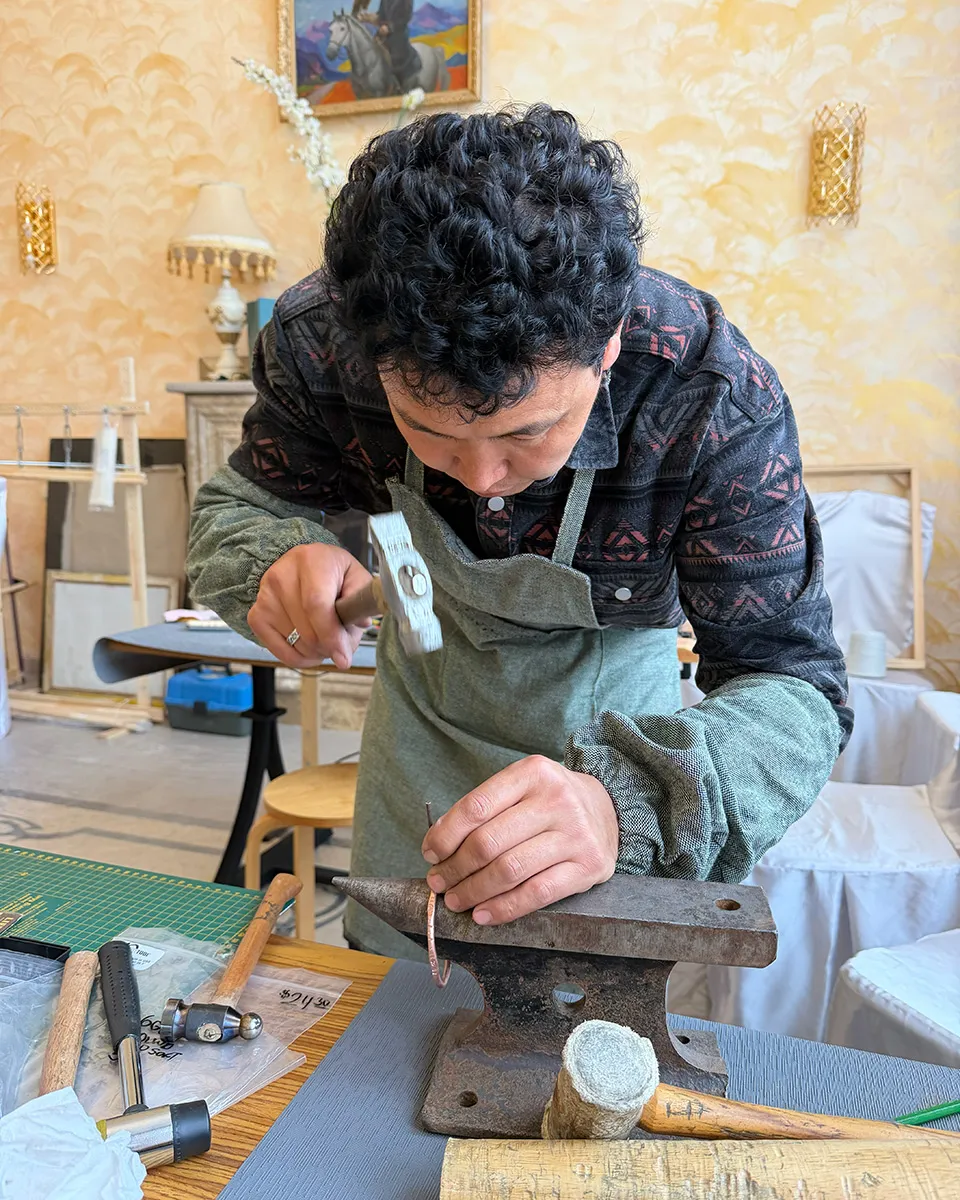
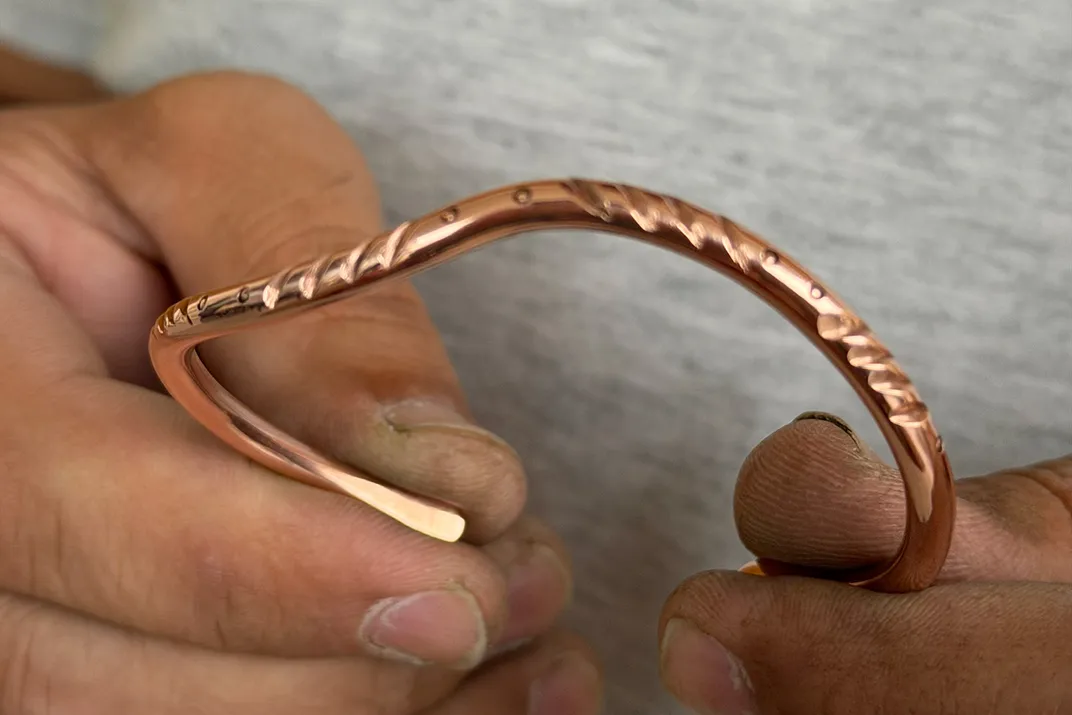
There is a special kind of excitement that comes with seeing the raw materials and all the tools laid out, knowing that after listening to Beeshligaii and trying our best, we would end the workshop with a work of our own—made with our own hands, made unique with our personal touches.
During the copper bracelet workshop, Beeshligaii explained that, traditionally, there are five etched lines, a sacred number for the Navajo (Diné) people. More than five lines symbolize the number of kills a warrior has. In Kazakh culture, the sacred number is seven, dating back to Kazakhstan’s nomadic heritage. The “rule of the seven grandfathers” dictates that everyone must know their lineage seven generations back. And the “ seven treasures” are believed to be essential for a prosperous life: bravery, a wise and beautiful wife, a loyal dog, comprehensive knowledge, a good rifle, a swift steed, and a hunting golden eagle.
We diligently bent, hammered, etched, and polished our copper, exploring different embellishing techniques with our instructors. As the designs took shape, you could see again how each artist’s individual style and inspiration was reflected in their work, regardless of any jewelry-making experience.
The next day, Preston and Vance led a hand-building and pinch pot workshop. More than exploring form through clay, we were learning about Tohono O’odham traditional methods of clay gathering and utilitarian pot making and firing.
With chairs covered and tables fully plastic-wrapped, everyone dove into shaping their pots and effigies, hands stained in red clay. Vance spoke about the techniques and lessons she learned from her elders and teachers, from how to blend the right amount of straw into the clay so it burns off correctly when the pot is fired, to remembering to have positive thoughts as you’re making your pot as the pot will be imbued with those thoughts as well.
Preston talked about their pottery collective, the O’odham Haha’adam Collective, and how important it is for them as artisans and for their community to pass along their knowledge and keep the making of traditional pottery alive. With over 30,000 Tohono O’odham community members and only about thirty people still making the pottery, Vance and Preston want to ensure this practice is carried forward by younger generations.
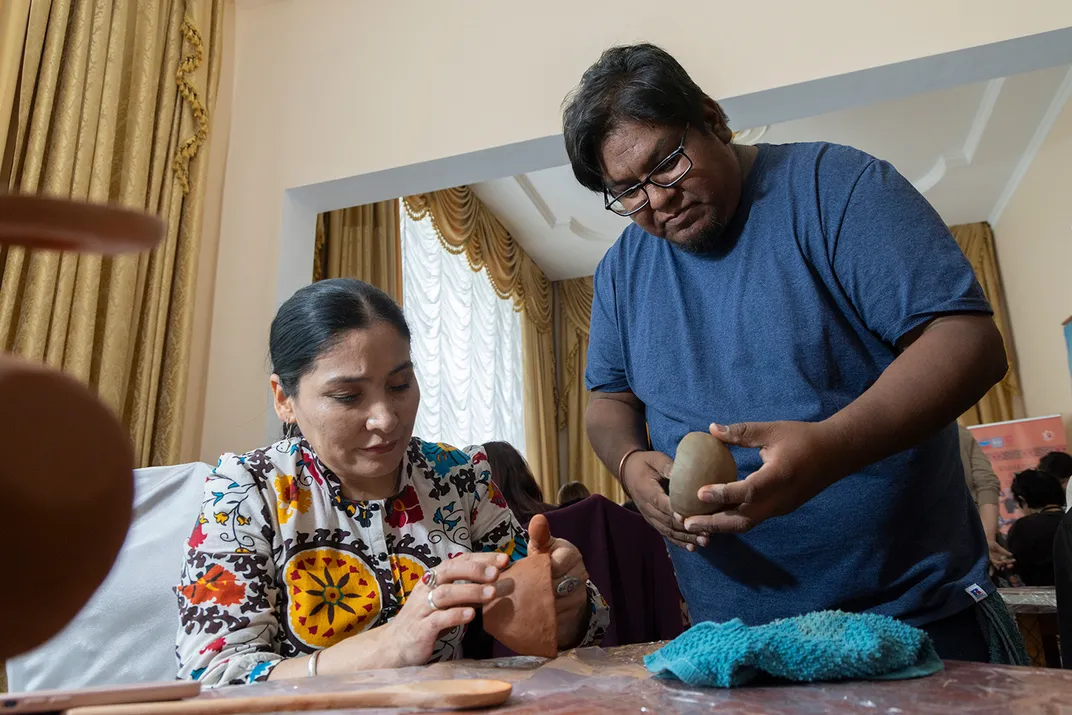
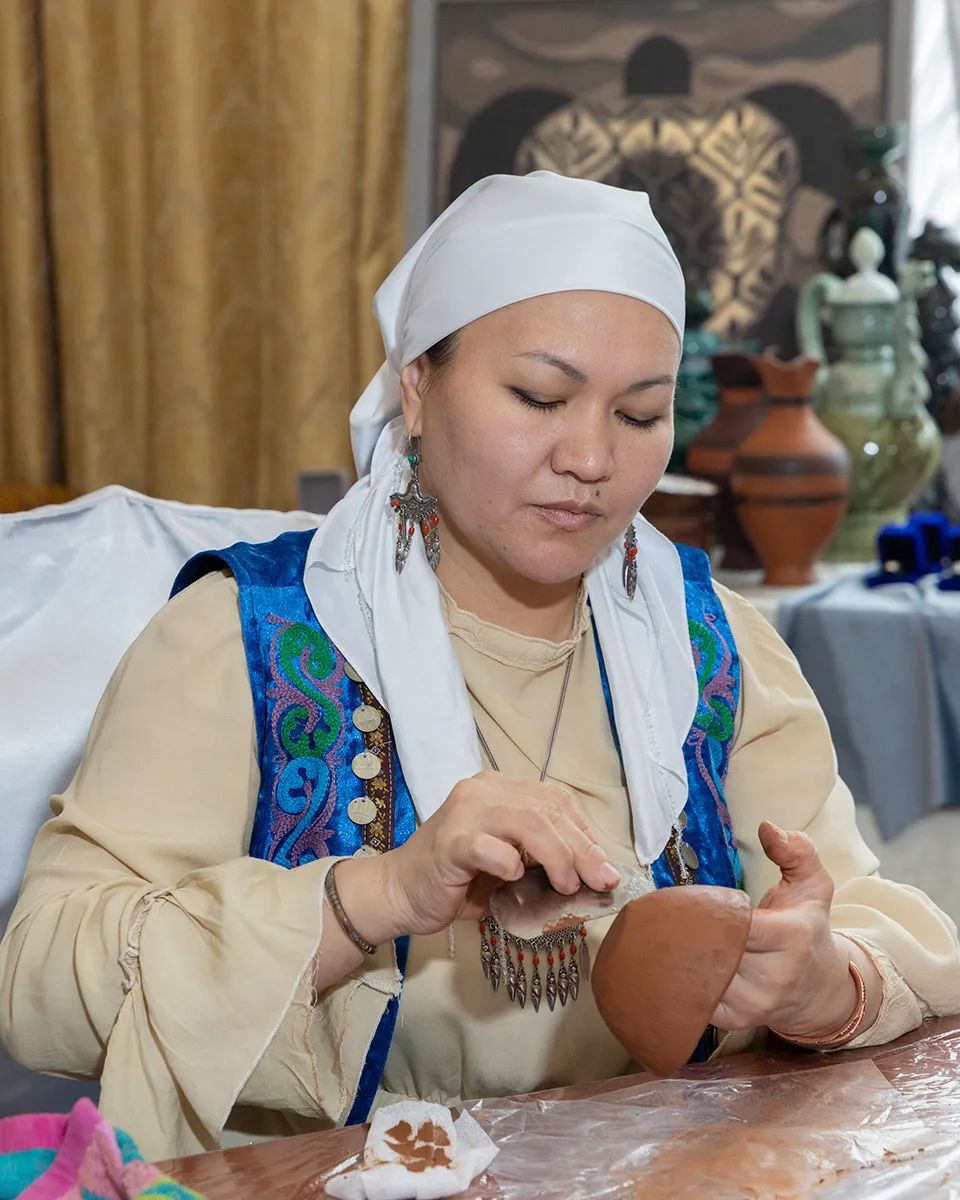
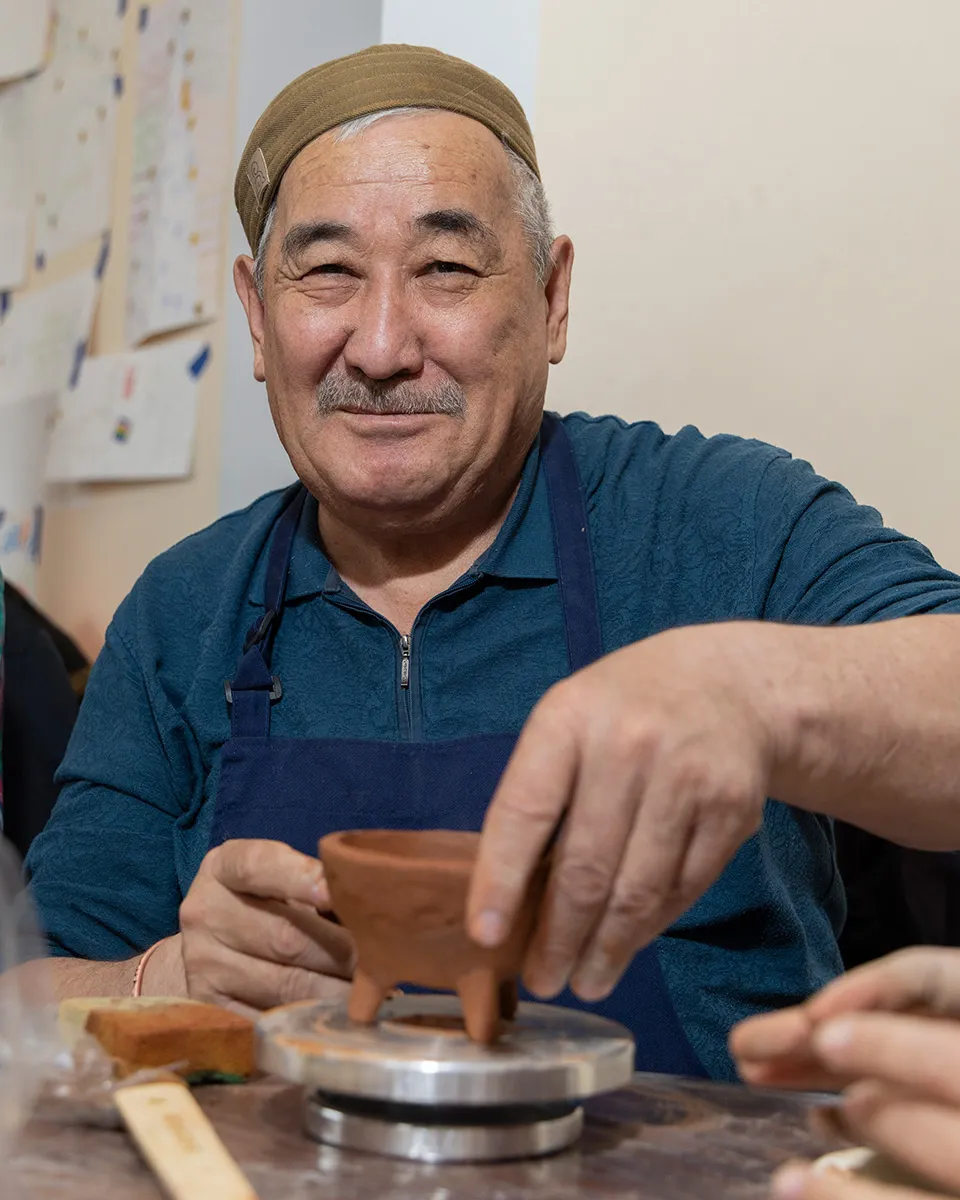
As forgiving a material as clay is, it wasn’t long before the artists began experimenting with shapes, sizes, and designs. From round and stout pots with traditional Kazakh motifs to slender vases, miniature pitchers, and animal shapes, the artists added their own aesthetic to each piece. At the beginning of the day, we asked the artists to design their own symbol, something that represented them, their work, and their heritage. In the late afternoon, they added those designs to their pieces before using stones to burnish the pots, adding a sheen to the clay one wouldn’t think possible using only a stone.
“When I first held clay in my hands, it brought back childhood memories of making vessels out of mud by the riverside, filling me with a special warmth,” weaver Mereke Aidarsha said. “I was especially impressed by Kathleen’s ceramic techniques and her method of polishing pieces using stone.”
Through each activity, artists connected with one another—through laughter, hand gestures and interpreters, story and technique sharing. As one artisan reflected at the end of the retreat, “Despite the language barrier, it was truly fascinating to learn the techniques and meanings of another culture, discovering what we have in common and what makes us so different and interesting to each other.”
Ceramicist Ainash Kapanova was grateful for the experience “to grow and expand in such an inspiring atmosphere, while also finding rest for the soul. I’m deeply grateful to the group for how easy it was to connect, open up, share valuable advice, and exchange experiences.” She described visiting workshops of other highly regarded artisans, “filled with the light and spirit of masters, which they so generously shared with us. It made our own dreams feel bigger and more tangible.”
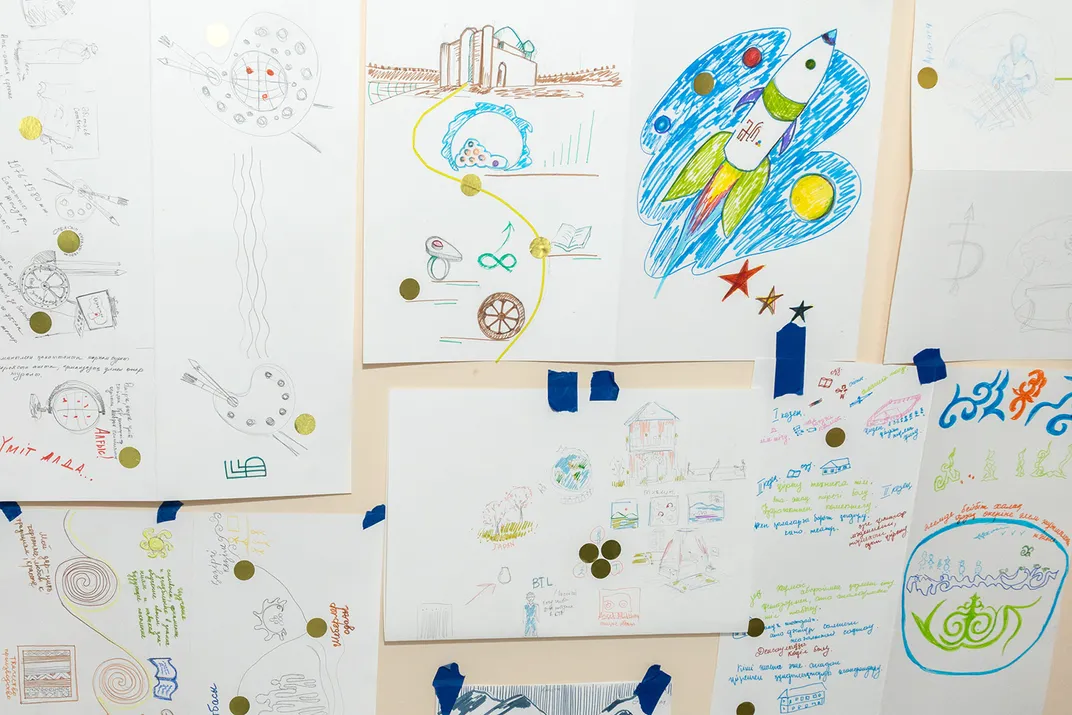
The fourth day of the retreat was hosted at Almaty Creative back in the city. As they reviewed the “creative roadmaps” they had been working on throughout the retreat, everyone was asked to make a plan: develop an action statement for what you want to take away from this retreat whether that may be growing your business, focusing on a new technique, implementing different designs and motifs, documenting your work, enhancing your storytelling and marketing efforts, connecting with more artists across Kazakhstan or the United Staes, whatever the priority may be. Then create actionable steps to implement one week, one month, and one year from now.
Our next exchange and gathering opportunity will be in October, when the Center will bring four artisans to Arizona to participate in the Tucson Meet Yourself festival. While there, they will have a chance to reconnect with Vance, Preston, and Beeshligaii and meet many other local artisans and community members.
As ceramicist Bolat Beissbekov succinctly put it, the retreat and other opportunities to connect across cultures “remind us that culture is not something of the past, but a living heritage that continues into the future.”
Sloane Keller is the program manager of the Kazakhstan Artisan Initiative. Lesli Robertson is the initiative’s program activity and design facilitator.
The Kazakhstan Artisan Initiative is made possible with support from Chevron.